
FREIT’s Portfolio Stability Tested by Debt Dynamics and Market Shifts
First Real Estate Investment Trust of New Jersey, Inc. (FREIT) shows solid income from a diversified property mix, but its long-term value proposition hinges on managing refinancing risk, maintaining occupancy, and adapting to evolving commercial real estate pressures in the New Jersey and New York markets.
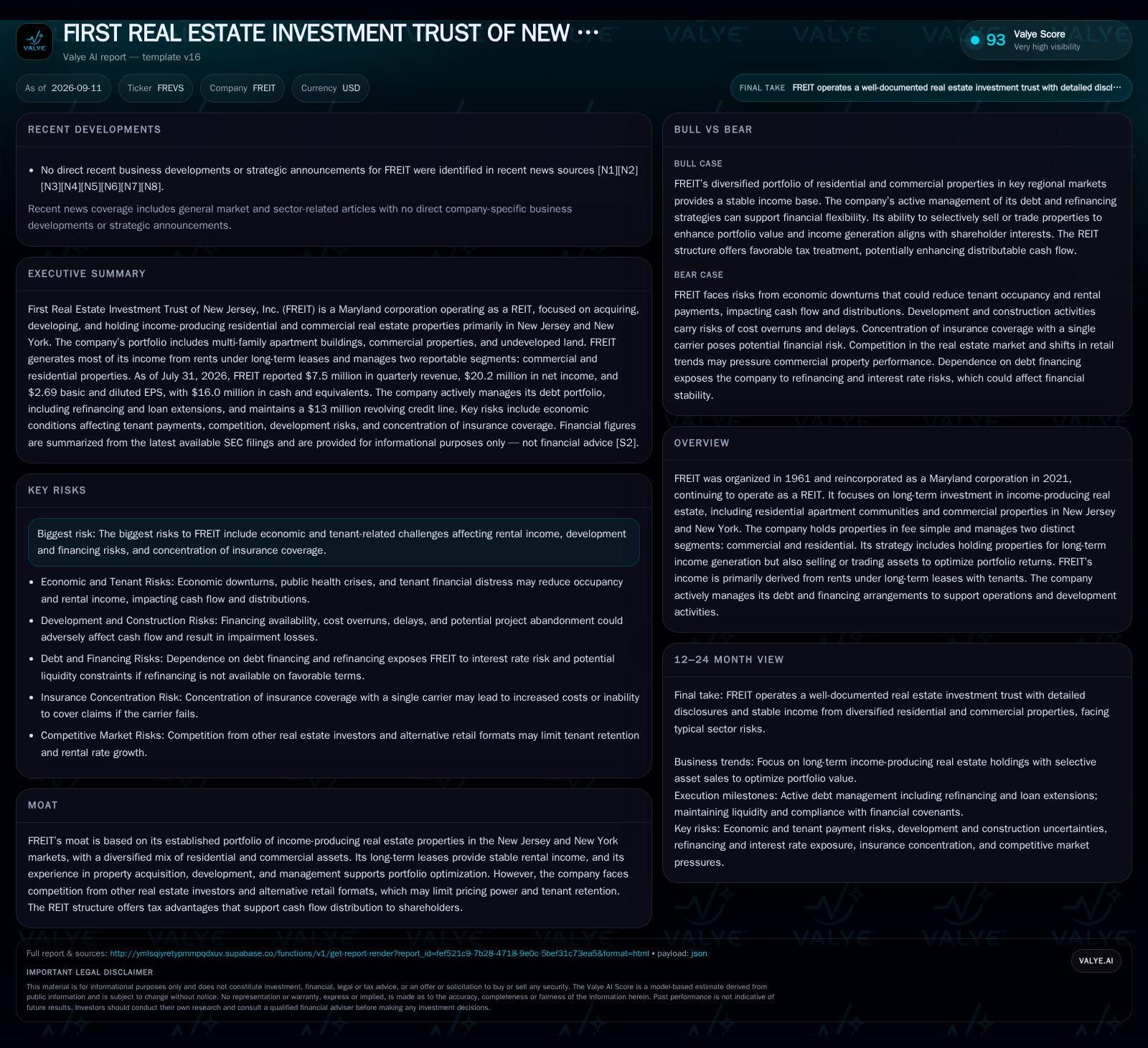
FREIT’s recent quarter demonstrates strong net income and cash reserves, supported by a diversified portfolio of residential and commercial properties. The REIT’s strategy of holding income-producing assets while selectively optimizing the portfolio is sound, but ongoing dependence on debt and exposure to tenant risk and market competition present meaningful challenges. The company’s ability to maintain stable occupancy, manage refinancing, and respond to shifting commercial real estate dynamics will determine its resilience and future distribution potential. [S2]
First Real Estate Investment Trust of New Jersey, Inc. (FREIT) exemplifies the classic regional REIT model: a diversified, income-generating property portfolio spanning residential and commercial real estate in the Northeast corridor, underpinned by a long-term holding strategy. Recent financials show robust net income and a healthy cash position, but these headline figures mask underlying exposure to debt refinancing cycles, tenant health, and shifting dynamics in both residential and commercial leasing. With no recent strategic announcements, the company’s next phase will likely hinge on its ability to defend occupancy, optimize portfolio returns, and navigate the capital markets as competitive and economic pressures evolve. [S2]
Recent Financial Results Reflect Portfolio Health, But Underlying Risks Remain
As of July 31, 2026, FREIT reported quarterly revenue of $7.5 million, net income of $20.2 million, and a basic and diluted EPS of $2.69, alongside cash and equivalents of $16.0 million [S2]. These numbers reflect the company’s stable income stream from its mix of 792 apartment units, a majority interest in Pierre Towers, five commercial properties, and three parcels of undeveloped land in New Jersey and New York [S1]. The company continues to rely on $121.3 million in non-recourse, fixed-rate mortgage debt and maintains access to a $13 million revolving credit line [S1]. While these facts indicate financial stability and operational discipline, they also underscore FREIT’s reliance on real estate market conditions, tenant solvency, and the capital markets for ongoing performance.
How FREIT’s Income Model Converts Rents Into Distributable Cash Flow
FREIT’s primary revenue driver is rental income from long-term leases across its residential and commercial portfolio. Residential assets generally offer more stable occupancy and cash flow, while commercial properties—especially in retail—face greater volatility due to tenant turnover and competition from e-commerce. The company’s fixed-rate mortgage structure provides predictability in debt service, but refinancing cycles introduce episodic risk: should credit tighten or property values decline, refinancing may become more costly or restrictive.
Operating leverage in this model is moderate. While property management and maintenance costs are relatively fixed, significant variable costs can arise from tenant turnover, re-leasing commissions, and property improvements. Capital expenditures—both for maintenance and value-add initiatives—are a recurring necessity to sustain occupancy and rental rates. FREIT’s ability to occasionally sell or trade properties allows for portfolio optimization, but the timing and magnitude of gains on such sales are inherently unpredictable. The REIT structure mandates distribution of most taxable income, which can limit retained earnings and necessitate ongoing access to debt or asset sales for funding major investments.
Regional Diversification and Long-Term Leases Offer Some Buffer, But Competitive Pressures Intensify
FREIT’s competitive position is rooted in its established presence in the New Jersey and New York real estate markets, with a diversified asset base that balances residential stability against commercial upside. Long-term leases, particularly in the residential segment, provide a degree of income visibility and tenant stickiness. However, the company faces competition from other regional REITs, private real estate investors, and, on the commercial side, alternative retail formats and the ongoing shift toward e-commerce.
Tenant retention and rental rate growth are critical—especially as newer, amenity-rich apartment complexes and upgraded retail centers compete for the same tenant pool. FREIT’s relatively small portfolio size compared to national REITs may limit economies of scale and negotiating leverage with vendors or tenants. Furthermore, concentrated insurance coverage with a single carrier introduces an additional layer of risk not always present in larger, more diversified peers [S1].
If Occupancy Holds and Refinancing Remains Favorable, Distribution Growth Could Resume
A favorable scenario for FREIT would see stable or improving occupancy rates across both residential and commercial segments, supported by continued economic recovery in the NJ/NY region. If tenant defaults remain low and new leasing activity supports modest rental rate increases, the company could maintain or modestly grow its distributable income. Successful refinancing of upcoming debt maturities at attractive rates—leveraging the current fixed-rate environment—would help preserve cash flow and enable continued portfolio investment.
Evidence that would confirm this scenario includes: upward trends in reported occupancy rates (if disclosed), stable to increasing rental income, successful refinancing announcements with similar or lower interest costs, and consistent or growing quarterly distributions to shareholders. Signs of asset sales at favorable cap rates or successful leasing of previously vacant commercial space would further support the upside thesis.
Sustained Income, but Pressures on Rental Growth and Debt Costs Limit Expansion
The most plausible path for FREIT is a continuation of current operating performance: steady rental income from residential properties, with commercial assets experiencing some turnover and rent pressure. Debt service remains manageable, but refinancing occurs at slightly higher rates as the interest rate environment normalizes. Asset sales are opportunistic rather than transformational, and capital expenditures focus on maintaining existing properties rather than aggressive expansion.
In this scenario, distributions are sustained but unlikely to grow meaningfully. Confirming evidence would be flat or slightly declining occupancy rates, stable but unremarkable rental growth, and refinancing announcements reflecting modestly higher debt costs. Falsification would come from material changes in occupancy, a sharp increase in tenant defaults, or unexpected impairment charges on commercial assets.
Rising Tenant Defaults or Unfavorable Refinancing Could Pressure Cash Flow and Distributions
The most adverse scenario would involve a combination of macroeconomic weakness (such as a regional recession) and elevated tenant defaults—particularly in the commercial segment. This could drive occupancy rates lower and force aggressive rent concessions or costly tenant improvement packages to fill vacancies. If refinancing windows coincide with periods of tighter credit or higher interest rates, debt service costs could rise materially, compressing free cash flow and forcing reductions in distributions or even asset sales at unfavorable prices.
Warning signs would include disclosure of rising tenant delinquencies, a spike in vacancy rates, unsuccessful refinancing attempts or loans renewed at punitive rates, and the need to draw on the revolving credit line to cover operating shortfalls. The loss or impairment of insurance coverage could also exacerbate downside risks in the event of a property-level loss.
What Will Determine FREIT’s Value Creation in the Next Two Years?
Quarterly occupancy rates for both residential and commercial segments, if disclosed, would provide direct evidence of underlying property performance and tenant demand.
Rental rate trends—especially new lease rates versus expiring rents—would help gauge pricing power and the ability to offset inflation or cost increases.
Refinancing outcomes: the interest rates, terms, and lender appetite on upcoming mortgage maturities will reveal FREIT’s capital market access and potential cost of capital pressure.
Levels of tenant defaults or lease terminations, if reported, would signal the health of the tenant base and pressure on cash flow.
Capital expenditure disclosure: the scale and nature of property investments indicate whether spending is defensive (maintenance) or offensive (value-add/upgrades).
Asset sale or acquisition activity: details on transaction multiples and cap rates would reveal management’s ability to optimize the portfolio and recycle capital.
Insurance carrier stability and any changes in coverage or cost would help assess exposure to catastrophic loss or operational disruption.
Distribution policy changes—either increases, cuts, or suspensions—would serve as a direct signal of management’s outlook on sustainable cash flow.
Disclaimer: This is research-only, informational analysis and not investment advice. It may include AI-generated interpretation and general industry context. Always verify important details using primary sources.

Comments