
Champions Oncology: TumorBank and Analytics Driving Innovation with Financial Focus
A differentiated platform built on exclusive patient-derived models and AI-driven bioinformatics powers Champions Oncology’s growth ambitions, but competitive intensity, liquidity constraints, and the challenge of scaling drug discovery loom large.
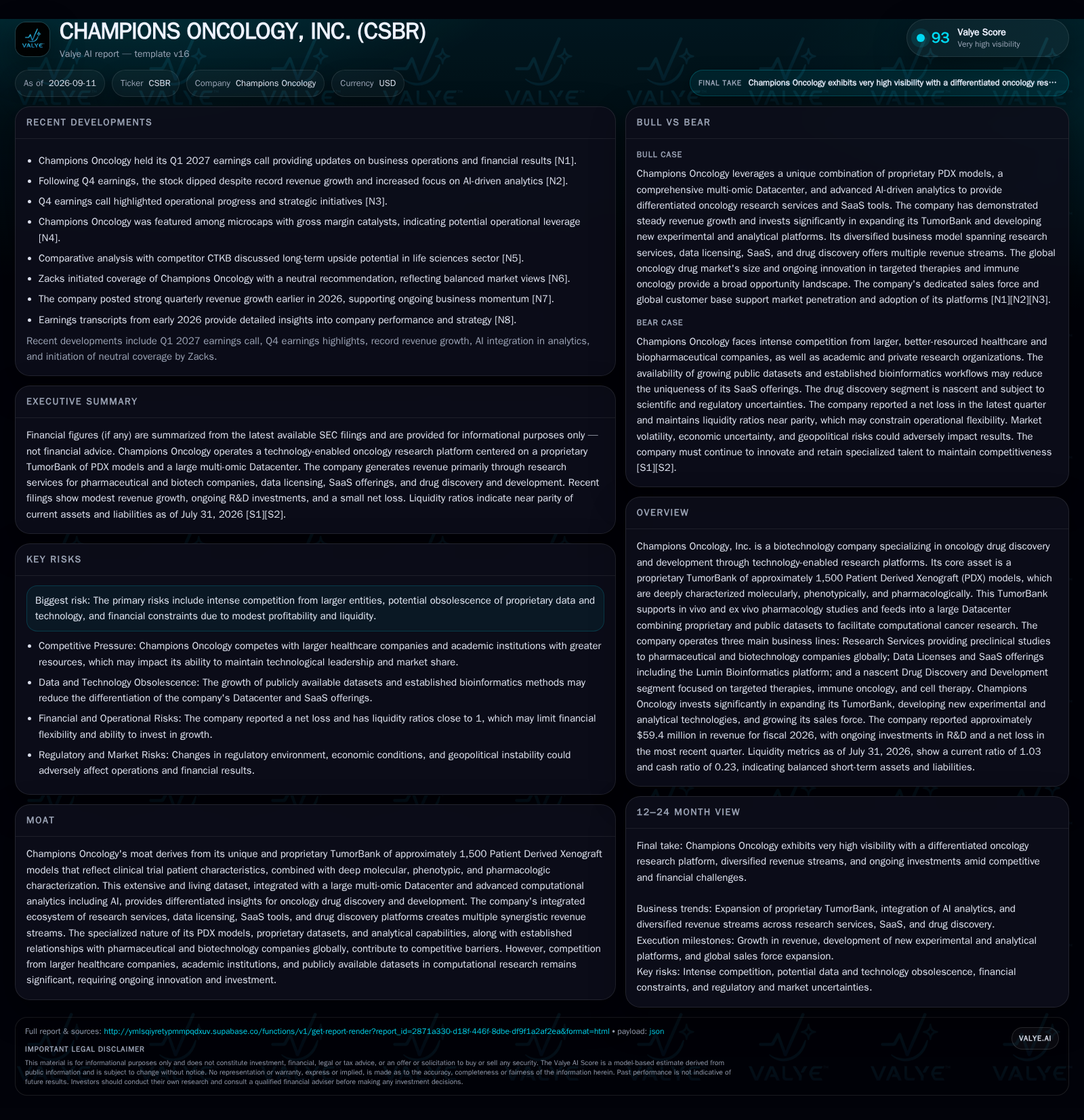
Champions Oncology leverages a unique TumorBank of 1,500 patient-derived xenograft models and a proprietary multi-omic Datacenter to deliver preclinical research services, SaaS analytics, and early-stage drug discovery. Fiscal 2026 revenue grew 4% to $59.4M, but the company reported a Q1 FY27 net loss and maintains a slim liquidity buffer. Competitive pressure from larger players and the risk of commoditization in bioinformatics threaten differentiation, while ongoing R&D investment is essential to sustain its advantage. Execution in scaling SaaS and progressing drug candidates will determine future value creation. [S1] [S2]
Champions Oncology sits at a pivotal intersection of technology-enabled oncology research and early-stage drug development. Its most distinctive asset, a proprietary bank of patient-derived xenograft (PDX) tumor models, underpins a multi-pronged business model spanning contract research, SaaS analytics, and a nascent foray into proprietary drug discovery. While the company’s revenue base continues to grow and its computational platforms advance, the persistent challenge is transforming scientific differentiation into scalable, recurring profits—especially as liquidity tightens, competition intensifies, and the boundaries between proprietary and public data blur. The company’s next phase will likely be defined by its ability to defend pricing, expand SaaS adoption, and demonstrate tangible progress in drug development, all while maintaining financial discipline.
Financial Results and Strategic Investments Define Current Position
Champions Oncology reported $59.4 million in revenue for fiscal 2026, a 4% increase over the prior year, indicating steady—if unspectacular—top-line growth in a competitive market. As of July 31, 2026, liquidity was tight: $4.36 million in cash and equivalents, a current ratio just above parity at 1.03, and a cash ratio of 0.23, reflecting limited cushion for operational shocks or aggressive investment. The company posted a net loss of $426,000 for Q1 FY27, with negative EPS, reinforcing the need for careful resource allocation. R&D spending remains substantial ($9.1M in FY26), focused on expanding the TumorBank and analytical platforms. These facts underscore a business that is investing for future differentiation but constrained by near-term financial resources. [S1] [S2]
Monetization Strategy Built on Unique Proprietary Resources
Champions Oncology’s business model is built on monetizing proprietary research assets through three synergistic channels: high-value research services, data/SaaS subscriptions, and early-stage drug development. The research services arm offers preclinical studies—priced from $125,000 to $500,000 per project—to global pharma and biotech clients, suggesting a revenue base driven by project wins, volume, and the ability to command premium pricing for unique models. This segment likely carries a mix of fixed (infrastructure, R&D) and variable (project-specific labor/materials) costs, creating potential for operating leverage as volume scales, but also exposing the business to utilization volatility.
The SaaS/data licensing line, led by the Lumin platform, aspires to recurring, higher-margin revenue by selling computational analytics on an annual subscription basis. However, the extent of recurring revenue, pricing tiers, and retention rates are not disclosed; the path to SaaS scale may depend on the platform’s ability to deliver unique insights not easily replicated by public datasets or competing software. The drug discovery segment is capital-intensive and high-risk, with potential for outsized returns if proprietary assets yield successful out-licensing or partnerships, but also significant upfront R&D and long development timelines.
Ongoing investment in TumorBank expansion and new analytics capabilities is crucial to maintaining differentiation, but with modest cash reserves and near-breakeven current ratio, Champions must carefully balance growth ambitions with financial discipline. Without external funding or accelerated SaaS/drug revenue, the company could face tough trade-offs between innovation and solvency.
Maintaining a Competitive Edge in a Fast-Changing Landscape
Champions Oncology’s competitive edge rests on its proprietary PDX TumorBank, which offers a living, deeply characterized resource for translational oncology research. This asset, combined with integrated multi-omic datasets and AI-driven analytics, provides a value proposition not easily matched by generic cell lines or basic in silico models. However, the market for preclinical services and computational oncology is highly competitive: large contract research organizations, biopharma R&D divisions, academic core facilities, and specialized bioinformatics firms all vie for pharma budgets.
A key risk is the growing volume and sophistication of publicly available datasets and open-source bioinformatics tools, which could erode the perceived uniqueness of Champions’ SaaS offerings. Larger players can cross-subsidize and bundle services, while academic institutions often operate at cost or with grant support. The company’s dedicated sales force and global reach are positives, but customer stickiness will depend on demonstrable, persistent advantages in data quality, model relevance, and analytic capability.
The nascent drug discovery segment faces even stiffer competition, requiring not just scientific excellence but also execution in clinical development, regulatory navigation, and deal-making—domains where scale and capital matter. The question for Champions is whether its proprietary platforms can generate sufficient proprietary insight and IP to justify premium pricing and create barriers to entry, or whether commoditization and capital constraints will cap its upside.
Platform Integration and Network Effects as Growth Catalysts
If Champions Oncology can leverage its TumorBank, multi-omic Datacenter, and AI-driven analytics to deliver consistently superior insights—demonstrated by outsized project wins, SaaS client growth, and successful out-licensing or partnerships in drug discovery—the business could achieve a step-change in profitability and strategic value. The most favorable scenario involves accelerating SaaS adoption, with Lumin becoming a standard computational tool for oncology R&D, driving recurring, high-margin revenue and strong customer retention.
Simultaneously, if the company’s proprietary models yield novel drug candidates that attract lucrative licensing deals or partnerships with major biopharma, Champions could realize milestone payments and longer-term royalties, transforming its risk/reward profile. Confirmation of this scenario would come from rapid SaaS ARR growth, a rising share of multi-year contracts, marquee customer wins, and public announcements of drug discovery partnerships or clinical progress.
Falsification would occur if SaaS growth stalls, retention lags, or drug discovery efforts fail to produce meaningful out-licensing or clinical milestones.
Incremental SaaS Adoption Supports Moderate Service Expansion
The most plausible path is one of incremental progress: research services remain the revenue anchor, growing in line with pharma R&D budgets and Champions’ ability to expand its model portfolio and global reach. SaaS and data licensing contribute a growing but still minority share of revenue, with adoption driven by targeted pharma clients seeking integrated analytics, but facing persistent price and retention pressure from free or low-cost alternatives.
Drug discovery remains a long-dated option, with periodic spending spikes but limited near-term revenue impact. The company continues to invest in TumorBank expansion and analytics, but must regularly recalibrate spending to match cash flow and available liquidity. Modest profitability and tight working capital persist, with potential for occasional external fundraising if growth opportunities or drug development require it.
Evidence supporting this scenario would be continued low-to-mid single-digit revenue growth, stable or slightly improving gross margins, and periodic announcements of incremental SaaS/customer wins, but without breakout success in either SaaS or drug out-licensing.
Business Model Risks from Liquidity and Market Competition
In a more adverse scenario, Champions Oncology’s cash reserves and slim current ratio leave it vulnerable to project delays, customer churn, or cost overruns. If larger CROs, academic centers, or open-source tools commoditize preclinical and computational research, Champions could face pricing pressure, declining project volumes, and shrinking SaaS subscriptions. In this environment, the company may be forced to cut R&D or sales investments, limiting its ability to innovate and retain talent.
The drug discovery segment, already capital-intensive and high-risk, could become an unsustainable cash drain, especially if early-stage programs fail to attract partners or show clinical promise. A sustained net loss and deteriorating liquidity could trigger the need for dilutive capital raises or strategic retrenchment. Confirmation of this downside would be a declining revenue base, mounting losses, negative cash flow, and disclosure of cost-cutting, asset sales, or layoffs.
Milestones That Reflect Progress on Champions Oncology’s Platform Vision
Quarterly growth in SaaS and data licensing revenue—if disclosed—would help assess whether Lumin and related platforms are gaining traction as recurring, scalable businesses.
Retention rates and expansion within existing pharma/biotech customers for both research services and SaaS would clarify customer stickiness and pricing power.
Number and quality of new drug discovery partnerships, out-licensing deals, or clinical-stage candidates would indicate whether the proprietary platform is generating monetizable innovation.
Gross and operating margin trends, especially as SaaS mix rises, will show if operating leverage is being realized or offset by competitive/pricing pressure.
Changes in cash balance, current ratio, and working capital management will reveal the company’s ability to self-fund growth and weather operational shocks.
R&D expense allocation breakdown—if disclosed—between TumorBank expansion, analytics development, and drug discovery would signal strategic priorities and risk appetite.
Sales cycle length and win rate for large research services projects, if reported, could test the strength of the company’s differentiation and sales execution.
The extent to which Champions can integrate new experimental modalities (e.g., radiopharmaceuticals) and analytics into its platform, as evidenced by customer adoption or new product launches.
Disclaimer: This is research-only, informational analysis and not investment advice. It may include AI-generated interpretation and general industry context. Always verify important details using primary sources.

Comments