
Toll Brothers, Inc. (TOL): Strategic Luxury Homebuilder Navigating Market Dynamics with Diversified Portfolio and Operational Integration
Toll Brothers leverages a broad geographic footprint, diversified luxury product lines, and an integrated services model to sustain competitive positioning, while managing risks from housing market cycles, capital-intensive land development, and joint venture complexities.
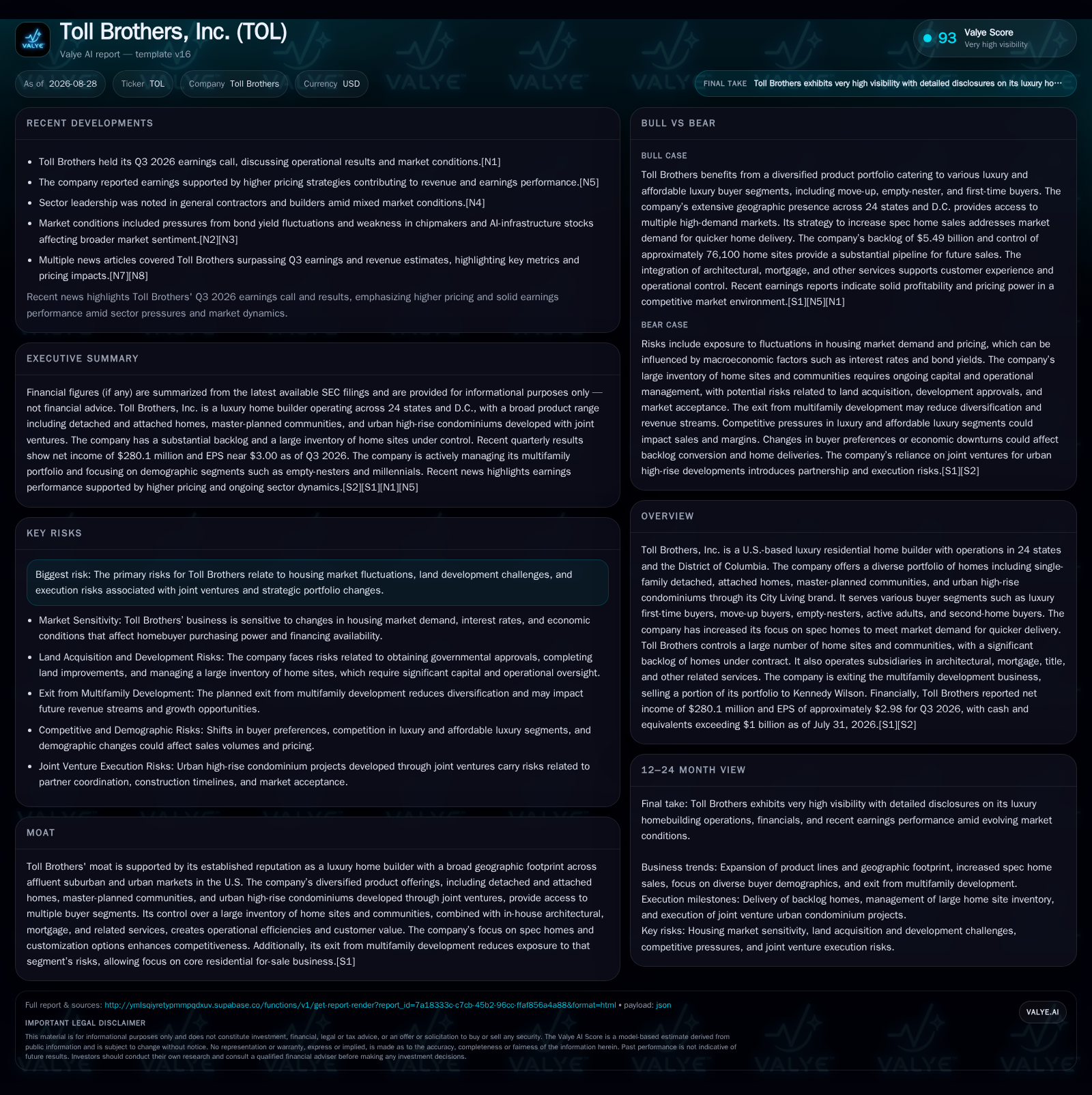
Toll Brothers operates a luxury homebuilding business across 24 states and D.C., with a large controlled home site inventory and a $5.49 billion backlog, supported by strong Q3 2026 earnings driven by pricing power. Its business model balances volume and mix through spec homes and customization options, while operational integration in financing and design offers customer convenience and potential margin leverage. The company’s moat is anchored in brand reputation, scale, and geographic breadth, but it faces cyclical housing demand risks, capital intensity in land development, and execution challenges in urban joint ventures. Key near-term focus includes backlog delivery, land management, and multifamily exit execution.
Toll Brothers, Inc., a premier U.S. luxury homebuilder operating in 24 states and D.C., stands at an inflection point balancing growth opportunities and market headwinds. Its substantial backlog of $5.49 billion and control of approximately 76,100 home sites provide a deep reservoir for future home sales, while its strategic shift toward spec homes caters to buyers seeking quicker delivery in a competitive market. The company’s integration across architectural design, mortgage, and title services supports operational efficiencies and enhanced customer value. Yet, capital intensity inherent in land acquisition and development, combined with cyclical housing demand and urban joint venture execution risks, underscore the need for vigilant operational management and market responsiveness. Toll Brothers’ recent earnings underscore its pricing power and resilience amid fluctuating macroeconomic factors such as interest rates and bond yields.[S1][S2][N5]
Latest Operating Snapshot
As of October 31, 2025, Toll Brothers maintained a robust backlog of $5.49 billion, consisting of 4,647 homes, with approximately 98% expected to be delivered during fiscal 2026. This sizable backlog indicates significant near-term revenue visibility and operational workload.[S1] The company’s controlled inventory includes about 76,100 home sites, of which 57% are optioned, and a growing portfolio of 3,043 spec homes, with 1,783 under construction.[S1] The increase in spec homes to 54% of total deliveries in fiscal 2025 reflects a strategic response to market demand for quicker home availability and competitiveness against existing homes.
Financially, Toll Brothers reported net income of $280.1 million in Q3 2026, with basic and diluted EPS near $3.00. This performance was supported by higher pricing strategies amid ongoing sector pressures including fluctuating bond yields and broader market volatility.[S2][N5] The company’s geographic footprint spans 24 states and the District of Columbia, with luxury home communities situated in affluent suburban and urban areas, including urban high-rise developments through the City Living brand joint ventures.[S1]
Business Model and Unit Economics
Toll Brothers generates revenue primarily through the sale of luxury and affordable luxury homes, spanning single-family detached, attached homes, master-planned communities, and urban high-rise condominiums. Pricing is influenced by base home prices augmented by a significant mix component: structural and finishing options averaged $202,000 per home in fiscal 2025, comprising 24.5% of the base price. This mix uplift enhances per-unit revenue and margin potential, reflecting effective customization strategies that cater to diverse buyer preferences.[S1]
The company’s fixed costs include land acquisition, development, and overhead for architectural, engineering, and sales operations, while variable costs scale with home construction volumes. The high capital intensity of land ownership and development requires consistent cash flow management, but operating leverage can emerge as overhead is spread over increasing deliveries. Spec home inventory investment supports volume flexibility and faster revenue recognition but increases working capital requirements and risk exposure if market demand softens. Toll Brothers’ integrated mortgage, title, and architectural subsidiaries potentially reduce customer acquisition friction and improve conversion rates, adding operational efficiency and possibly higher lifetime transaction value per homebuyer.
Moat, Competition and Counterforces
Toll Brothers’ moat is primarily built on brand recognition in the luxury home segment, a large and geographically diversified footprint, and a broad product portfolio serving multiple buyer demographics including luxury first-time buyers, move-up buyers, empty-nesters, and active adults. Its control of a vast home site inventory and diversified community types—from suburban master-planned developments to urban high-rise condominiums—creates barriers to entry through scale and land position.[S1] Integration of ancillary services such as mortgage and architectural offerings further differentiates the customer experience and operational control.
Competitive pressures stem from other national and regional luxury homebuilders, local developers, and the broader residential real estate market, including resale homes which compete on immediacy and price. The rise in spec homes enhances Toll Brothers’ ability to compete with resale in terms of delivery speed. However, risks to the moat include cyclical housing demand fluctuations influenced by macroeconomic factors like interest rates and credit availability, land development risks tied to regulatory approvals and capital costs, and execution risks inherent in joint venture urban projects. The recent exit from multifamily development narrows diversification but allows greater strategic focus on core for-sale residential operations.
Bull Case
In a bullish scenario, Toll Brothers capitalizes on sustained demand in luxury housing driven by demographic tailwinds including affluent millennials, empty-nesters, and second-home buyers. The company’s extensive backlog and large controlled land inventory enable steady volume growth and margin expansion through option mix and pricing power. Increasing spec home sales facilitate faster delivery and competitive positioning versus resale homes, enhancing market share. The integrated service subsidiaries streamline the customer journey, improving conversion rates and reducing sales cycle length. Urban high-rise joint ventures mature successfully, providing incremental revenue streams and geographic diversification.
Confirmation of this scenario would include continued backlog growth, rising option penetration, stable or improving pricing despite interest rate fluctuations, and successful urban project deliveries. Conversely, falsification could arise from backlog declines, pricing pressure from competition or demand contraction, failed joint venture projects, or rising land costs outpacing price gains. The bull case hinges on Toll Brothers’ ability to balance volume, price, and mix while managing capital deployment effectively.
Base Case
The base case envisions moderate housing market growth with some cyclical softness due to macroeconomic factors such as interest rate volatility and bond yield fluctuations. Toll Brothers maintains its leadership in the luxury segment with stable pricing power but faces margin pressure from increased land development costs and competitive dynamics. Spec home strategy delivers volume flexibility but working capital demands moderate free cash flow generation. The exit from multifamily development removes a diversification layer but refocuses management attention on core single-family and attached home communities. Urban joint ventures contribute steady but limited incremental revenue with measured risk exposure.
Backlog conversion proceeds at a normalized pace, with option mix and pricing trends roughly stable. Capital allocation prioritizes land replenishment and backlog delivery, balancing growth and returns. Confirmation would be steady backlog levels, consistent pricing, and cash flow generation sufficient to fund land options. Falsification would involve notable backlog erosion, significant margin compression, or operational setbacks in joint ventures. This scenario reflects a balanced interplay of growth opportunities and cyclical headwinds.
Bear Case
In a downside scenario, Toll Brothers faces a sharp contraction in housing demand driven by rising interest rates, tightening mortgage availability, or an economic downturn reducing buyer purchasing power. Pricing power erodes, leading to margin compression exacerbated by high fixed land and development costs. Spec home inventory turns into a liability with slower sales, increasing holding costs and cash burn. Land acquisition and development stumble due to regulatory delays or capital constraints, impairing the replenishment pipeline. The exit from multifamily development removes a potential revenue buffer, increasing reliance on a shrinking luxury home market. Urban joint ventures face execution delays or market acceptance failures, further weighing on results.
Confirming evidence would include backlog declines, rising cancellations, price reductions, and cash flow stress. Falsification would be a quick recovery in demand, stable pricing, and effective inventory management. The bear case underscores the cyclical vulnerability of the homebuilding business and the capital-intensive nature of land ownership, with operational leverage turning negative amid volume declines.
What Matters Next
Key performance indicators for Toll Brothers include backlog size and composition, particularly the proportion of spec homes versus contract sales, which illuminate demand dynamics and delivery timing. Monitoring option mix penetration and average option value is critical to understanding margin expansion potential. Land inventory levels, including owned versus optioned home sites, signal the company’s growth runway and capital intensity. Pricing trends relative to input cost inflation are crucial for margin sustainability amid competitive pressures.
Operational milestones such as the pace of backlog conversion, delivery volumes, and joint venture urban project progress provide insight into execution effectiveness. Financial metrics including free cash flow generation, working capital trends, and debt levels reflect capital flexibility. External factors like mortgage interest rates, bond yields, and regional housing market conditions will materially influence demand and pricing power. While some KPIs like backlog and land control are disclosed, others such as cancellation rates, customer acquisition costs, and joint venture profitability would be useful metrics to track if disclosed.
Disclaimer: This is research-only, informational analysis and not investment advice. It may include AI-generated interpretation and general industry context. Always verify important details using primary sources.

Comments