
Jack Henry & Associates Inc. (JKHY) — Navigating Payment Tech Evolution Amidst Competitive and Operational Challenges
Jack Henry leverages long-term contracts and specialized financial technology services to drive growth in processing and cloud offerings, yet faces margin pressures from rising costs, cybersecurity risks, and competitive dynamics that test its ability to sustain operational leverage and client retention.
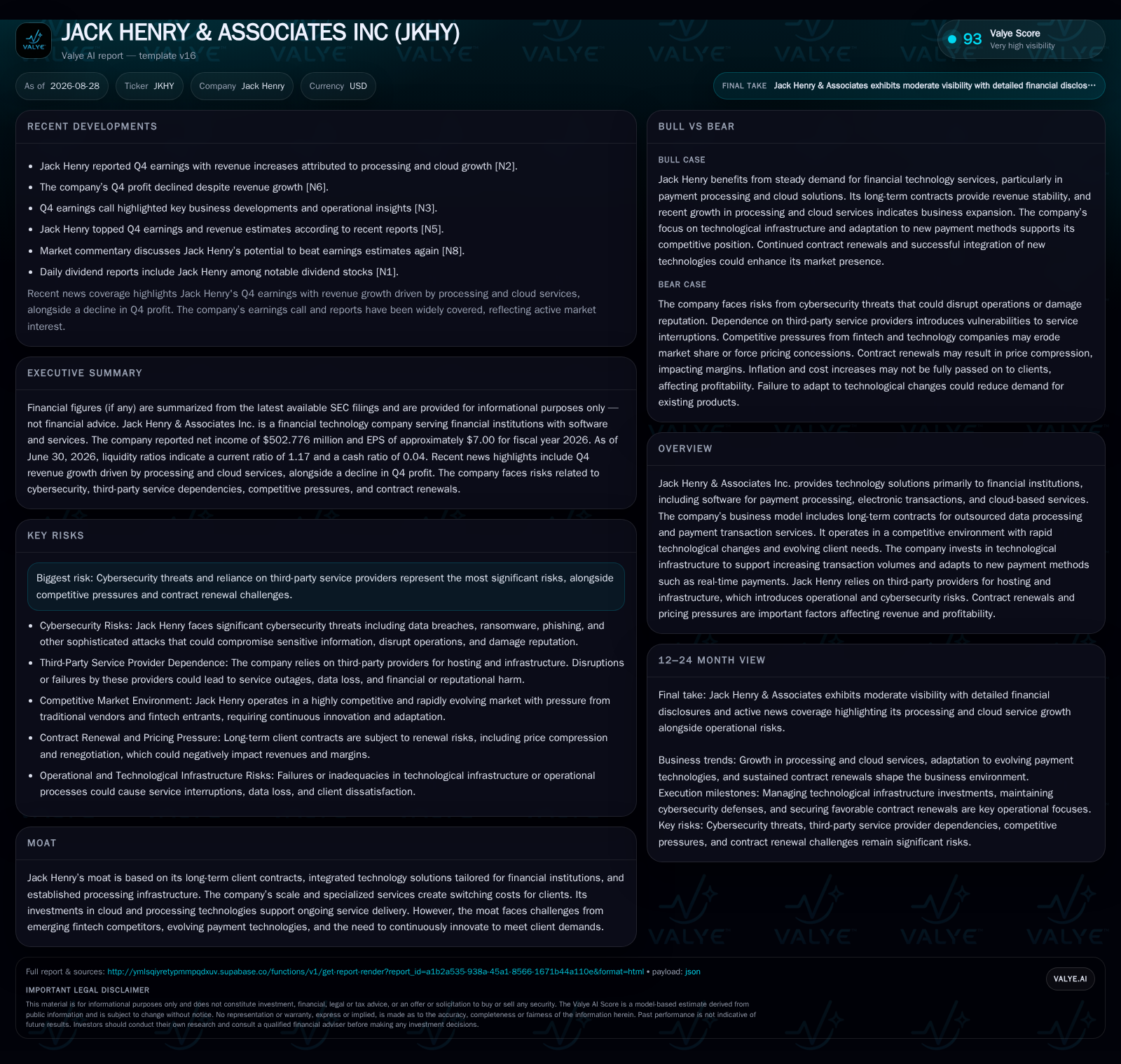
Jack Henry & Associates reported strong revenue growth driven by processing and cloud services but faced a profit decline in Q4 2026. Its business model relies on long-term contracts with financial institutions, providing steady revenue but exposing it to contract renewal and pricing pressures. The firm’s moat centers on integrated technology platforms and switching costs, though fintech competition and third-party dependencies pose risks. The key to upside lies in successful tech adaptation and contract renewals, while downside hinges on cybersecurity failures, margin erosion, and operational disruptions.
Jack Henry & Associates operates at the intersection of traditional financial institutions and rapidly evolving payment technologies, offering software and processing services underpinned by long-term contracts. The company’s recent fiscal year results demonstrate the strategic push into cloud and processing services, driving revenue growth but revealing margin challenges amid inflation and competitive dynamics. Its reliance on third-party infrastructure and exposure to cybersecurity risks represent operational complexities that could influence future performance. Understanding how Jack Henry balances contract renewal dynamics, technology investments, and competitive pressures is essential to assessing its medium-term trajectory.
Latest Operating Snapshot
Jack Henry reported a net income of $502.776 million for fiscal 2026 with basic EPS of approximately $7.00, reflecting solid profitability amid revenue growth [S1]. The company’s Q4 earnings highlighted increased revenues driven by growth in processing and cloud services, signaling successful expansion in high-demand segments [N2].
Despite top-line growth, Q4 profit declined, indicating margin pressures potentially linked to cost inflation, increased technology investments, or competitive pricing concessions [N6]. Liquidity metrics as of mid-2026 show a current ratio of 1.17 and a cash ratio of 0.04, reflecting moderate short-term potential financial flexibility but a relatively low cash buffer [S1][S2]. These factors underscore a business balancing growth initiatives with operational cost management amid a competitive and risk-laden environment.
Business Model and Unit Economics
Jack Henry’s revenue model centers on providing outsourced data processing and payment transaction services to financial institutions under contracts averaging six years [S1]. This structure creates a recurring revenue base with predictable volume tied to transaction flows, while pricing is often fixed or subject to renewal negotiations, introducing potential price rigidity or compression.
Economically, the business likely exhibits high fixed costs in technology infrastructure and service delivery platforms, with variable costs scaling with transaction volumes. Operating leverage arises if volume growth outpaces fixed expenses, but rising inflation and investments in cloud capabilities could dilute margin expansion. Capital intensity includes investments in secure data centers, cloud migration, and cybersecurity, with the timing and scale of these investments influencing profitability trajectories. The relatively low cash ratio suggests limited excess liquidity to absorb shocks or fund large incremental capital outlays without external financing.
Moat, Competition and Counterforces
Jack Henry’s moat derives from long-term contractual relationships with financial institutions, integrated technology tailored to banking payment processing, and established operational scale that generates switching costs. Its specialization in core banking software and processing services creates a barrier to entry for new competitors and fosters client dependency on its platforms [S1].
However, the moat is challenged by fintech companies innovating in payments, offering faster, more flexible solutions that appeal to clients seeking modernization. Additionally, reliance on third-party hosting and infrastructure providers introduces operational risk and potential service disruptions, weakening the reliability advantage. Pricing pressures during contract renewals and evolving payment technologies such as real-time payment networks require continuous innovation. The competitive landscape also includes traditional software vendors and emerging payment-focused platforms, intensifying the battle for market share.
Bull Case
In the optimistic scenario, Jack Henry capitalizes on the increasing demand for cloud-based payment processing by successfully integrating new payment technologies such as real-time payments, broadening its service offerings. Strong contract renewal rates at stable or improved pricing provide revenue visibility and margin stability. Continued investment in technology infrastructure enhances operational reliability and scalability, driving operating leverage as volumes grow faster than fixed costs [S1][N2].
Confirming evidence would include sustained or rising renewal rates, client additions in new payment segments, and margin improvements despite cost inflation. Additionally, successful cybersecurity defenses maintaining client trust and limited operational disruptions would support this case. Falsification would occur if contract renewals decline or prices erode materially, technology investments fail to generate volume growth, or cybersecurity incidents cause client attrition.
Base Case
The base case envisions steady revenue growth driven by processing and cloud services offset by moderate margin compression due to inflationary cost pressures and competitive pricing concessions during contract renewals. Jack Henry maintains its core client base with typical renewal rates but faces incremental pressure to invest in technology and cybersecurity, limiting margin expansion [S1][N6].
Operational risks related to third-party infrastructure are managed but require ongoing expenditure to mitigate service disruptions. Competitive dynamics result in incremental innovation but no major market share shifts. Profitability stabilizes around current levels, supported by moderate volume growth and pricing discipline. This scenario assumes a balanced outcome with neither significant upside from technology breakthroughs nor severe downside from operational failures.
Bear Case
In the downside scenario, Jack Henry suffers from cybersecurity breaches or repeated service interruptions stemming from third-party infrastructure failures, undermining client confidence and causing contract non-renewals or price concessions. Fintech competitors gain share by offering more agile, cost-effective payment solutions, pressuring Jack Henry’s legacy products and eroding its client base [S1].
Inflationary cost increases outpace the company’s ability to pass through expenses, compressing margins further. Contract renewals become more challenging, leading to revenue declines or stagnant growth. Failure to adapt quickly to evolving payment technologies diminishes relevance, triggering volume declines. Confirming evidence includes material client losses, increasing cybersecurity incidents, and negative margin trends. Falsification would be demonstrated by stable renewals, effective incident mitigation, and successful product updates.
What Matters Next
Key performance indicators to monitor include contract renewal rates and average pricing per contract—critical for revenue visibility and margin outlook. Tracking revenue growth specifically in processing and cloud services will reveal if business expansion continues to offset legacy pressures.
Margin trends and operating expenses, particularly in technology infrastructure and cybersecurity, will indicate whether cost management is effective amid inflation. Cybersecurity incident frequency and severity are vital external risk markers.
Third-party service provider reliability metrics, if disclosed, would help assess operational risk exposures. Adoption rates of new payment technologies such as real-time payments among clients will provide insight into the company’s innovation success. Finally, liquidity metrics including cash flow from operations and capital expenditures reveal potential financial flexibility to invest or weather downturns.
Disclaimer: This is research-only, informational analysis and not investment advice. It may include AI-generated interpretation and general industry context. Always verify important details using primary sources.

Comments