
Biomerica Inc (BMRA) Company Analysis: Navigating Diagnostic Innovation Amid Financial Strains
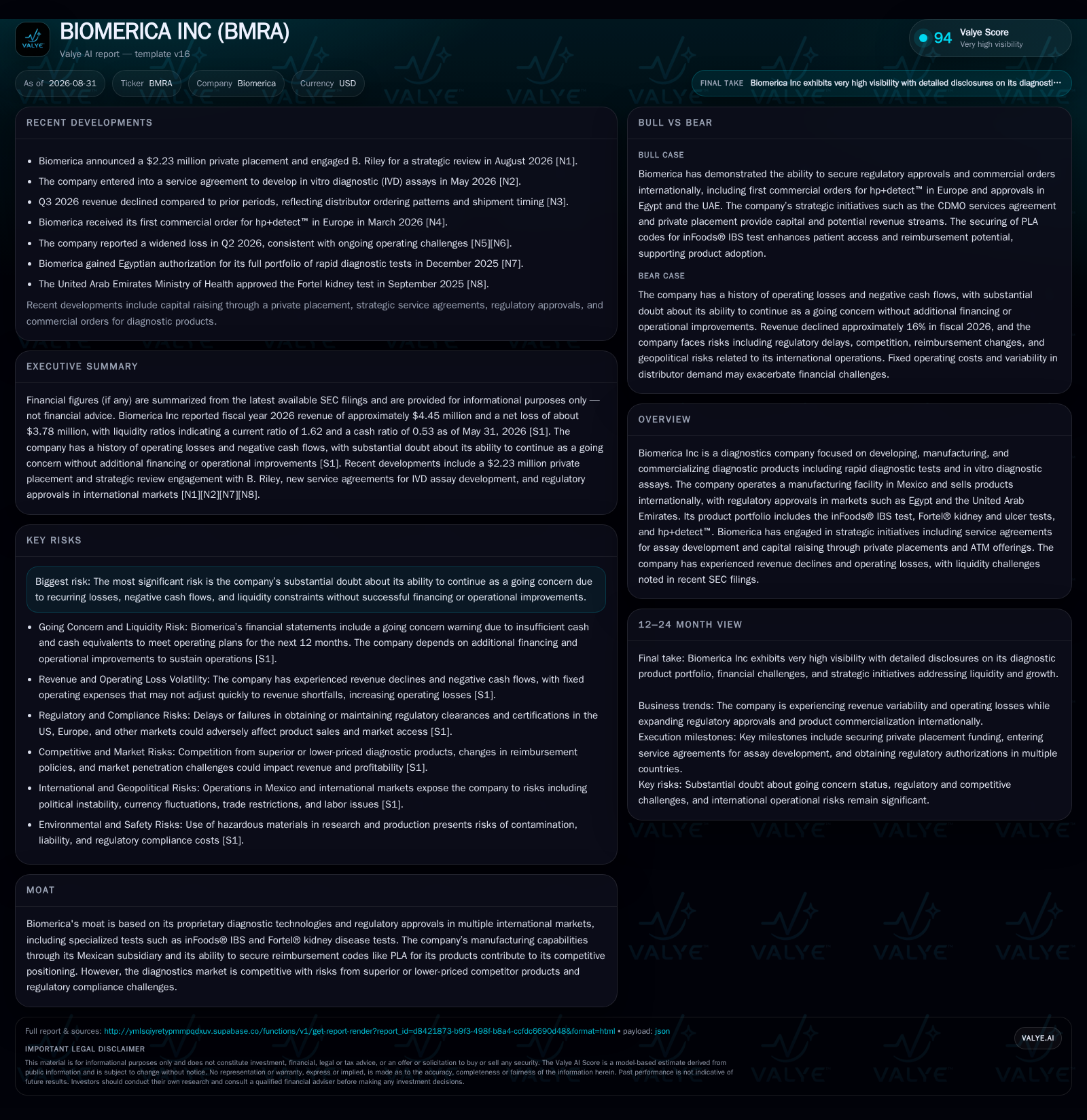
Biomerica Inc operates in the competitive diagnostics industry with specialized rapid and in vitro diagnostic tests, facing challenges from revenue volatility, liquidity constraints, and execution risks while pursuing international regulatory approvals and strategic capital initiatives.
Biomerica’s business hinges on proprietary diagnostic assays and international market access, supported by modest manufacturing scale and recent strategic partnerships. Despite promising product placements and reimbursement progress, persistent operating losses, limited liquidity, and competitive/regulatory risks cloud near-term viability. Future value depends critically on effective commercialization scaling, capital infusion, and navigating complex global regulatory landscapes.
Biomerica Inc is a diagnostic product developer specializing in rapid tests and in vitro assays with a global footprint anchored by manufacturing in Mexico and regulatory approvals across multiple international markets. Despite a portfolio featuring differentiated diagnostic tests like inFoods® IBS and Fortel® kidney assessments, the company faces a precarious financial situation marked by declining revenue, operating losses, and liquidity constraints. Recent strategic moves including capital raises and service agreements hint at potential growth pathways, but Biomerica’s ability to stabilize and scale operations amid regulatory, competitive, and geopolitical headwinds will determine its medium-term survival and value creation.
Latest Operating Snapshot
As of August 31, 2026, Biomerica reported fiscal year 2026 revenue of approximately $4.45 million, reflecting a 16% decline from the previous year primarily due to distributor ordering variability and shipment timing disruptions [S1][N3]. The operating environment remains challenging, with a net loss of about $3.78 million and liquidity constrained to $1.3 million in cash and equivalents as of May 31, 2026, resulting in a current ratio of 1.62 and a cash ratio of 0.53 [S1].
Strategically, Biomerica completed a $2.23 million private placement in August 2026 and engaged B. Riley for a comprehensive strategic review, signaling attempts to address capital needs and operational restructuring [N1]. The company also secured a Master Services Agreement for contract development and manufacturing organization (CDMO) services targeting fees in excess of $1.75 million, aiming to diversify revenue streams beyond product sales [N2]. Regulatory progress includes Egyptian authorization for its rapid diagnostic portfolio and UAE approval for the Fortel kidney test, supporting international market expansion efforts [N7][N8]. These facts indicate a firm actively managing immediate financial pressures while pursuing growth opportunities.
Business Model and Unit Economics
Biomerica’s revenue generation centers on the development, manufacturing, and commercialization of proprietary diagnostic tests, including rapid diagnostics and in vitro assays. Pricing dynamics likely hinge on reimbursement mechanisms in target markets, as evidenced by obtaining PLA codes for the inFoods® IBS test to enhance insurance coverage and patient access [N1]. The company’s product mix spans several specialized tests, potentially allowing for differentiated pricing but also posing complexity in commercial execution.
Manufacturing through Biomerica de Mexico introduces cost advantages via lower labor and operational expenses but simultaneously exposes the company to geopolitical and supply chain risks. The fixed cost base implied by maintaining production facilities and R&D functions contributes to operating leverage; however, current revenue shortfalls suggest insufficient scale to absorb fixed expenses, resulting in sustained operating losses. The recent CDMO services agreement may improve capacity utilization and margin profiles if demand materializes. Overall, the economics are capital-intensive and volume-sensitive, with profitability contingent on scaling sales and maintaining favorable reimbursement.
Moat, Competition and Counterforces
Biomerica’s moat derives primarily from its proprietary diagnostic technologies, regulatory approvals across multiple jurisdictions including Egypt and UAE, and reimbursement positioning such as PLA codes for inFoods®. These factors create barriers to entry by competitors lacking such clearances or payer recognition. Additionally, the company’s vertical integration via its Mexican manufacturing subsidiary supports operational control and potential cost advantages.
Conversely, the diagnostics industry remains highly competitive with numerous peers offering superior or lower-cost alternatives. Regulatory clearance delays and evolving reimbursement landscapes pose ongoing risks to market access and pricing power. Distributor variability and international geopolitical risks further weaken stability. Biomerica’s relatively small scale and financial fragility limit its ability to invest aggressively in innovation or marketing, exposing it to competitive displacement and margin pressure.
Bull Case
In an optimistic scenario, Biomerica successfully leverages its recent regulatory approvals and reimbursement advances to drive commercial adoption of its diagnostic portfolio, particularly the inFoods® IBS and hp+detect™ tests. The ability to secure PLA codes facilitates insurance reimbursement, stimulating demand and improving pricing power. The CDMO services agreement evolves into a steady revenue contributor, helping diversify income and utilize fixed assets efficiently.
Capital raised through the private placement and subsequent financing, complemented by strategic guidance from B. Riley, enables the company to stabilize operations, invest in marketing and sales infrastructure, and expand international distribution channels. Revenue growth and improving operating leverage eventually curtail losses and set the stage for profitability. Key confirming evidence would include sequential revenue growth, expanding margins, and consistent new commercial contracts. Failure to achieve these would falsify this scenario.
Base Case
The base case anticipates Biomerica maintaining its current product portfolio with modest revenue fluctuations reflecting distributor ordering patterns and international shipment timing. Regulatory approvals stabilize but do not rapidly expand, and reimbursement gains incrementally improve access without dramatic volume uplift. CDMO service revenues contribute modestly but do not significantly offset core operating losses.
Liquidity constraints continue to pressure the company, requiring intermittent capital raises or asset sales to sustain operations. Operating losses persist but narrow moderately as cost controls offset some revenue weakness. Competitive pressures and regulatory hurdles prevent significant market share gains. The company remains a small player in niche diagnostic segments with limited scalability absent breakthrough product adoption or partnership deals. Confirmation would be stable but sub-scale revenue and recurring financing requirements; falsification would be a material revenue decline or insolvency.
Bear Case
The downside scenario materializes if Biomerica fails to improve its revenue trajectory amid increasing distributor variability, shipment disruptions, or regulatory delays. Competitive pressures intensify with entrants offering more effective or less expensive diagnostics, eroding Biomerica’s market share. Reimbursement setbacks or policy changes reduce pricing and patient access, further depressing sales.
Simultaneously, fixed operating costs and international operational risks exacerbate cash burn, quickly depleting liquidity. Failure to secure additional financing or sell non-core assets leads to insolvency risk, consistent with the company’s substantial doubt disclosures [S1]. Confirming evidence includes continued revenue decline, inability to raise capital, or loss of regulatory approvals. Conversely, any reversal in these trends would challenge this pessimistic outlook.
What Matters Next
Key performance indicators and milestones to watch include: 1) Quarterly revenue trends, especially growth or stabilization in international markets; 2) Margin improvements and operating loss trajectory to assess operating leverage; 3) Progress and results from the B. Riley strategic review providing insight on capital structure or strategic alternatives; 4) New regulatory approvals or expanded reimbursement codes enhancing market access; 5) Commercial adoption rates and order volumes for hp+detect™ and inFoods® IBS tests; 6) Cash runway and capital raising success to mitigate going concern risk; 7) CDMO contract execution and contribution to revenue diversification; 8) Management changes and cost-control initiatives impacting operational efficiency.
Monitoring these metrics will illuminate Biomerica’s capacity to execute its growth strategy, manage liquidity, and withstand competitive and regulatory headwinds. The company’s future hinges on translating approvals and strategic initiatives into sustainable revenue and operational stability.
Disclaimer: This is research-only, informational analysis and not investment advice. It may include AI-generated interpretation and general industry context. Always verify important details using primary sources.

Comments