
Idaho Copper Corp (COPR): Strategic Development of the CuMo Project Amid Industry and Execution Risks
Idaho Copper Corp is advancing its large-scale copper-molybdenum-silver deposit through exploration and technological innovation while navigating the capital-intensive, regulatory-heavy mining sector. Recent governance and financing milestones enhance potential but fundamental project and market uncertainties remain significant.
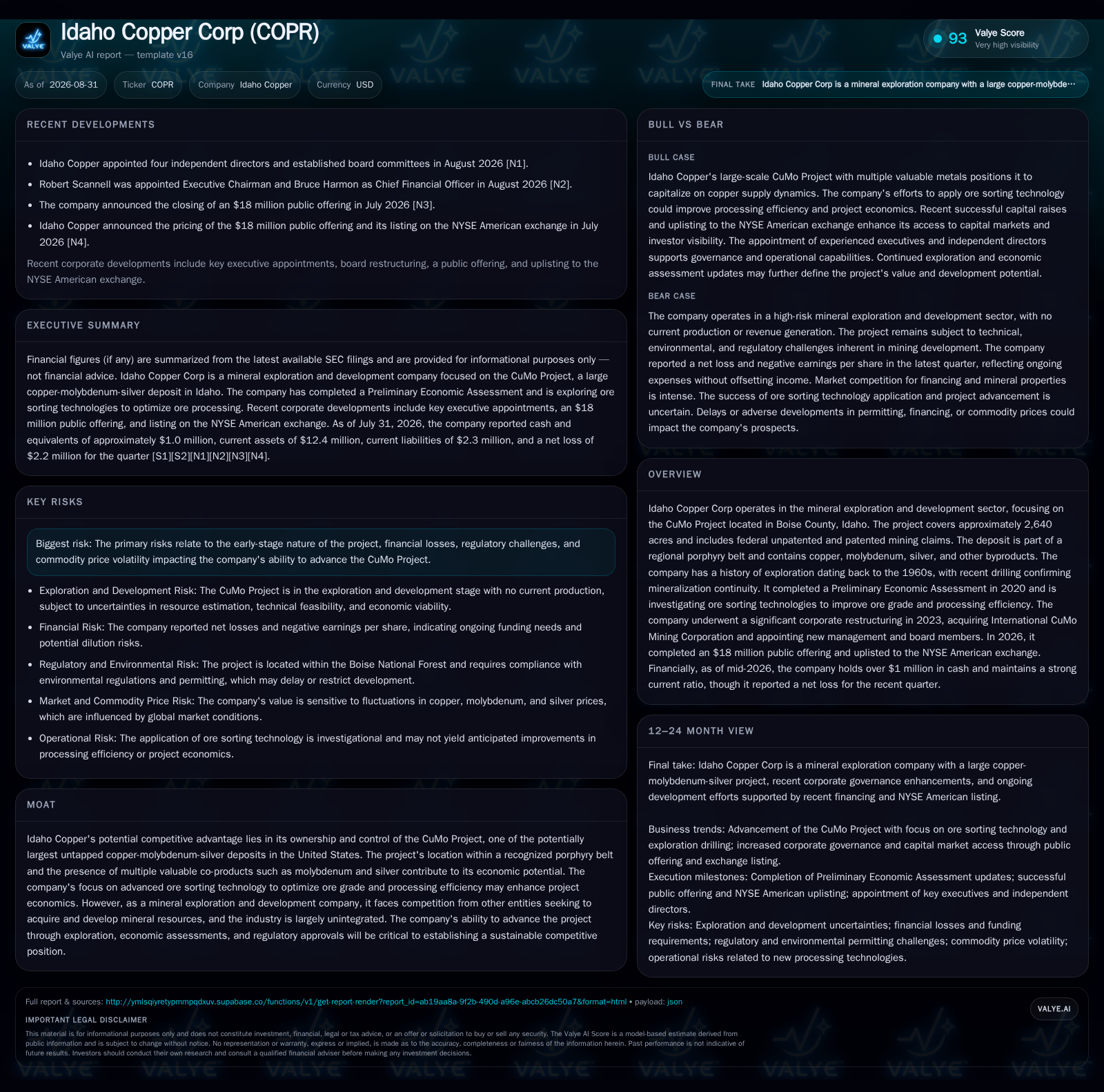
Idaho Copper Corp operates the CuMo Project, a multi-metal porphyry deposit in Idaho, currently in exploration and development phases. The company recently raised $18 million via a public offering and uplisted to the NYSE American exchange, positioning itself for further advancement. Key value drivers include ore sorting technology to improve processing economics and the project’s multi-metal resource base. However, the firm faces typical early-stage mining risks: no production or revenue, regulatory complexity, capital demands, and commodity price volatility. Operational execution and regulatory progress over the next 12-24 months will critically determine Idaho Copper's transition from exploration to development and eventual production.
Idaho Copper Corp, a mineral exploration and development company, is focused on advancing the CuMo Project, a significant copper-molybdenum-silver deposit located in Boise County, Idaho. The deposit's multi-metal characteristics, complemented by ongoing exploration and technological efforts such as ore sorting, position the company to potentially capitalize on copper market dynamics. Recent corporate developments—including an $18 million public offering, NYSE American uplisting, and key executive appointments—have bolstered its capital base and governance framework. However, as an early-stage project still without production, Idaho Copper faces typical sector headwinds, including regulatory hurdles, financial losses, and the inherent uncertainties of mineral exploration and development [S1][S2][N1][N2][N3][N4].
Latest Operating Snapshot
Idaho Copper’s CuMo Project covers approximately 2,640 acres in Boise County, Idaho, comprising 126 federal unpatented and 6 patented mining claims within the Boise National Forest [S1]. This land position situates the company in a recognized porphyry belt with copper, molybdenum, silver, and byproducts tungsten and rhenium, providing a diversified metal resource base. The company completed a Preliminary Economic Assessment (PEA) in 2020 and continues to investigate ore sorting technology aimed at enhancing ore grade and processing efficiency [S1].
Recent corporate activities include the appointment of four independent directors and the establishment of board committees, strengthening governance [N1]. In August 2026, Robert Scannell was named Executive Chairman and Bruce Harmon assumed the role of CFO, consolidating leadership at a pivotal development stage [N2]. Financially, after an $18 million public offering and uplisting to the NYSE American in mid-2026, the company held $1 million in cash and reported a net loss of $2.2 million for the quarter ending July 31, 2026, reflecting ongoing exploration and operational expenses without revenue generation [S2][N3][N4]. These developments are critical for operational continuity and advancing project milestones.
Business Model and Unit Economics
Idaho Copper’s business model centers on exploring and developing the CuMo Project, with value realization contingent on converting mineral resources into economically extractable reserves and subsequently producing and selling metals. Revenue depends on commodity prices for copper, molybdenum, silver, and byproducts, which are influenced by global supply-demand dynamics. The company currently incurs exploration and development expenses without any production revenue, resulting in negative earnings and reliance on capital markets for funding [S2].
Unit economics will heavily depend on ore grade, recovery rates, capital expenditure (CapEx) for mine and processing plant construction, and operating costs (OpEx). The company's investigation of ore sorting technology could improve unit economics by increasing feed grade and reducing processing volumes and costs if proven effective. However, mining projects are capital-intensive with high fixed costs, leading to significant operating leverage once production commences. The current stage implies high variable exploration costs and upfront capital requirements, with operating leverage potential materializing only upon project ramp-up and steady-state operations.
Moat, Competition and Counterforces
Idaho Copper’s potential competitive advantage stems from ownership of one of the larger untapped porphyry copper-molybdenum-silver deposits in the U.S., located in a known mineral belt with diversified metals. The inclusion of valuable byproducts such as tungsten and rhenium may provide incremental economic benefit and reduce dependency on copper prices alone. The company’s exploration track record and application of ore sorting technology to enhance processing efficiency could differentiate its project economics versus peers.
However, the mining and exploration industry is highly fragmented and competitive, with many companies vying for capital and mineral assets. Regulatory permitting, environmental concerns related to operating within a national forest, and technological uncertainties regarding processing innovations pose significant counterforces. Established mining companies with operational mines have scale advantages, established cash flows, and stronger access to financing. Idaho Copper’s early-stage status and lack of production expose it to risks from capital markets volatility and execution challenges, limiting its moat until successful project development.
Bull Case
In a favorable scenario, Idaho Copper successfully advances the CuMo Project through updated economic assessments, incorporating ore sorting technology that demonstrably improves ore grade and processing efficiency. This enhancement leads to lower operating costs and higher margins, making the project economically viable even under moderate commodity prices. The company leverages its $18 million capital raise and NYSE American listing to attract additional funding, enabling timely permitting, construction, and eventual production. Strengthened governance with experienced executives and independent directors drives disciplined project execution and operational excellence.
Confirmation of this bull case would include successful pilot testing of ore sorting, positive feasibility study outcomes, smooth regulatory approvals, and stable or rising copper and co-product prices. Early-stage falsification could occur if ore sorting fails to deliver expected benefits, permitting is delayed or denied, or capital markets become inaccessible, stalling development.
Base Case
The base case envisions steady progress in exploration and technical validation of the CuMo Project, with gradual updates to economic assessments reflecting modest improvements in resource definition and processing plans. Ore sorting technology shows some benefits but does not dramatically alter project economics. The company maintains access to capital markets through its NYSE American listing but requires additional funding rounds, causing dilution and shareholder uncertainty. Regulatory permitting proceeds with typical delays but no major setbacks.
Commodity prices experience moderate volatility but remain within ranges that allow the project to remain potentially viable pending further development. The company continues to report losses as it invests in preproduction activities, while governance enhancements improve operational rigor. Execution milestones are met incrementally without breakthrough events.
Bear Case
In the downside scenario, Idaho Copper encounters significant technical, regulatory, or financial setbacks. Ore sorting technology fails to achieve meaningful gains, leaving processing costs and grades suboptimal. Environmental permitting within Boise National Forest proves more stringent or prolonged than anticipated, delaying timelines and increasing compliance costs. Commodity price declines reduce project valuation, undermining investor confidence and limiting access to capital. The company’s cash reserves deplete without securing additional financing, exacerbating liquidity risks and forcing project suspension or asset sale.
Confirmation of the bear case would be ongoing net losses escalating, failure to raise sufficient capital, adverse regulatory rulings, or evidence of resource depletion or metallurgical challenges. Conversely, improved exploration results, positive permitting progress, or capital market support could falsify this scenario.
What Matters Next
Key performance indicators and milestones to monitor include: (1) updates to Preliminary Economic Assessment or feasibility studies reflecting ore sorting impacts and resource conversion; (2) progress and timelines in obtaining environmental permits within the Boise National Forest; (3) results of ore sorting pilot programs demonstrating processing efficiency gains; (4) cash burn rate and additional capital raises or financing arrangements; (5) commodity price trends for copper, molybdenum, silver, and byproducts; (6) exploration drilling results confirming mineralization continuity or expansion; (7) operational progress against planned development milestones; and (8) changes in management or governance impacting strategic direction.
Disclosure of specific unit operating costs, recovery rates, and capital expenditure estimates in future filings would be useful metrics to assess project economics more granularly. Tracking these indicators will provide insight into Idaho Copper’s execution capabilities, financial sustainability, and the evolving economic viability of the CuMo Project.
Disclaimer: This is research-only, informational analysis and not investment advice. It may include AI-generated interpretation and general industry context. Always verify important details using primary sources.

Comments