
Royale Energy, Inc. (ROYL) — Navigating Financial and Operational Challenges Amid Limited Public Transparency
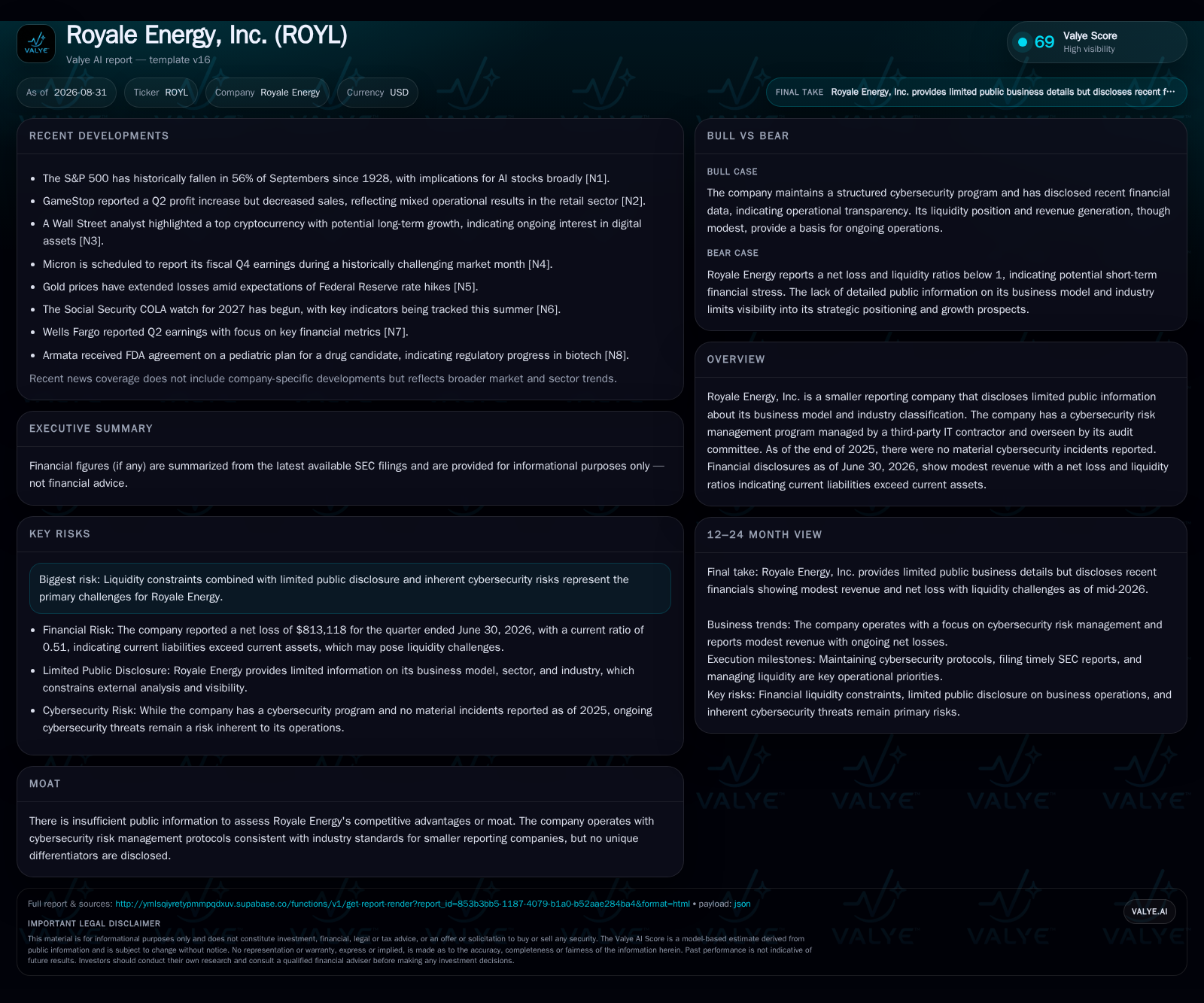
Royale Energy, Inc. reports modest revenue with ongoing net losses and liquidity constraints as of mid-2026. Its operational focus on cybersecurity risk management reflects an effort to maintain enterprise resilience, yet limited public disclosure clouds assessment of its competitive positioning and growth prospects.
Royale Energy exhibits weak liquidity and sustained net losses with minimal revenue growth, operating under a cybersecurity framework to safeguard enterprise systems. The lack of detailed public information restricts insight into its business model and competitive advantages, raising uncertainty about its capacity to achieve sustainable profitability or scale. Key risks include financial strain and limited strategic visibility, while maintaining cybersecurity protocols and improving liquidity are critical near-term priorities.
As of August 2026, Royale Energy, Inc. faces a challenging financial environment marked by modest revenue generation and ongoing net losses, coupled with liquidity ratios signaling potential short-term financial stress. The company maintains a cybersecurity risk management program with no reported material breaches, underscoring operational diligence amid limited public information. This opacity in business model and industry classification constrains investor and analyst visibility into its strategic direction and competitive stance. Understanding Royale Energy's prospects entails scrutinizing its financial dynamics, operational capacities, and the broader context of its sector engagement, where uncertainty remains a key theme.
1. Latest Operating Snapshot
Royale Energy reported revenue of $680,141 and a net loss of $813,118 as of June 30, 2026, translating to a negative EPS of $0.01 per share [S2]. These figures reflect ongoing challenges in generating sufficient profitability despite some revenue activity. The imbalance between revenue and expenses highlights operational inefficiencies or capital consumption beyond current income streams.
Liquidity metrics show a current ratio of 0.51 and a cash ratio of 0.11, with current liabilities of $26.57 million exceeding current assets of $13.64 million [S2]. This financial structure suggests potential short-term liquidity constraints that could impair the company’s ability to meet obligations without external financing or cash flow improvements. Additionally, the company’s maintenance of a cybersecurity risk management program administered by third-party contractors and overseen by its audit committee, with no material incidents reported as of December 31, 2025, indicates a controlled operational risk environment [S1].
2. Business Model and Unit Economics
Public disclosures offer limited insight into Royale Energy’s revenue drivers or cost structure, complicating precise unit economics analysis. The modest revenue base coupled with significant net losses suggests a cost structure that currently outpaces income, possibly due to fixed costs or investment in operational capabilities unaccompanied by scale economies. If the business relies on capital-intensive assets or personnel, fixed costs could weigh heavily on margins absent revenue growth or margin expansion.
Pricing and volume dynamics remain opaque, but liquidity shortfalls imply limited operating leverage at present. The company’s cybersecurity program, managed externally, may introduce variable costs tied to service contracts, which could moderate fixed cost burdens. However, persistent net losses suggest variable costs or overheads exceed incremental revenue. Capital intensity might be moderate, given limited reported investment disclosures, but the negative cash ratio points to constrained internal cash generation to fund growth or working capital needs without external capital injections.
3. Moat, Competition and Counterforces
Royale Energy’s public disclosures do not reveal identifiable competitive advantages or differentiated capabilities that could constitute a durable moat. The cybersecurity program aligns with standard risk management practices expected of reporting companies but does not imply unique technological or operational barriers. The absence of detailed sector or operational information precludes evaluating product differentiation, scale advantages, or customer switching costs.
Competitive pressures likely stem from peers with clearer market positioning and more transparent business models. Without evidence of proprietary technology, exclusive contracts, or high customer retention, Royale Energy may face intensified competition in capital access, talent acquisition, or operational efficiency. Counterforces include liquidity constraints limiting investment in competitive initiatives and transparency deficits affecting stakeholder confidence, which may hamper strategic partnerships or capital raising.
4. Bull Case
In an optimistic scenario, Royale Energy leverages its cybersecurity risk management framework to sustain operational continuity and build stakeholder trust, thereby attracting strategic partners or investors. Improved financial discipline and targeted cost management could narrow losses, while modest revenue growth, possibly from niche or emerging market activities, may develop into a stable base. Incremental improvements in liquidity through capital raises or asset optimization could enable reinvestment into scalable operations.
Confirming evidence would include consistent reductions in net losses, stabilization or growth of revenue, and improved liquidity ratios over successive quarters. Transparent disclosures clarifying business segments and growth initiatives could further validate progress. Conversely, failure to reduce losses or enhance liquidity, or any material cybersecurity incidents, would falsify this bullish outlook.
5. Base Case
The base case envisions Royale Energy continuing to function as a smaller reporting company with ongoing modest revenue and periodic net losses, sustaining its cybersecurity protocols without material breach. Liquidity challenges persist but are managed through conservative spending and possibly incremental financing, allowing the company to maintain operations without significant growth acceleration.
This scenario assumes no major shifts in business model or sector engagement, with limited public disclosure continuing to constrain external visibility. Financial performance remains stable but unimpressive, and operational risk is contained. Evidence includes consistent financial results resembling recent quarters, maintenance of cybersecurity controls, and absence of new strategic disclosures. Deviations such as improved financial metrics or strategic pivots would shift this assessment.
6. Bear Case
Downside risk centers on Royale Energy’s liquidity shortfall worsening, potentially leading to an inability to service obligations or sustain operations without dilutive capital raises or asset sales. Continued net losses exacerbate financial strain, while limited transparency undermines investor confidence. A material cybersecurity breach could compound operational risks and financial liabilities, further damaging prospects.
Confirming evidence would be deteriorating liquidity ratios, widening losses, delayed or missed SEC filings, or reports of cybersecurity incidents. Falsification would require stable or improving liquidity, reduced losses, and sustained cybersecurity integrity. The lack of robust competitive advantages or clear growth pathways intensifies vulnerability in this scenario.
7. What Matters Next
Key performance indicators to monitor include quarterly revenue growth and net income trends to assess operational improvement or deterioration. Liquidity metrics such as current ratio, cash ratio, and changes in working capital provide insights into short-term financial health and runway. Disclosure frequency and depth concerning the company’s business segments, strategic initiatives, or capital structure changes would enhance transparency and inform valuation.
Additionally, updates on cybersecurity program effectiveness and any incident disclosures remain critical given operational risk. Capital raising activities or restructuring plans would materially affect potential financial flexibility. Finally, any indication of sector classification or market positioning would help contextualize competitive dynamics and growth potential.
Disclaimer: This is research-only, informational analysis and not investment advice. It may include AI-generated interpretation and general industry context. Always verify important details using primary sources.

Comments