
PHAOS Technology Holdings (Cayman) Ltd: Navigating Liquidity Strains Amid Concentrated Market Risks in Specialized Microscopy Equipment
PHAOS Technology operates in a niche microscopy market with revenue concentrated among a few customers and Singapore geography, facing significant liquidity pressures and strategic challenges despite recent capital market access.
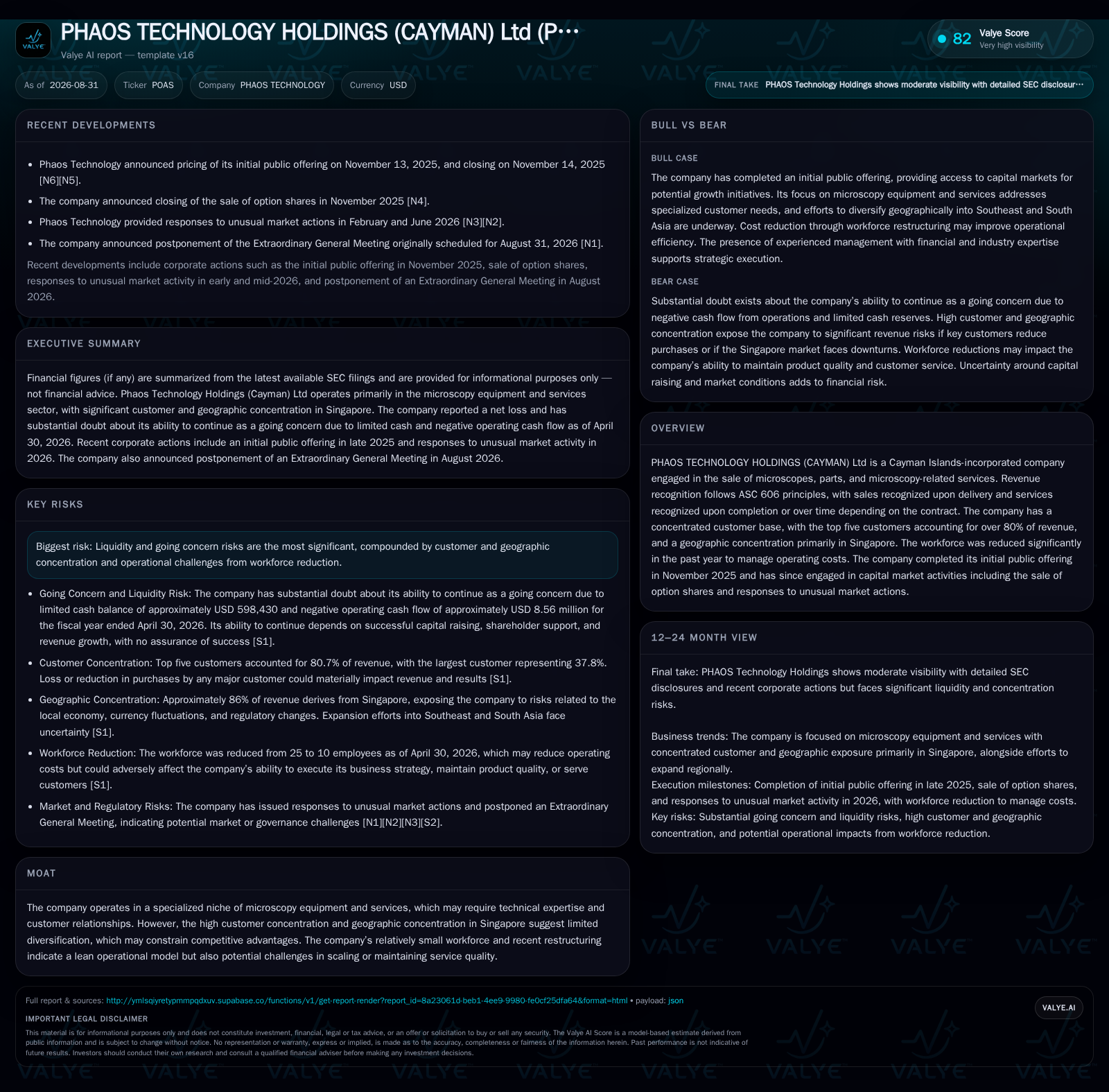
PHAOS Technology Holdings, a specialized microscopy equipment and services provider, reports substantial going concern doubts driven by negative operating cash flow and limited liquidity. The firm’s financial vulnerability is compounded by high customer and geographic concentration in Singapore and a sharply reduced workforce. While the recent IPO and cost rationalization offer some strategic levers, the company’s ability to scale, diversify, and sustain service quality remains uncertain. Key risks center on capital raising success, customer retention, and execution amid a lean operational footprint.
PHAOS Technology Holdings is a niche player focusing on microscopy equipment and related services, with a highly concentrated revenue base both by customer and geography. Despite completing an initial public offering in late 2025 to bolster its financial footing, the company faces significant liquidity constraints and operational risks. Its shrinking workforce and concentrated customer portfolio amplify exposure to market fluctuations and operational disruptions. This analysis explores PHAOS’s business model, competitive environment, and the plausible scenarios that could influence its future viability amid these headwinds.
Latest Operating Snapshot
PHAOS Technology ended fiscal 2026 with a net loss of approximately USD 4.8 million and negative operating cash flow of around USD 8.56 million, resulting in substantial doubt about its ability to continue as a going concern. Liquidity remains constrained, with cash and equivalents at roughly USD 598,000 as of April 30, 2026 [S1]. These financial outcomes highlight ongoing challenges in generating positive cash flow from core operations despite recent capital market activities.
The company’s revenue profile shows high concentration risk: the top five customers contributed 80.7% of total revenue, with a single customer representing nearly 38%. Additionally, about 86% of revenue derives from Singapore-based customers, emphasizing geographic concentration vulnerability. Workforce reductions from 25 to 10 employees over the last year aim to control costs but raise concerns about sustaining operational capacity. Corporate governance actions including an IPO in November 2025, followed by responses to unusual market activity and a postponed Extraordinary General Meeting, indicate strategic and market uncertainties [S1][N1][N2][N3][N5].
Business Model and Unit Economics
PHAOS’s revenue primarily derives from sales of microscopes, parts, and microscopy-related services, recognized upon delivery or service completion per ASC 606. This transactional revenue model implies limited recurring revenue streams or subscription-like stability, resulting in revenue volatility tied to order flows and customer purchasing patterns. The high customer concentration intensifies this risk, as volume fluctuations with a few customers can substantially impact overall revenue.
Fixed costs appear relatively high given the specialized technical expertise required, but the company’s recent workforce reduction suggests efforts to decrease fixed overhead and improve cost structure leverage. However, the lean staffing model may constrain capacity to scale or promptly respond to customer demands. Capital intensity likely centers around inventory, R&D, and manufacturing or sourcing of microscopy components, but specific capital expenditure details are not disclosed. Operating leverage could emerge if revenue growth outpaces fixed cost base, but current losses and cash burn indicate the company has yet to reach a scale where leverage benefits materialize.
Moat, Competition and Counterforces
PHAOS operates in a specialized microscopy niche, which requires technical know-how and strong customer relationships, potentially creating modest switching costs for customers reliant on tailored equipment and support. However, the company’s small size, limited geographic reach, and high customer concentration weaken its competitive positioning. Its dominant exposure to Singapore’s market indicates a narrow competitive moat vulnerable to local economic or regulatory shifts.
Competitors likely include larger microscopy equipment manufacturers with broader product portfolios, global distribution networks, and more diversified customer bases. These competitors can leverage scale economies, more robust R&D budgets, and diversified geographic risk to exert pricing pressure and capture larger market share. PHAOS’s recent operational downsizing could impair customer service quality, further eroding its competitive standing if not offset by product differentiation or strategic partnerships.
Bull Case
In a favorable scenario, PHAOS leverages its recent IPO proceeds and improved cost structure to stabilize liquidity and invest selectively in expanding its geographic footprint beyond Singapore into Southeast and South Asia. This regional diversification could mitigate concentration risks and attract a broader customer base, enhancing revenue stability. The company’s technical expertise in microscopy equipment meets specialized needs that larger competitors may overlook, allowing PHAOS to build deeper customer relationships and modest pricing power.
Further workforce optimization combined with disciplined capital allocation could improve gross margins and operational efficiency, enabling positive operating cash flow within 12 to 24 months. Confirmation of this scenario would include sequential revenue growth with diversification, improved cash flow metrics, and successful capital raising to extend runway. Conversely, failure to secure new customers outside Singapore or sustained operating losses would falsify this optimistic outlook.
Base Case
Under a moderate outlook, PHAOS continues to service its concentrated customer base primarily in Singapore while cautiously managing costs. The company’s lean operations maintain a controlled burn rate but do not achieve significant scale or geographic diversification in the near term. Revenue remains volatile due to dependence on a few customers, and operating losses persist but narrow over time as cost savings partially offset stagnant top-line growth.
Liquidity remains tight, with periodic capital raises required to fund operations. The company avoids insolvency but struggles to build durable competitive advantages beyond its niche expertise. Indicators supporting this scenario include stable but modest revenue trends, incremental margin improvement, and continued reliance on a small customer set. A shift towards declining revenues or inability to maintain minimum operational capacity would contradict this baseline.
Bear Case
The downside scenario involves continued negative cash flow and failure to raise sufficient capital, leading to insolvency or forced restructuring. High customer concentration risk materializes as one or more key customers significantly reduce orders or exit, causing steep revenue declines. The geographic concentration in Singapore exposes PHAOS to adverse market or regulatory shocks, further depressing sales volumes.
Workforce reductions and operational constraints impair product quality and service responsiveness, accelerating customer attrition. Market and governance uncertainties, exemplified by postponed meetings and unusual market activity, exacerbate investor skepticism and limit financing options. Evidence of this scenario includes widening losses, liquidity depletion below critical levels, loss of major contracts, and inability to stabilize workforce or service levels.
What Matters Next
Key performance indicators to watch include monthly or quarterly revenue trends by customer and geography to assess concentration risk and diversification progress. Monitoring operating cash flow and burn rate will reveal the company’s runway and capital efficiency. Updates on capital raising activities or new financing agreements will clarify liquidity outlook.
Customer retention and contract continued-adoption indicators are critical metrics to gauge revenue stability, though not currently disclosed, they would be valuable. Workforce size and composition changes should be tracked to understand operational capacity and cost structure evolution. Finally, market and regulatory developments in Singapore and broader Southeast Asia, as well as any corporate governance updates such as rescheduled meetings or shareholder resolutions, will provide insights into external risk factors and stakeholder confidence.
Disclaimer: This is research-only, informational analysis and not investment advice. It may include AI-generated interpretation and general industry context. Always verify important details using primary sources.

Comments