
CytoDyn Inc.: Clinical-Stage Oncology Biotech Navigating Development and Financial Constraints
CytoDyn advances leronlimab through Phase 2 solid tumor trials and expanded access programs while facing execution and liquidity challenges. Strategic collaborations and novel CCR5 targeting underpin potential, but key clinical and financial risks persist.
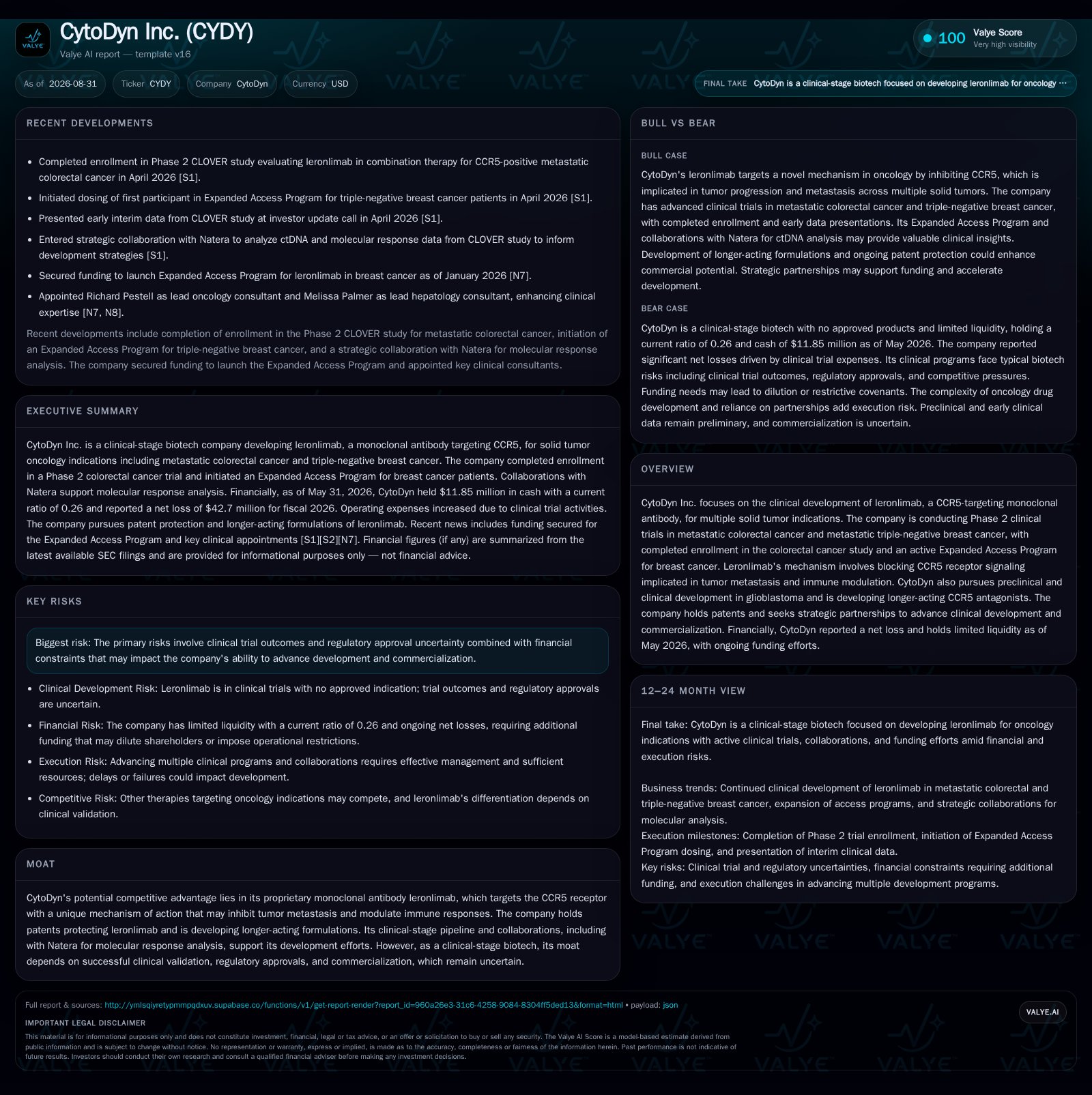
CytoDyn is a clinical-stage biotech focused on leronlimab, a monoclonal antibody targeting CCR5 in solid tumors. The company has completed enrollment in a Phase 2 metastatic colorectal cancer trial and initiated an expanded access program for triple-negative breast cancer. Collaborations with Natera enhance molecular insights. Financially constrained with ongoing net losses, CytoDyn’s outlook hinges on clinical success, strategic partnerships, and capital raising to sustain development and commercialization efforts.
CytoDyn Inc. is advancing leronlimab, a humanized monoclonal antibody targeting the CCR5 receptor, through pivotal Phase 2 trials in metastatic colorectal cancer and triple-negative breast cancer. The company’s strategy leverages a novel mechanism of action that intersects tumor progression, metastasis, and immune modulation. Amid limited liquidity and significant net losses, CytoDyn is pursuing strategic collaborations and expanded access programs to build clinical and commercial momentum. The company’s prospects hinge on demonstrating clinical efficacy, navigating complex oncology development risks, raising capital, and extending intellectual property through innovative drug design and partnerships.
Latest Operating Snapshot
CytoDyn completed enrollment in its Phase 2 CLOVER study for relapsed/refractory microsatellite stable metastatic colorectal cancer with over 60 patients across multiple U.S. sites as of April 2026, marking a key clinical milestone [S1]. Concurrently, the company initiated an Expanded Access Program (EAP) for triple-negative breast cancer patients in April 2026, providing treatment options to patients with limited alternatives and generating real-world data [S1]. These developments indicate progress in clinical validation and patient engagement.
Strategic collaboration with Natera, Inc. to analyze circulating tumor DNA (ctDNA) and molecular response data from the CLOVER study enhances CytoDyn’s ability to assess biological effects and disease progression at a molecular level, potentially refining patient selection and trial endpoints [S1]. Financially, CytoDyn reported a net loss of $42.7 million for fiscal 2026, with cash and equivalents at $11.85 million and a current ratio of 0.26 as of May 31, 2026, highlighting liquidity constraints amidst increasing clinical trial expenditures [S1][S2].
Business Model and Unit Economics
CytoDyn’s business model centers on developing leronlimab, a proprietary CCR5-targeting monoclonal antibody, through clinical validation for oncology indications. Revenue generation depends on successful clinical trial outcomes, regulatory approval, and subsequent commercialization or strategic partnerships. Currently, the company incurs predominantly fixed costs related to clinical trial operations, regulatory compliance, and R&D, leading to substantial operating losses absent product sales. Variable costs include incremental patient enrollment and drug manufacturing for trials and expanded access programs.
Given the clinical-stage status, unit economics such as customer acquisition cost or lifetime value are not currently applicable. Capital intensity is high due to the cost of running multi-site Phase 2 studies and molecular analysis collaborations. Operating leverage could emerge if leronlimab gains regulatory approval and commercial launch proceeds, allowing fixed R&D infrastructure costs to be amortized over product sales. However, scaling manufacturing and market access efforts may introduce new capital and operational demands. Success in developing longer-acting formulations could improve product differentiation and pricing potential, enhancing unit economics.
Moat, Competition and Counterforces
CytoDyn’s moat potentially derives from its unique targeting of the CCR5 receptor, implicated in tumor metastasis, immune regulation, and angiogenesis, which may differentiate leronlimab from other oncology therapeutics. Patent protection on leronlimab and related technologies, alongside ongoing development of longer-acting CCR5 antagonists via AI-driven discovery, could extend exclusivity and commercial viability. Collaborations, such as with Natera for biomarker-driven patient stratification, may strengthen clinical development efficiency and therapeutic precision.
However, as a clinical-stage biotech, the company’s moat is contingent on clinical proof of efficacy and safety, regulatory approvals, and successful commercialization. Competitors include other immuno-oncology agents, targeted therapies, and emerging CCR5 antagonists. The oncology market is highly competitive and rapidly evolving, with multiple companies pursuing alternative mechanisms for metastatic cancers. The absence of approved products and limited financial resources expose CytoDyn to execution risk, and potential entry of more advanced competitors could erode market positioning.
Bull Case
In the bull scenario, leronlimab demonstrates clear clinical efficacy in Phase 2 trials, with biomarker analyses from Natera collaboration validating CCR5 inhibition as a critical therapeutic axis in metastatic colorectal and triple-negative breast cancers. These results lead to expedited regulatory pathways and eventual approval, enabling CytoDyn to commercialize leronlimab either independently or via lucrative partnerships. Development of longer-acting formulations further improves patient compliance and competitive positioning, enabling premium pricing and expanding indications.
Confirming evidence would include positive interim and final trial data showing statistically and clinically meaningful survival or progression-free survival benefits, favorable safety profiles, and robust molecular response correlations. Successful fundraising or partnering to fund late-stage trials and commercialization would support this scenario. Falsification would occur if trials fail to meet endpoints, biomarker data do not correlate with outcomes, or if funding constraints force operational retrenchment.
Base Case
The base case assumes incremental clinical progress with leronlimab showing modest efficacy signals sufficient to justify further development but requiring larger or combination trials. Expanded Access Programs generate real-world data that support niche use in refractory patient populations, but broad market adoption remains uncertain. Regulatory approval may be achieved for limited indications with cautious labeling. CytoDyn manages funding through a mix of equity raises and partnerships, balancing dilution risks against operational continuity.
This scenario is supported by steady patient enrollment, stable clinical data trends without major safety concerns, and ongoing collaboration outcomes that inform development strategies. Financial metrics remain tight but manageable with disciplined spending. Falsification would involve either breakthrough clinical results driving rapid expansion or failure to sustain funding and clinical momentum leading to program discontinuation.
Bear Case
In the bear case, CytoDyn’s clinical trials fail to demonstrate meaningful efficacy, or safety concerns emerge, leading to regulatory setbacks or trial termination. Limited cash reserves and a current ratio of 0.26 constrain operational flexibility, forcing dilutive financings or asset sales under unfavorable terms. Competitive pressures from more advanced or effective therapies further limit commercial prospects. The company struggles to attract strategic partnerships or sustain clinical programs, potentially resulting in asset write-downs or restructuring.
Confirmation of this downside would be negative interim data releases, failure to secure additional funding, or loss of key clinical collaborators. Conversely, falsification would be marked by positive clinical data, successful capital raises, or strategic partnerships mitigating financial risks.
What Matters Next
Key performance indicators and milestones for CytoDyn include: (1) presentation of final Phase 2 CLOVER study data with statistical analysis of primary and secondary endpoints; (2) clinical outcomes and safety data from the Expanded Access Program for triple-negative breast cancer; (3) progress and results from the Natera ctDNA molecular response collaboration, including biomarker validation; (4) advancement of longer-acting CCR5 antagonist molecules through preclinical or early clinical development; (5) achievement of strategic partnerships or licensing deals to secure funding and expand development capacity; (6) cash runway duration and capital raising efforts to support ongoing trials; (7) regulatory interactions and submissions to clarify approval pathways; and (8) potential initiation of investigator-initiated trials in glioblastoma or other indications.
While some of these KPIs are publicly disclosed, others, such as detailed biomarker validation data or partnership terms, may not be fully transparent, necessitating close investor monitoring. Successful navigation of these milestones would materially affect CytoDyn’s developmental trajectory and valuation.
Disclaimer: This is research-only, informational analysis and not investment advice. It may include AI-generated interpretation and general industry context. Always verify important details using primary sources.

Comments