
Stimcell Energetics Inc. (STME) Equity Analysis: Navigating Financial Strains Amid Promising Microcurrent Therapy Innovation
Stimcell Energetics develops proprietary microcurrent electrical therapy devices targeting diabetes-related complications but faces critical financial and regulatory headwinds that constrain near-term commercialization and growth potential.
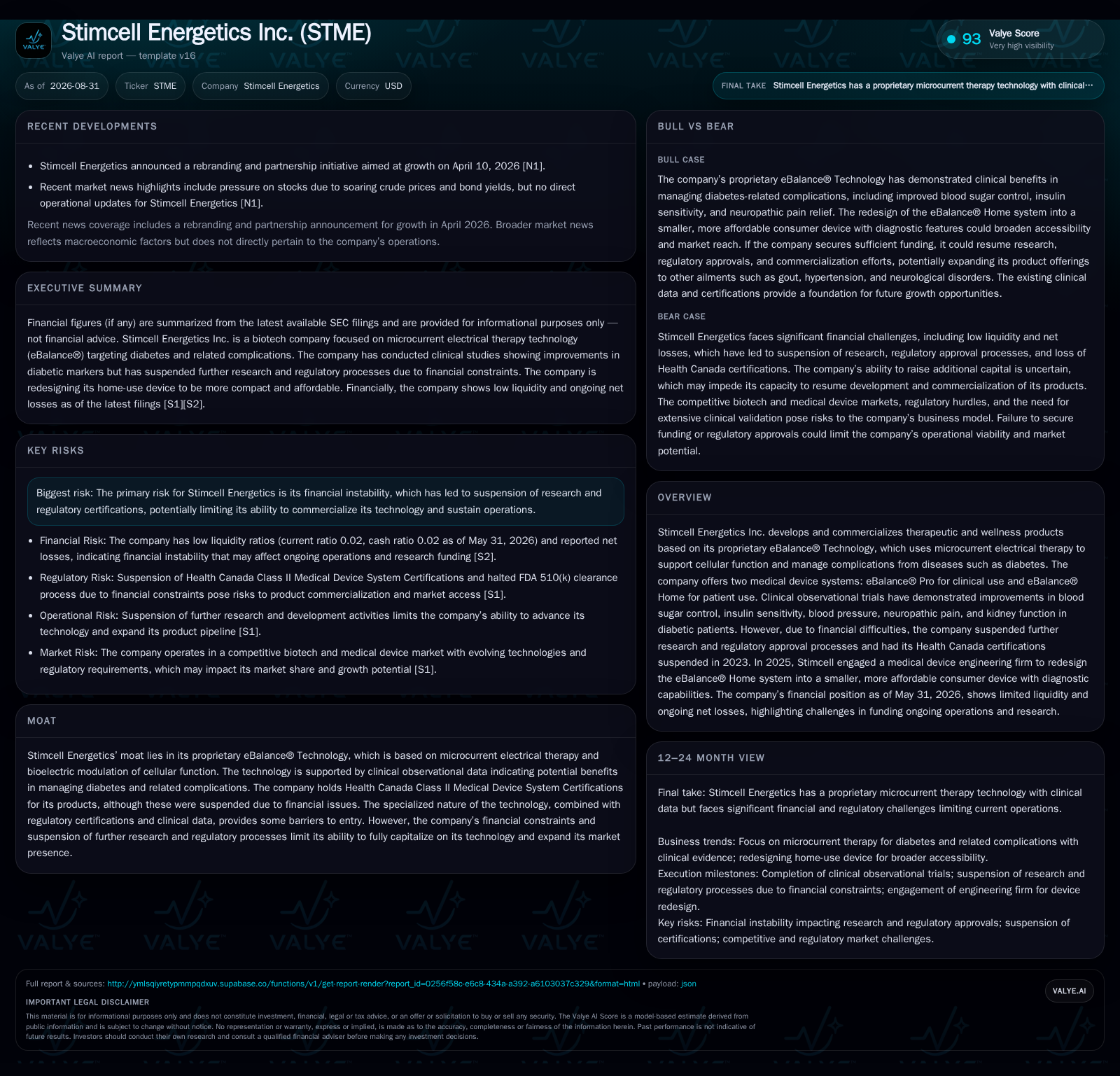
Stimcell Energetics offers innovative eBalance® Technology with clinical evidence supporting diabetic health improvements. However, pervasive financial distress has halted regulatory approval and research activities, suspended certifications, and pressured operations. The company’s redevelopment of its home-use device aims to broaden consumer appeal but requires successful funding and regulatory navigation. Competitive risks and capital scarcity create a challenging backdrop, with the value hinging on execution of funding, approvals, and market adoption in a capital-intensive, regulated biotech environment.
Stimcell Energetics Inc. operates in the challenging biotech-medical device interface, developing microcurrent electrical therapy products aimed at alleviating diabetes-related health issues. Despite promising clinical data demonstrating improved glycemic control and neuropathic pain relief, the company’s progress has been hampered by financial distress leading to suspended regulatory certifications and halted research efforts. A strategic pivot involves redesigning their eBalance® Home device into a smaller, more affordable consumer unit with diagnostics, aiming to unlock broader market appeal. The company’s future hinges on securing adequate funding, navigating complex regulatory pathways, and successfully commercializing its platform amid intense competition and stringent medical device standards.
Latest Operating Snapshot
Stimcell Energetics currently faces significant operational constraints stemming from financial distress. As of May 31, 2026, the company reported cash and equivalents of only $30,736 against current liabilities exceeding $1.86 million, resulting in a critically low current ratio and cash ratio of 0.02 each [S2]. This acute liquidity shortage has necessitated suspending research activities and the FDA 510(k) clearance process for its flagship eBalance® Technology [S1].
Regulatory setbacks have compounded operational difficulties. The company’s Health Canada Class II Medical Device System Certifications for both eBalance® Home and Pro products were suspended in June 2023 due to financial difficulties [S1]. Concurrently, the company has engaged an engineering firm to redesign the eBalance® Home device into a smaller, more affordable consumer unit with integrated diagnostics, aiming to revive its commercialization prospects [S1]. These developments underscore a bifurcation between promising technological innovations and constrained operational execution.
Business Model and Unit Economics
Stimcell Energetics’ business model centers on developing and commercializing medical devices based on proprietary eBalance® Technology, which delivers subsensory microcurrent electrical therapy intended to improve cellular function and mitigate diabetes-related complications. Revenue generation depends on device sales to healthcare professionals (eBalance® Pro) and consumers (eBalance® Home), potentially supported by recurring sales of consumables or service contracts if introduced. Pricing dynamics hinge on device cost, affordability, and perceived clinical efficacy.
The company’s capital intensity is elevated due to the need for ongoing clinical research, regulatory filings, and manufacturing scale-up. Fixed costs include R&D and regulatory compliance expenditures, while variable costs encompass device components and assembly. Operating leverage could emerge if commercial volumes scale and fixed costs are effectively absorbed. However, current financial constraints impede research and regulatory progress, undermining the pathway to achieving sufficient volumes. The ongoing device redesign targets cost reductions and broader market accessibility, which could improve unit economics if successfully implemented and accepted by users.
Moat, Competition and Counterforces
Stimcell Energetics’ moat is derived primarily from its proprietary eBalance® Technology platform, which utilizes microcurrent electrical therapy—a modality supported by clinical observational data signaling benefits in glycemic control, insulin sensitivity, and neuropathic pain management. Regulatory certifications, albeit currently suspended, and intellectual property around the microcurrent application provide some entry barriers against generic substitutes or non-validated therapies.
Nonetheless, the company confronts formidable counterforces. The biotech and medical device sectors are highly competitive and capital intensive, with numerous firms advancing alternative diabetes and neuropathy treatments, including pharmaceuticals, implantable devices, and other bioelectronic medicine platforms. Regulatory hurdles and the need for extensive clinical validation impose time and cost burdens. Furthermore, financial instability undermines Stimcell’s ability to maintain research momentum, retain talent, and execute commercialization. Thus, the moat’s sustainability depends on overcoming these execution and capital challenges while defending against technological substitution and competitor innovations.
Bull Case
In a favorable scenario, Stimcell Energetics successfully secures sufficient capital to resume research and regulatory approval processes, leveraging existing clinical data demonstrating meaningful improvements in diabetic markers such as fasting blood glucose, plasma insulin, and HbA1c [S1]. Completion and validation of further clinical trials could solidify the technology’s therapeutic credibility, accelerating FDA clearance and Health Canada re-certification.
The redesigned eBalance® Home device, smaller and more affordable with integrated diagnostics, could broaden patient adoption beyond clinical settings to the consumer market, driving scale and improving unit economics. Expansion of the product pipeline to address additional indications like hypertension and neuropathic disorders would diversify revenue streams. Confirming evidence would include successful regulatory milestones, positive post-redesign user feedback, and incremental revenue growth. Falsification would occur if funding remains elusive, clinical results fail to replicate, or regulatory barriers persist, stalling commercialization.
Base Case
The base case envisions a protracted recovery where Stimcell Energetics manages to partially stabilize finances through partnerships or modest capital raises, allowing limited resumption of research and regulatory engagement. Regulatory approvals are achieved but delayed, resulting in gradual reintroduction of the eBalance® Home and Pro devices into select markets following redesign completion.
Revenue growth is measured as market acceptance remains tentative amid competitive alternatives, and the company continues navigating regulatory and reimbursement complexities. Operating losses persist but narrow as fixed costs are managed and volumes increase slowly. Clinical innovation progresses incrementally without rapid expansion into new indications. Confirmation involves incremental regulatory progress, cautious revenue upticks, and manageable financing rounds; falsification includes renewed financial distress or failure to clear regulatory hurdles.
Bear Case
Under a negative scenario, Stimcell Energetics fails to secure sufficient funding to restart research or regulatory processes, resulting in permanent suspension of development for eBalance® Technology. The prolonged suspension of Health Canada certifications and halted FDA clearance effectively bar commercial sales, eroding customer and investor confidence.
Competitive advances by better-funded peers with alternative bioelectronic or pharmaceutical therapies further marginalize Stimcell’s value proposition. The redesigned home device fails to materialize or gain market traction due to inadequate resources or inferior performance. Confirming evidence includes persistent liquidity crises, regulatory denials, and competitor breakthroughs. Falsification would require unexpected capital infusion or breakthrough clinical and regulatory successes reversing the decline.
What Matters Next
Key performance indicators that will illuminate Stimcell Energetics’ trajectory include: (1) successful completion and publication of new clinical trials validating eBalance® Technology’s efficacy and safety; (2) progress in regulatory approvals, particularly FDA 510(k) clearance and Health Canada certification reinstatement; (3) milestones in the redesign and manufacturing readiness of the eBalance® Home consumer device; (4) capital raising events or strategic partnerships providing financial runway; (5) initial sales volumes and user adoption metrics post-product relaunch; (6) gross margin improvements signaling manufacturing and cost efficiencies; (7) R&D expenditure trends reflecting reinvestment in innovation; and (8) competitive landscape developments such as alternative therapy approvals or pricing shifts.
Disclosure of these metrics would enhance transparency regarding commercial viability and operational health. Their evolution will directly impact Stimcell’s ability to translate its proprietary technology into sustainable revenue growth while navigating the complexities inherent in medical device commercialization and diabetic care markets.
Disclaimer: This is research-only, informational analysis and not investment advice. It may include AI-generated interpretation and general industry context. Always verify important details using primary sources.

Comments