
Science Applications International Corp (SAIC) – Navigating Federal IT Services Amid Geopolitical and Fiscal Uncertainties
SAIC’s entrenched role as a federal IT and engineering contractor provides revenue resilience but faces margin pressure and execution risks amid shifting government budgets and macroeconomic volatility.
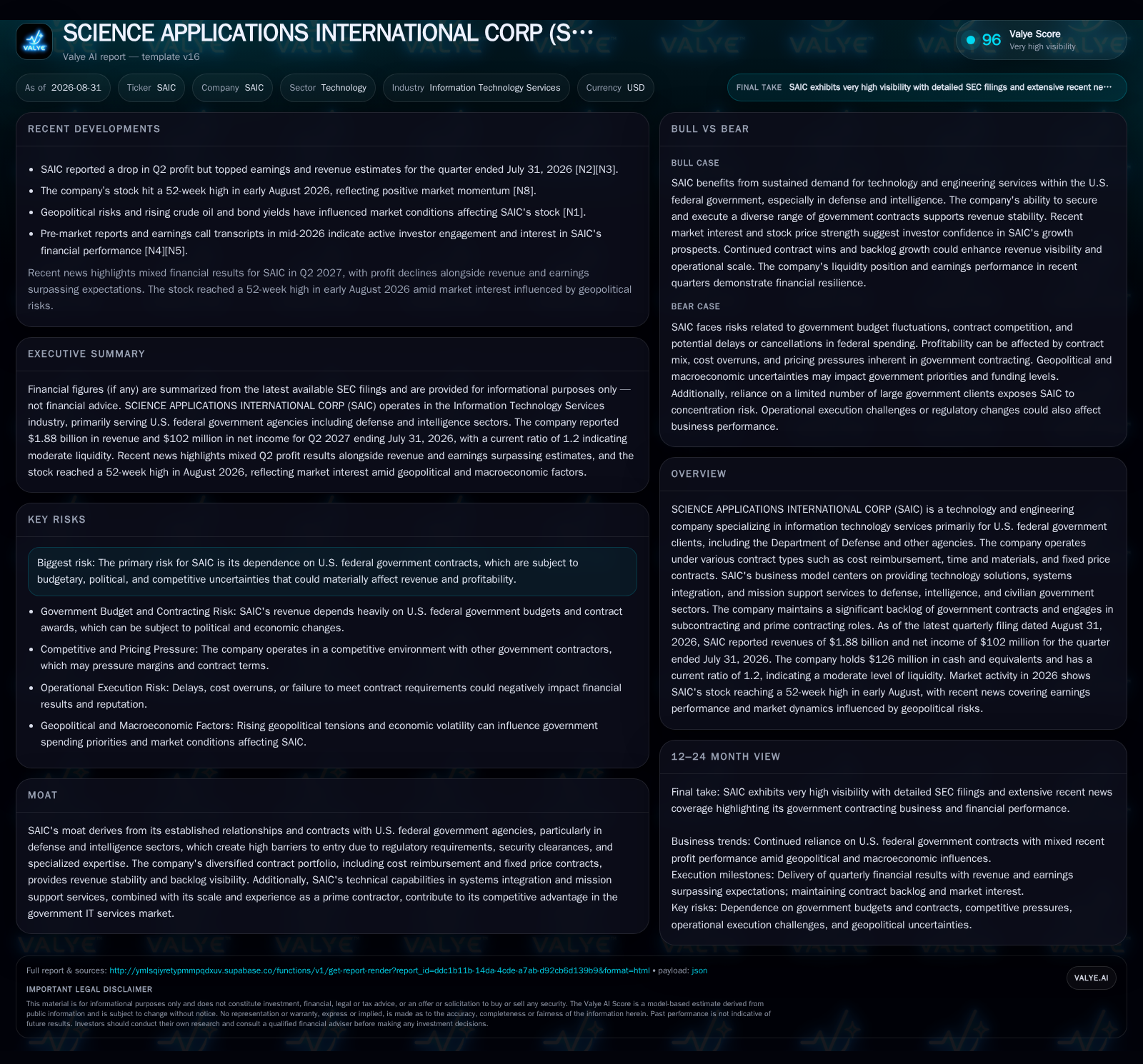
SAIC reported $1.88 billion revenue and $102 million net income for Q2 2027, reflecting robust top-line performance despite a profit decline. Operating primarily under U.S. federal government contracts, SAIC’s diversified contract types and technical capabilities underpin backlog stability. However, profitability remains sensitive to contract mix and execution challenges. The company’s moat stems from regulatory barriers and deep government relationships, but exposure to budget fluctuations and competitive pressures poses risks. Market interest remains strong, evidenced by a 52-week high stock price. Key near-term factors include contract awards, operating margins, backlog growth, and geopolitical developments.
Science Applications International Corporation (SAIC) operates at the intersection of technology and government services, delivering IT and engineering solutions primarily to U.S. federal agencies including defense, intelligence, and civilian sectors. For Q2 2027 ended July 31, 2026, SAIC reported $1.88 billion in revenue and $102 million net income, a solid top-line performance despite a profit decline. This financial snapshot underscores SAIC’s ability to navigate a complex contracting environment characterized by diverse contract types, geopolitical risk, and evolving federal spending priorities. SAIC’s stock reaching a 52-week high in early August 2026 signals investor confidence, yet the sustainability of growth and margin expansion depends on execution agility and government budget dynamics.
Latest Operating Snapshot
For the quarter ended July 31, 2026, SAIC posted revenues of $1.88 billion and net income of $102 million with diluted EPS of $2.38, exceeding consensus revenue and earnings estimates despite a decline in profit compared to prior periods [S2][N2][N3]. The company reported a current ratio of 1.2 and cash and equivalents of $126 million, indicating moderate liquidity to manage near-term obligations [S2].
Market activity showed SAIC’s stock hitting a 52-week high in early August 2026, reflecting positive investor sentiment amid ongoing geopolitical tensions and macroeconomic headwinds such as rising crude oil prices and bond yields that affect government spending and capital markets [N1][N8]. Additionally, active investor engagement is evident from multiple earnings call transcripts and pre-market reports in mid-2026, underscoring market focus on SAIC’s federal contract portfolio and execution [N4][N5].
Business Model and Unit Economics
SAIC generates revenue by providing information technology, systems integration, engineering, and mission support services primarily to U.S. federal government clients, including the Department of Defense and intelligence agencies. The company operates under varied contract forms—cost reimbursement, time and materials, and fixed price—each with distinct margin profiles and risk exposures. Cost reimbursement contracts offer lower margin but reduce cost risk, whereas fixed price contracts provide margin upside but expose SAIC to potential cost overruns.
Operating leverage for SAIC is moderate: while a sizeable portion of costs are labor-related and somewhat fixed due to security clearance and training requirements, fluctuations in contract mix and staffing levels influence margins. Capital intensity is relatively low, centered on skilled personnel rather than heavy plant or equipment, reducing asset intensity but heightening reliance on human capital. Profitability hinges on efficient project execution, contract pricing discipline, and backlog conversion, with potential leverage if growing backlog sustains higher margin contract wins.
Moat, Competition and Counterforces
SAIC’s moat largely stems from its entrenched relationships with U.S. federal agencies, underpinned by the complexity of regulatory compliance, stringent security clearances, and specialized technical expertise required for defense and intelligence projects. These factors create high barriers for new entrants and foster sticky client relationships. Additionally, SAIC’s mix of prime and subcontracting roles provides diversified access and scale advantages in bidding for large government programs.
Competitive pressure originates from other established federal contractors such as Leidos, Booz Allen Hamilton, and CACI, which compete aggressively on pricing, technical capabilities, and contract scope. Pricing pressure can erode margins, especially on fixed-price engagements. Furthermore, government budget uncertainties and shifting priorities could intensify competition for a finite pool of contracts. Technological evolution and potential shifts toward commercial cloud and IT providers could also disrupt traditional government IT contracting models, challenging SAIC’s competitive positioning.
Bull Case
In a bullish scenario, SAIC continues to capitalize on sustained and potentially growing federal IT and defense spending driven by strategic geopolitical imperatives, including modernization of defense systems and increasing cybersecurity investments. Continued success in securing a diversified mix of contracts—balancing cost reimbursement and higher-margin fixed-price jobs—would enhance revenue visibility and margin expansion. The company’s backlog growth and operational scale could create meaningful operating leverage, improving profitability.
Investor confidence, as reflected in recent stock price strength, would be justified by steady contract awards, successful project execution, and controlled costs. Favorable macro conditions, such as stable government budgets and moderated geopolitical tensions, would reduce risk premiums and support valuation expansion. Confirmation of this scenario would include sustained backlog growth, margin improvement, and consecutive quarters of earnings beats. Conversely, failure to sustain contract wins or margin improvements would falsify this optimistic outlook.
Base Case
The base case envisions SAIC maintaining steady revenue growth reflective of continued federal IT and defense spending but with ongoing margin pressure due to competitive pricing and contract mix shifts. Revenue stability arises from a broad contract portfolio and established government relationships, but profitability faces headwinds from cost inflation, project execution complexity, and cautious government budgets.
The company’s liquidity and moderate leverage provide operational flexibility but limit aggressive investment or acquisition strategies. Market valuation will likely reflect a risk-adjusted view balancing stable revenue streams against margin volatility and geopolitical uncertainties. Key dynamics include modest backlog growth, flat to slightly improving margins, and consistent but unspectacular earnings performance. Disconfirming evidence would be a sudden surge in government spending or breakthrough contract wins lifting margins significantly.
Bear Case
In a downside scenario, SAIC suffers from deteriorating government budgets driven by political shifts or economic constraints, leading to contract cancellations, reduced awards, or delayed spending. Increased competition intensifies pricing pressure, compressing margins further. Operational challenges such as cost overruns, compliance issues, or failure to meet contract deliverables could damage reputation and financial results.
Geopolitical turmoil and macroeconomic volatility could exacerbate risk aversion in federal procurement, constraining SAIC’s opportunities. Concentration in a limited number of large government clients exposes SAIC to disproportionate risk if these clients reduce spending. Confirmation would be visible through shrinking backlog, declining margins, consecutive quarters of profit erosion, and negative cash flow trends. Conversely, resilience in contract awards or margin stabilization would falsify the bear thesis.
What Matters Next
Key performance indicators to monitor include quarterly revenue growth and margin trends to assess operating leverage and cost management. Backlog size and composition provide insight into future revenue visibility and contract mix dynamics, crucial for projecting profitability. Contract win rates and the pipeline quality serve as leading indicators for growth potential and competitive positioning.
Cash flow generation and liquidity metrics will reveal potential financial flexibility amid investment or cyclical pressures. Monitoring government budget appropriations and defense spending policies offers context for demand sustainability. Finally, tracking geopolitical developments and macroeconomic indicators such as bond yields and crude oil prices will help anticipate external risks influencing government contracting behavior.
Disclaimer: This is research-only, informational analysis and not investment advice. It may include AI-generated interpretation and general industry context. Always verify important details using primary sources.

Comments