
Sasol Ltd: Integrated Energy and Chemicals with Proprietary Tech Amid Regulatory Headwinds
Sasol operates integrated coal- and gas-based value chains producing fuels and chemicals worldwide, leveraging proprietary Fischer-Tropsch technology and strategic joint ventures. Facing regulatory and market challenges, the company’s future hinges on technology-driven innovation, operational efficiency, and navigating complex legal environments.
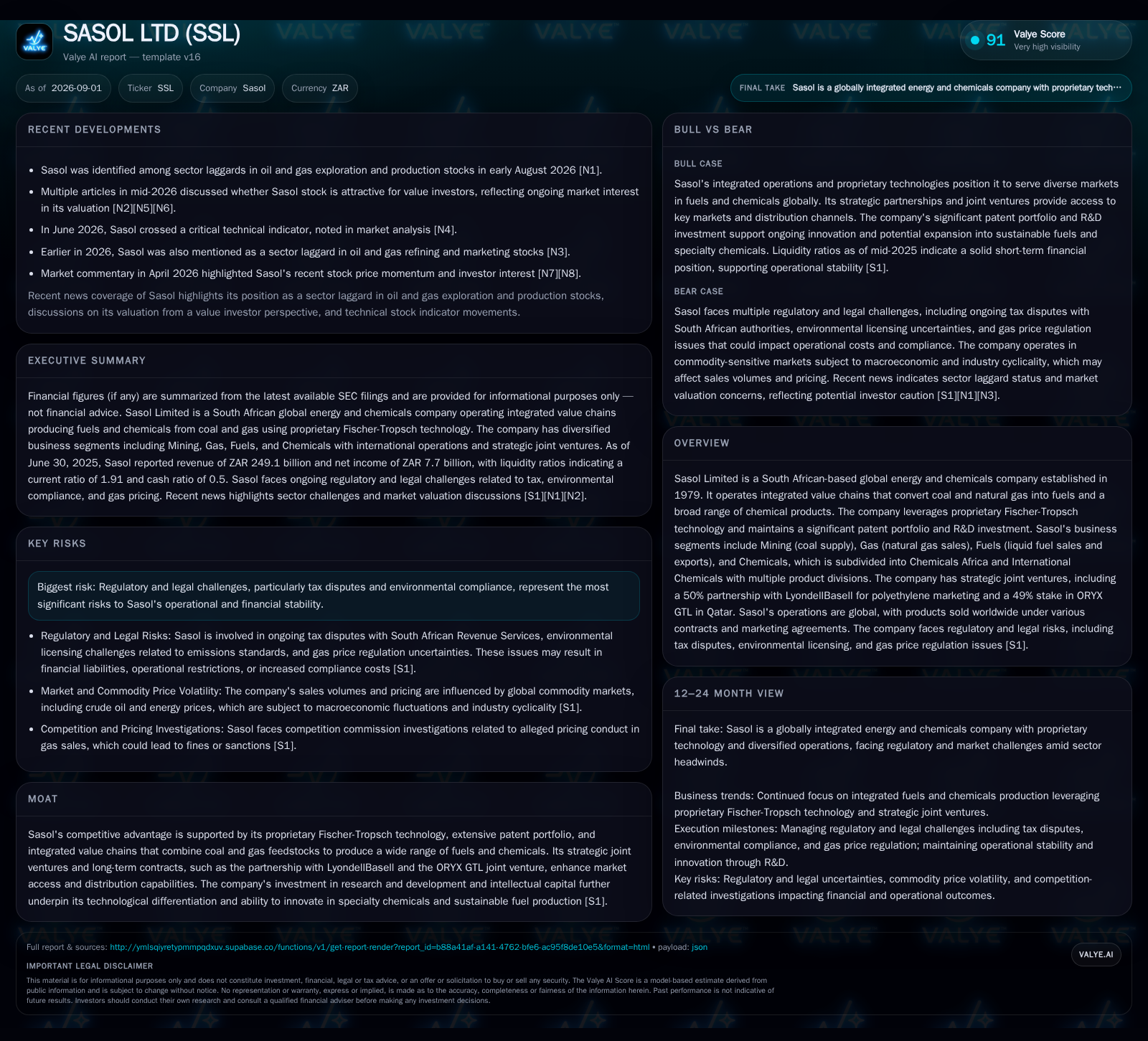
Sasol is a South African global energy and chemicals company with integrated operations converting coal and natural gas into fuels and chemicals using proprietary Fischer-Tropsch technology. The company’s diversified business segments and significant patent portfolio underpin its technological moat, while strategic joint ventures enhance market access. However, ongoing regulatory and legal challenges, commodity price exposure, and sector valuation pressures pose material risks. Sasol’s ability to leverage R&D for specialty chemicals and sustainable fuels development, maintain operational leverage, and manage regulatory uncertainties will shape its medium-term trajectory.
Sasol Limited is a South African-headquartered global energy and chemicals company established in 1979, operating integrated value chains that convert coal and natural gas into a broad portfolio of fuels and chemical products. The company leverages proprietary Fischer-Tropsch technology and maintains a substantial patent portfolio, supported by strategic joint ventures such as those with LyondellBasell and ORYX GTL. Despite solid revenue and liquidity metrics as of mid-2025, Sasol confronts considerable regulatory and legal challenges, including tax disputes and environmental compliance issues, which pose risks to operational stability. Its future trajectory will depend on balancing capital-intensive operations, innovation-driven growth, and navigating complex regulatory landscapes in a volatile commodity environment.
Latest Operating Snapshot
As of June 30, 2025, Sasol reported revenue of ZAR 249.1 billion and net income of ZAR 7.7 billion, reflecting continued scale in its integrated energy and chemicals operations [S1]. Liquidity was supported by cash and equivalents totaling ZAR 41.05 billion and short-term investments of ZAR 5.62 billion, yielding a current ratio of 1.91, indicating reasonable short-term potential financial flexibility [S1].
Strategically, Sasol operates through four segments: Mining (coal supply), Gas (natural gas sales), Fuels (domestic and export liquid fuel sales), and Chemicals (split between Africa and International operations) [S1]. The company’s proprietary Fischer-Tropsch process underpins its conversion of coal and gas feedstocks into diverse fuels and chemicals, with a patent portfolio exceeding 2,100 active patents and annual R&D spending above R1.5 billion [S1].
Recent market commentary highlights Sasol as a sector laggard within oil and gas exploration and production stocks due to valuation concerns and technical stock indicators, underscoring investor caution amid macro and sector challenges [N1][N3][N4]. Ongoing regulatory and legal risks including tax disputes with South African authorities and environmental licensing uncertainties remain material operational headwinds [S1].
Business Model and Unit Economics
Sasol’s business model centers on integrated value chains that convert coal and natural gas into fuels and chemicals leveraging proprietary Fischer-Tropsch (FT) technology. Revenue generation depends on sales volumes of fuels, polymers, fertilizers, and specialty chemicals across domestic and international markets, with pricing influenced by global commodity markets and contract terms [S1]. The company's joint ventures, such as with LyondellBasell for polyethylene marketing and ORYX GTL for gas-to-liquids production, extend market access and distribution capabilities.
Economically, Sasol operates capital-intensive assets requiring substantial fixed investments, such as FT synthesis plants and mining operations. Operating leverage emerges from scale efficiencies in integrated production; however, variable costs remain significant given feedstock procurement and energy consumption. Pricing power is constrained by commodity market volatility and regulatory pricing controls, particularly in gas sales segments. The company’s R&D investment supports product innovation that can improve margin profiles through specialty chemicals and sustainable fuels, potentially shifting the revenue mix toward higher value-added products and enhancing operating margins.
Moat, Competition and Counterforces
Sasol’s moat derives primarily from its proprietary Fischer-Tropsch technology and extensive patent portfolio, which provide technological barriers to entry in coal- and gas-to-liquids conversion and specialty chemical production. The integrated nature of its value chains—combining coal supply, gas processing, fuels, and chemicals—creates operational synergies that are difficult to replicate. Strategic joint ventures, notably the partnership with LyondellBasell and the ORYX GTL JV in Qatar, enhance distribution reach and market penetration, reinforcing competitive positioning.
Countervailing forces include regulatory scrutiny, particularly tax and environmental compliance risks, which could constrain operational flexibility or impose financial penalties. Commodity price volatility affects feedstock costs and product pricing, limiting margin stability. Competition arises from global energy and chemical companies with alternative feedstocks and technologies, such as oil-refining majors and petrochemical producers adopting bio-based or renewable feedstocks. Additionally, increasing environmental regulation and the transition to sustainable fuels pose substitution risks to conventional coal and gas-based products.
Bull Case
In a bull scenario, Sasol leverages its proprietary Fischer-Tropsch technology and substantial patent portfolio to expand its specialty chemicals and sustainable fuels offerings, capturing higher-margin niches less sensitive to commodity cycles. Strategic joint ventures provide stable market access and distribution channels, while ongoing R&D investments enable product innovation that drives pricing power and customer retention. Operational efficiencies from integrated value chains and scale economies improve cost competitiveness and drive operating leverage.
Confirming evidence would include sustained revenue growth in specialty chemical segments, successful commercialization of sustainable fuel products, stable or improving operating margins, and resolution or mitigation of regulatory and legal challenges without material financial impact. Increased renewables or low-carbon product sales and expanding joint venture contributions would further validate this pathway. A falsification test would be failure to commercialize new products, persistent margin compression due to feedstock or regulatory costs, or worsening regulatory sanctions undermining profitability.
Base Case
Under the base case, Sasol maintains its integrated coal- and gas-based operations with steady but modest revenue growth aligned with global energy demand trends. The company manages regulatory and legal risks through negotiated settlements and compliance investments, avoiding significant disruptions or fines. Commodity price volatility leads to earnings fluctuations, but diversified product mix and joint ventures provide some revenue stability.
Operating leverage is moderate, with capital expenditures largely offset by operational efficiencies and incremental R&D-driven innovation. The firm sustains its market position through its technological advantages and joint ventures but faces ongoing competitive pressures from alternative feedstocks and tightening environmental regulations. Stock market valuation remains subdued due to sector cyclicality and regulatory uncertainty, attracting selective value-oriented investors. Key metrics such as margins, cash flow, and debt levels remain stable but without significant improvement.
Bear Case
In the downside scenario, Sasol’s business suffers from unresolved regulatory and legal challenges that result in costly penalties, operational restrictions, or increased compliance expenditures, eroding profitability. Tax disputes with South African authorities escalate, and environmental licensing delays or sanctions restrict production capacity or increase capital intensity. Gas price regulation uncertainty leads to revenue and margin volatility in the Gas segment.
Simultaneously, commodity price declines or sustained volatility depress product pricing and sales volumes. Competition intensifies as alternative technologies erode demand for coal- and gas-based fuels and chemicals, compressing Sasol’s market share and pricing power. Failure to innovate or successfully commercialize sustainable products leaves Sasol exposed to sector transition risks. Confirming evidence includes margin contraction, increased debt or liquidity strain, regulatory fines, or loss of key customers. A reversal in regulatory pressures or successful product innovation would falsify this bear case.
What Matters Next
Key performance indicators to monitor include segment revenue growth and margin trends in Fuels and Chemicals, especially specialty and sustainable product lines, to assess progress on product mix transformation. Regulatory developments are critical, particularly resolution of tax disputes, progress on environmental licensing, and outcomes of competition commission investigations related to gas pricing and pricing conduct.
Operational metrics such as capital expenditure efficiency, operating cash flow generation, and joint venture performance (notably the LyondellBasell and ORYX GTL partnerships) will indicate operational leverage and market access sustainability. Research and development outcomes, measured by new product launches, patent filings, and commercial-scale sustainable fuel projects, serve as leading indicators of innovation-driven growth potential. Finally, commodity price trends and macroeconomic factors affecting feedstock costs and product demand will materially influence financial outcomes.
Disclaimer: This is research-only, informational analysis and not investment advice. It may include AI-generated interpretation and general industry context. Always verify important details using primary sources.

Comments