
Agilent Technologies, Inc. (A) Comprehensive Business and Equity Analysis
A detailed analysis of Agilent Technologies' business model, competitive positioning, and financial outlook, integrating recent developments and structural industry forces shaping its growth and risks.
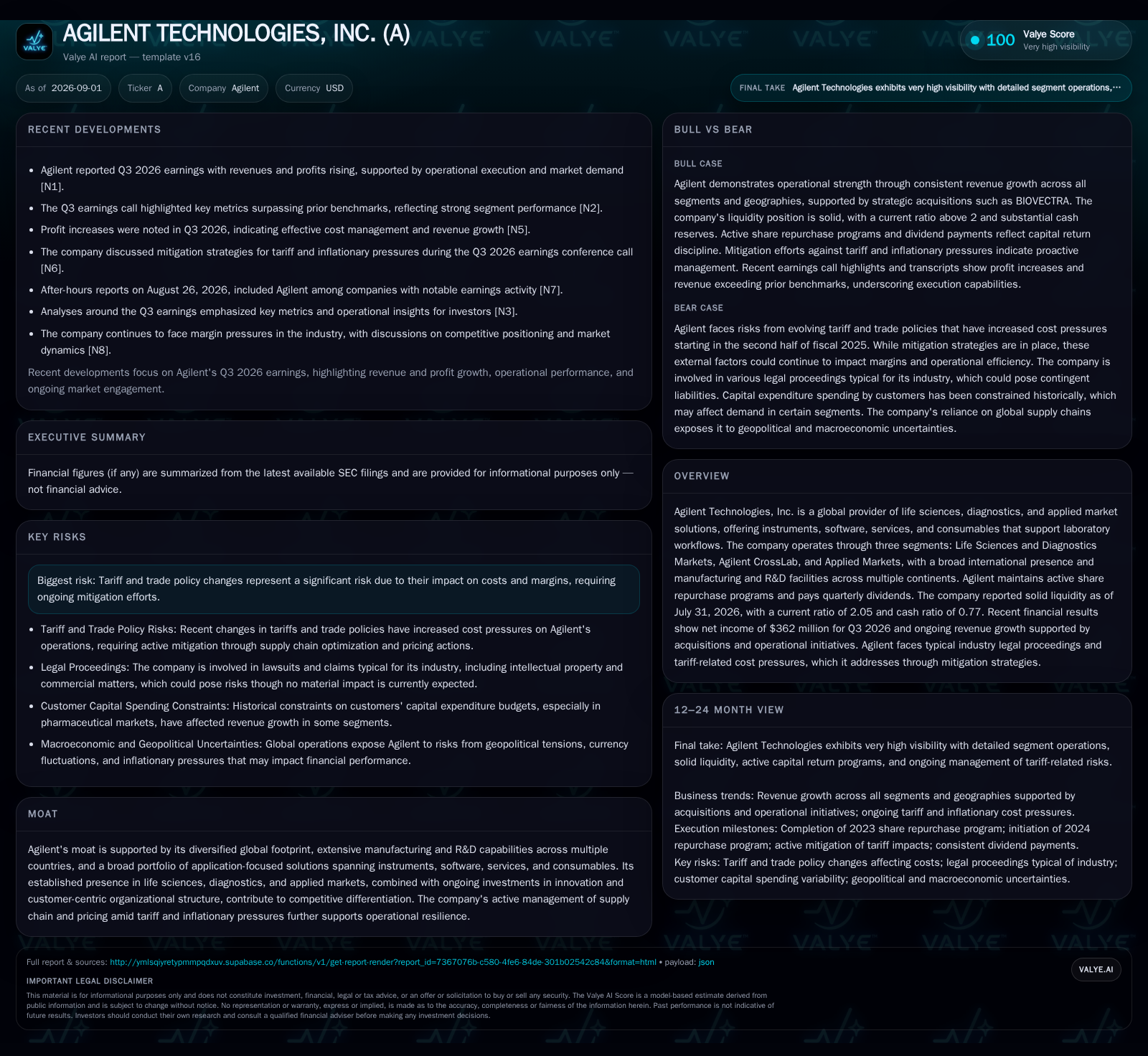
Agilent Technologies leverages a diversified global footprint and broad life sciences and applied markets portfolio to deliver steady revenue growth supported by strategic acquisitions and operational discipline. While tariff and inflationary pressures pose margin risks, proactive mitigation and solid liquidity underpin resilience. The company’s mix of instruments, software, services, and consumables, combined with ongoing R&D investments, fosters a sustainable competitive position. Key challenges include geopolitical uncertainties, customer capital spending variability, and legal exposures. The investment thesis weighs robust execution and capital returns against external cost headwinds and sector cyclicality.
Agilent Technologies stands as a critical supplier to life sciences and applied markets, delivering instruments, software, services, and consumables that address complex laboratory workflows worldwide. Recent quarterly results demonstrate continued revenue and profit growth, supported by operational execution and strategic acquisitions amid challenging macroeconomic conditions. The company’s diversified global footprint and broad product portfolio provide resilience against cost pressures from tariffs and inflation. However, navigating ongoing geopolitical uncertainties, capital spending cyclicality, and industry-typical legal risks will be essential to sustaining growth and margin expansion. This analysis explores Agilent’s business economics, competitive dynamics, and plausible future trajectories in the evolving scientific instruments landscape.
Latest Operating Snapshot
In Q3 2026, Agilent reported net income of $362 million and basic and diluted EPS of $1.28, driven by revenue and profit increases across all segments and geographic regions [N1][N5]. This reflects strong operational execution in a complex macro environment. The BIOVECTRA acquisition contributed to revenue growth, indicating successful strategic expansion [S1].
The company faces tariff and inflationary pressures that emerged in the second half of fiscal 2025 but actively manages these through supply chain optimization and pricing strategies [N6]. Liquidity remains robust, with $1.758 billion in cash and cash equivalents and a current ratio of 2.05 as of July 31, 2026, supporting potential financial flexibility [S1]. Active capital return via share repurchases and dividends continues, highlighting management’s capital discipline [S1].
Business Model and Unit Economics
Agilent’s revenue derives from a diversified portfolio comprising instruments, software, services, and consumables tailored to life sciences, diagnostics, and applied markets. The mix of products includes high-value capital equipment and recurrent consumables and service revenues. This blend provides a degree of revenue stability, with consumables and services generating recurring volume and margin streams that complement more lumpy instrument sales [S1].
The company operates globally with extensive manufacturing and R&D facilities across multiple continents, implying significant fixed capital investments and ongoing innovation expenses. Operating leverage emerges by spreading fixed costs over growing volumes and expanding higher-margin software and service contracts. However, tariff-related cost increases and inflation can compress margins if not fully offset by pricing. Capital intensity and complexity in supply chains require agile management to sustain profitability and growth [S1][N6].
Moat, Competition and Counterforces
Agilent’s competitive moat is supported by its integrated product portfolio spanning instruments, software, services, and consumables, enabling end-to-end solutions for laboratory workflows. The company’s global footprint with manufacturing and R&D in multiple countries facilitates proximity to key markets and innovation adaptability. Customer switching costs arise from integrated workflows and service contracts, which can enhance retention and pricing power [S1].
Nonetheless, the industry faces competitive pressures from peers offering specialized or lower-cost alternatives, and disruption risks from technological substitution or evolving customer preferences. Tariff and inflationary cost pressures challenge margin sustainability, while geopolitical tensions and fluctuating capital spending by customers introduce uncertainty. The company’s ability to innovate and maintain supply chain resilience will be pivotal in defending its position [N8][S1].
Bull Case
In the bull scenario, Agilent continues to leverage its diversified global presence and broad portfolio to capture expanding demand in life sciences, diagnostics, and applied markets. Strategic acquisitions like BIOVECTRA enhance product breadth and cross-selling opportunities, fueling above-market revenue growth. Effective mitigation of tariff and inflationary pressures through pricing and supply chain optimization preserves or improves margins, amplifying operating leverage.
Consistent free cash flow generation supports sustained capital returns via share repurchases and dividends, reinforcing investor confidence. Validation comes from ongoing revenue and profit growth surpassing estimates, reported liquidity position metrics, and management’s successful navigation of external risks. Falsification would occur if revenue growth stalls, margin compression deepens despite mitigation, or competitive disruptions erode market share [N1][N5][S1].
Base Case
The base case envisions steady growth aligned with historical trends, driven by balanced contributions from all segments and geographies. Tariff and inflationary pressures persist but are managed without significant margin deterioration, resulting in moderate operating leverage gains. The company maintains investment in R&D and capital expenditures to sustain innovation and operational capacity.
Capital return programs continue, reflecting stable cash flow generation, but external uncertainties such as geopolitical risks and customer capital spending variability temper upside potential. Revenue growth moderates with some cyclicality in customer demand, while ongoing legal proceedings remain manageable without material financial impact. This scenario assumes competitive dynamics remain stable without disruptive technological shifts [S1][N6].
Bear Case
Under a bear case, escalating tariff and trade policy changes exacerbate cost pressures beyond mitigation capacity, squeezing margins and eroding profitability. Supply chain disruptions and inflationary spikes increase operational complexity and capital spending requirements. Customer capital budgets contract more sharply, particularly in pharmaceutical and applied markets, reducing demand for capital equipment and associated consumables.
Legal risks materialize into significant liabilities, or geopolitical tensions disrupt global operations and supply chains. Competitive erosion intensifies as rivals capitalize on technological innovation or price advantages, leading to market share loss. Indicators that would falsify this scenario include successful margin recovery despite tariffs, stable or growing capital spending, and contained legal exposures [S1][N8].
What Matters Next
Key performance indicators to monitor include segment revenue growth rates and geographic contributions to detect shifts in demand patterns. Margin trends, particularly gross and operating margins, will reveal the effectiveness of tariff and inflation mitigation strategies. Cash flow from operations and free cash flow generation provide insight into capital return sustainability and investment capacity.
R&D spending levels and product pipeline progress are useful metrics for assessing innovation momentum. Customer capital expenditure trends, though not always disclosed, are critical for forecasting demand in capital equipment segments. Legal proceedings updates and geopolitical developments must be tracked for potential risk materialization. Finally, management commentary on supply chain resilience and pricing power will inform competitive positioning.
Disclaimer: This is research-only, informational analysis and not investment advice. It may include AI-generated interpretation and general industry context. Always verify important details using primary sources.

Comments