
Sportsman's Warehouse Holdings, Inc. (SPWH) — Navigating Operational Challenges in Outdoor Retail
Sportsman's Warehouse continues to generate substantial revenue within its outdoor sporting goods niche but faces persistent net losses, liquidity constraints, and ongoing legal and cybersecurity risks. This analysis explores the company's business model economics, competitive positioning, and plausible future trajectories amid a challenging retail environment.
Sportsman's Warehouse operates as a specialized outdoor sporting goods retailer with meaningful revenue but recent quarters marked by net losses and constrained cash liquidity. Its business model centers on seasonal retail volume and product mix, with limited disclosed scale advantages or proprietary assets. Key risks include ongoing legal proceedings and cybersecurity threats, which require vigilant management. The company’s future hinges on improving profitability through operational leverage, sustaining customer loyalty in a niche segment, managing cost structure, and navigating competitive pressures from generalist and specialty retailers. Monitoring revenue quality, margin trends, and liquidity will be crucial to assess recovery potential.
Sportsman's Warehouse Holdings, Inc. operates within the outdoor sporting goods retail sector, generating significant quarterly revenue yet struggling with consistent profitability. The company’s recent results reveal net losses alongside limited cash liquidity, emphasizing the challenges inherent in retailing seasonal and discretionary products. While management actively engages in cybersecurity risk mitigation and legal oversight, ongoing legal uncertainties and competitive pressures persist. This analysis delves beyond headline figures to examine the company's underlying business economics, competitive moat, and strategic pathways, identifying critical performance levers and risks shaping its medium-term outlook.
Latest Operating Snapshot
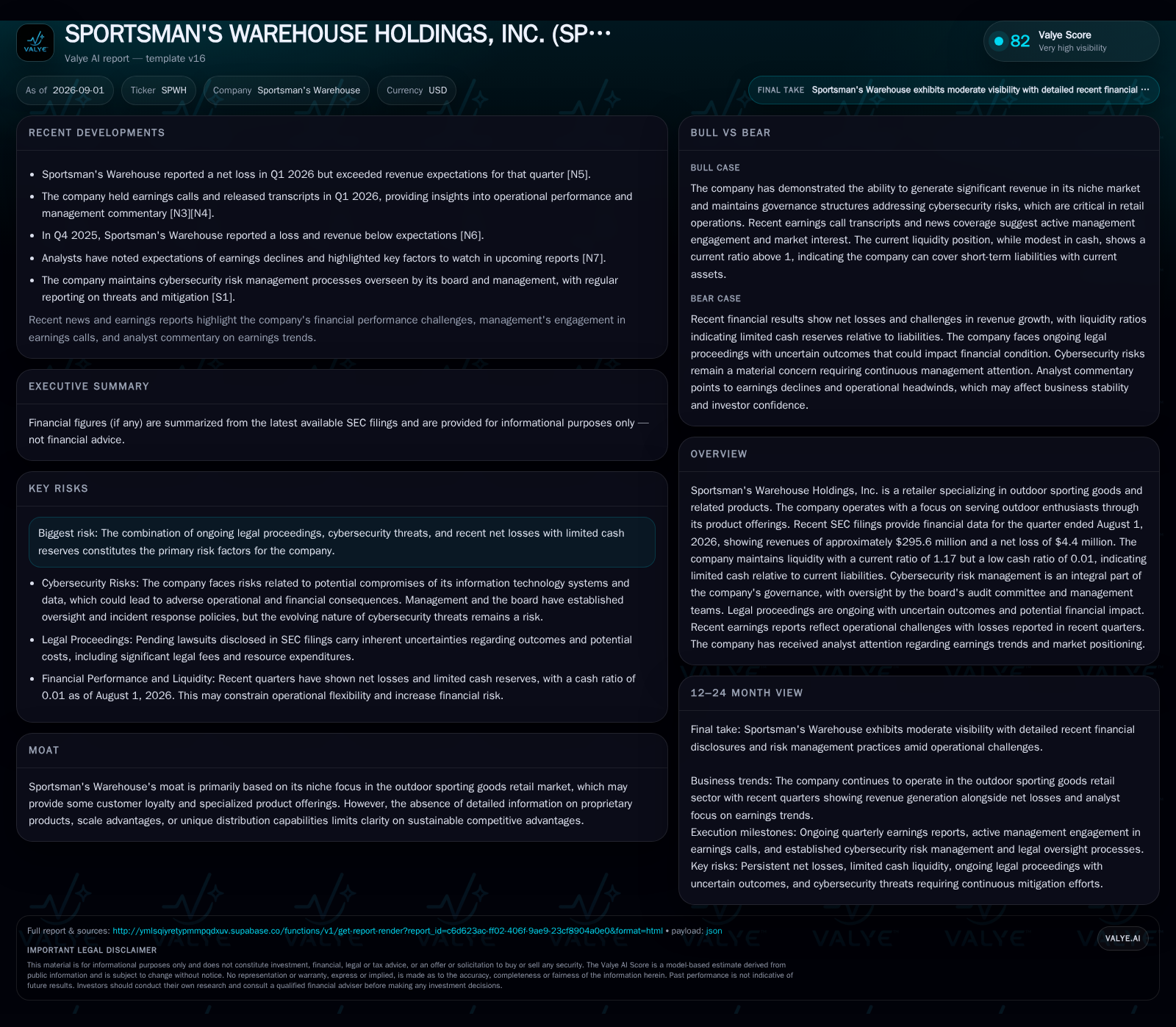
In the quarter ended August 1, 2026, Sportsman's Warehouse reported revenues of approximately $295.6 million but incurred a net loss of $4.4 million, translating to a negative $0.11 earnings per share [S2]. This juxtaposition of solid top-line performance coupled with a bottom-line deficit underscores challenges in cost control or margin compression. The current ratio of 1.17 indicates that the company’s current assets slightly exceed current liabilities, suggesting moderate short-term financial stability; however, a cash ratio of 0.01 reveals a very low level of cash on hand relative to liabilities, constraining operational flexibility and possibly increasing reliance on receivables or inventory to fund working capital needs [S2].
Governance around cybersecurity risks has been formalized, with the board’s audit committee and management overseeing risk management and incident response policies. This focus is significant given the retail sector’s increasing vulnerability to data breaches and operational disruptions [S1]. Meanwhile, unresolved legal proceedings disclosed in filings introduce financial and reputational uncertainties that could impose additional costs or distract management [S1]. Recent analyst commentary points to earnings declines and operational headwinds, reflecting market skepticism about near-term profitability and growth dynamics [N7].
Business Model and Unit Economics
Sportsman's Warehouse generates revenue primarily through the sale of outdoor sporting goods and related products, targeting outdoor enthusiasts. The business model relies on retail volume driven by seasonal demand and product mix, which can be influenced by weather, economic conditions, and consumer discretionary spending. Pricing power is likely modest given competitive pressures and the commoditized nature of many outdoor accessories and apparel items. The company’s revenue predominately depends on physical store sales complemented by online channels, with inventory management and supply chain efficiency critical to margin performance.
Operating leverage appears constrained by a fixed cost structure common in retail, including store leases, labor, and distribution expenses. While higher sales volume could improve gross margins by diluting fixed costs, persistent net losses suggest current sales levels are insufficient to cover overhead. Capital needs include inventory procurement and maintaining retail locations, which involve moderate capital intensity. The low cash ratio signals limited liquidity buffer to absorb shocks or invest aggressively. Achieving operating leverage will depend on scaling sales efficiently, optimizing product mix towards higher-margin items, controlling SG&A expenses, and improving stock turnover.
Moat, Competition and Counterforces
Sportsman's Warehouse’s moat is rooted in niche specialization within the outdoor sporting goods retail segment, potentially fostering customer loyalty through tailored product assortments and brand affinity among outdoor enthusiasts. This focus may limit direct competition to generalist retailers and large sporting goods chains that cater to broader markets. Nonetheless, absence of disclosed proprietary products, exclusive supplier relationships, or significant scale advantages dilutes the durability of this competitive edge. The retail sector’s inherently low switching costs and price sensitivity further challenge the company’s ability to sustain pricing power.
Competitive pressures arise from both brick-and-mortar and e-commerce players, including specialty retailers and mass merchants with diversified offerings. Larger competitors may leverage scale for better purchasing terms, broader product variety, and advanced digital capabilities. The evolving consumer preference towards online shopping necessitates ongoing investment in e-commerce and omnichannel integration, which could strain resources. Counterforces to moat expansion include rising operational costs, inventory risks, and potential market saturation in the niche segment.
Bull Case
A positive scenario envisions Sportsman's Warehouse successfully leveraging its niche focus to deepen customer loyalty and improve same-store sales through enhanced merchandising, targeted marketing, and e-commerce growth. Demonstrated ability to generate nearly $300 million quarterly revenue signals meaningful market demand that, if combined with operational improvements, could translate into profitability. Efficient inventory management and cost discipline might unlock operating leverage, turning modest revenue gains into improved margins. The company’s formal cybersecurity governance reduces operational risk and builds trust in digital channels, supporting omnichannel expansion.
Confirming evidence would include sequential revenue growth with expanding gross margins, reduction in SG&A as a percentage of sales, and positive cash flow generation. Successful resolution or favorable outcomes in legal proceedings would alleviate overhangs. Conversely, failure to improve profitability despite stable revenues, increasing legal costs, or deteriorating liquidity would falsify this scenario.
Base Case
The base case anticipates continued revenue generation around current levels with persistent net losses, reflecting ongoing challenges in cost management and competitive pressures. The company maintains moderate liquidity but faces limited cash reserves, requiring careful working capital management. Cybersecurity risk oversight continues without major incidents, but legal uncertainties persist without resolution. The outdoor retail market remains stable but competitive, limiting pricing power and margin expansion.
This scenario presumes incremental operational adjustments rather than transformative change, with earnings volatility linked to seasonal factors and economic cycles. Management engagement in earnings calls and analyst dialogue supports transparency but does not yet translate into sustained profitability. Key falsification would be either a sharp recovery in profitability or a material deterioration in revenue or liquidity beyond projections.
Bear Case
The downside scenario features deteriorating revenue amid intensified competition and weakening consumer demand, leading to widening losses and cash flow deficits. Limited cash reserves constrain the ability to invest in marketing, e-commerce capabilities, or inventory optimization, creating a negative feedback loop. Escalating legal costs or adverse judgments impose additional financial strain, while any cybersecurity breach could damage reputation and result in costly remediation. These factors undermine investor confidence and operational stability.
Confirming evidence includes consecutive quarters of declining revenue, margin compression, increased borrowing or liquidity pressures, and negative developments in legal proceedings. Conversely, stabilization or improvement in these metrics would challenge this bear thesis.
What Matters Next
Key performance indicators to monitor include quarterly revenue trends, particularly same-store sales growth and online channel performance, which indicate customer engagement and market traction. Gross margin movements and SG&A expense ratios will reveal operating leverage and cost control effectiveness. Cash flow from operations and cash ratio changes will signal liquidity health and potential financial flexibility. Updates on legal proceedings, including any settlements or rulings, are critical for assessing contingent liabilities. Cybersecurity incident reports or risk management enhancements provide insight into operational risk mitigation. Finally, management commentary on strategic initiatives and capital allocation in upcoming earnings calls will offer clues on the company’s ability to navigate competitive and market challenges.
Disclaimer: This is research-only, informational analysis and not investment advice. It may include AI-generated interpretation and general industry context. Always verify important details using primary sources.

Comments