
Yext, Inc. (YEXT) Company Analysis as of September 2026
Yext operates a digital presence platform integrating AI-driven search and a broad publisher network, facing strategic inflection between sustaining profitability and navigating competitive and regulatory challenges.
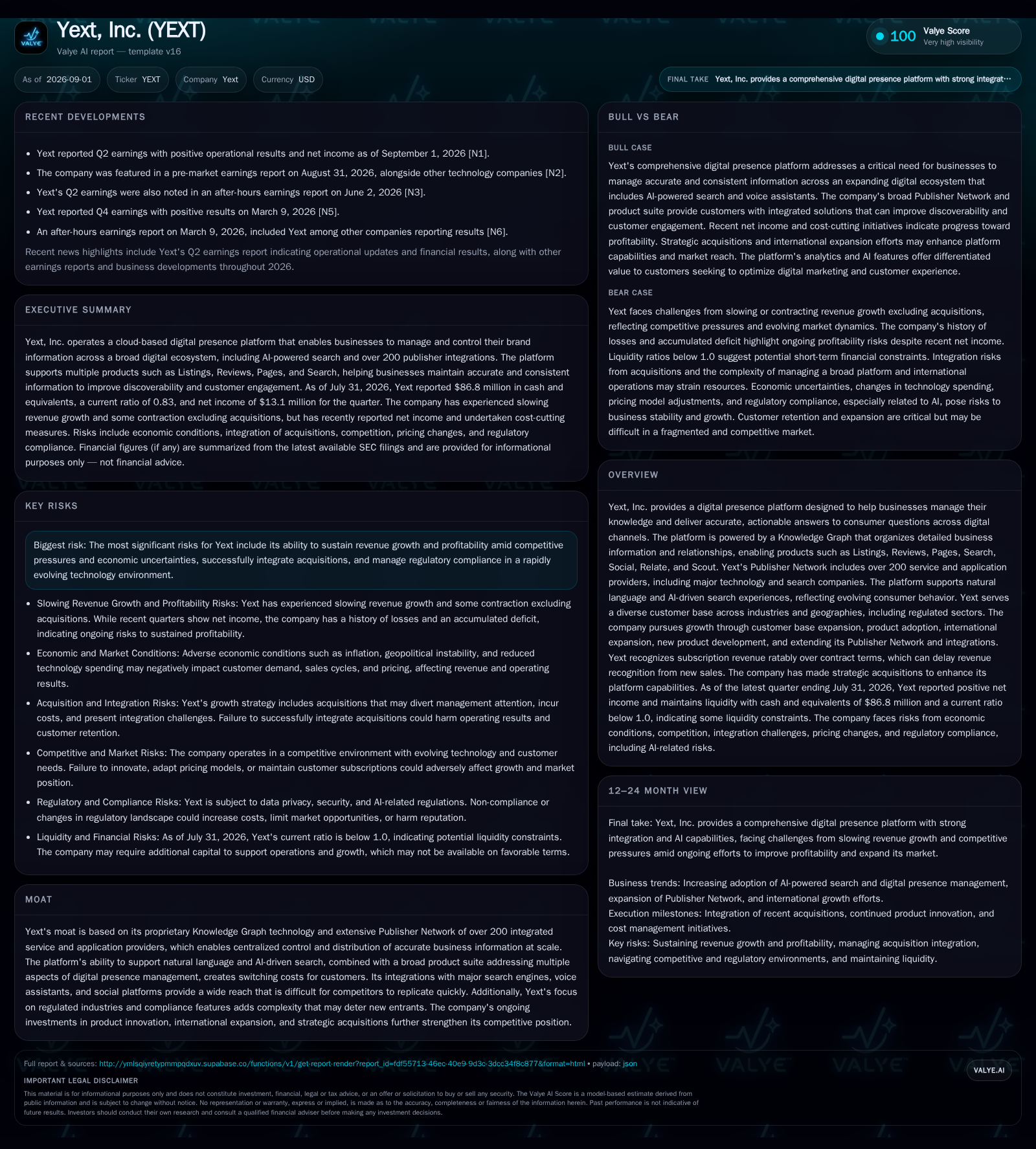
Yext offers a cloud-based platform that centralizes and distributes verified business data across an extensive digital ecosystem, leveraging a proprietary Knowledge Graph and AI capabilities. While recent quarters show progress toward profitability driven by cost controls and strategic acquisitions, Yext contends with slowing organic revenue growth, liquidity pressures, and intense competition. The company’s moat stems from its broad integrations and AI-powered features, but sustained success will depend on integration execution, innovation pace, customer retention, and regulatory compliance.
Yext, Inc. operates a comprehensive digital presence platform that enables businesses to maintain accurate and consistent information across an extensive digital ecosystem spanning search engines, voice assistants, social networks, and more. Central to its offering is a proprietary Knowledge Graph and AI-powered natural language search capabilities, distributed via a Publisher Network of over 200 partners including Amazon Alexa, Google, and Apple. Despite showing recent net income and undertaking cost-cutting actions, Yext faces slowing organic revenue growth, liquidity pressures, and competitive challenges. The company’s future hinges on successful integration of acquisitions, scaling AI innovations, navigating regulatory risks, and expanding international footprints to reinforce its market position and profitability trajectory.
Latest Operating Snapshot
As of July 31, 2026, Yext reported $86.8 million in cash and equivalents alongside current assets of $198.6 million and current liabilities totaling $240.0 million, resulting in a current ratio of 0.83. This indicates potential near-term liquidity constraints despite positive net income of $13.1 million for Q2 2026 and $15.8 million for the first six months [S2].
Yext’s revenue growth has slowed and even contracted on an organic basis excluding acquisitions, reflecting competitive pressures and market maturation. The company has responded with cost-cutting initiatives including workforce reductions aimed at improving profitability and operational efficiency [S1][S2].
The platform continues to evolve with a broad product suite supported by its Knowledge Graph technology, integrating data across more than 200 publishers such as Amazon Alexa, Google, Apple, and social platforms. Recent acquisitions like Hearsay, KabanaSoft, and GoShine AI Ltd. are designed to expand capabilities in AI search and digital presence management [S1].
Yext’s subscription revenue recognition method—ratably over the subscription term—means that new sales growth may not immediately reflect in quarterly operating results, complicating short-term revenue visibility [S1].
Business Model and Unit Economics
Yext derives revenue primarily from subscription fees paid by businesses for access to its digital presence platform and related services. The platform’s pricing likely blends volume (number of locations or listings managed), product breadth (e.g., Listings, Reviews, Search), and complexity (industry-specific compliance features), enabling some pricing differentiation based on customer size and vertical. Revenue recognition ratably over contract terms smooths income but delays impact from new acquisitions or upsells [S1].
Fixed costs include R&D for platform development, infrastructure to support high data volumes and integrations, and sales and marketing expenses to acquire and retain clients. Variable components relate to customer support and operational scaling tied to active subscriptions. Operating leverage could materialize if fixed costs remain stable while subscription volume and product adoption grow, but slowing organic growth and acquisition integration costs may offset this potential.
Capital intensity is moderate, centered on software development and cloud infrastructure rather than physical assets. However, acquisitions to expand AI capabilities and publisher network integrations require strategic investment, with potential for short-term margin pressure due to integration and restructuring costs [S1].
Yext’s unit economics depend on retention and expansion within existing customers, as recurring subscription revenue underpins long-term profitability. Switching frictions arise from the complexity of integrating multiple digital channels and regulatory compliance, but competitors offering similar AI-driven solutions and digital presence services can erode pricing power if Yext fails to innovate and demonstrate clear value differentiation.
Moat, Competition and Counterforces
Yext’s moat primarily stems from its proprietary Knowledge Graph technology combined with its extensive Publisher Network of over 200 service providers, including major search engines, voice assistants, and social platforms. This integration scale enables centralized management and distribution of verified business information at scale, creating switching costs for customers who would otherwise have to manage disparate channels independently [S1].
The platform’s support for natural language and AI-driven search enhances user experience and aligns with evolving consumer behavior, further differentiating Yext. Its compliance features tailored for regulated industries like healthcare and financial services add a layer of complexity that may deter new entrants lacking such capabilities.
Competitive pressures come from large technology companies embedding digital presence services within broader ecosystems, specialized digital marketing agencies, and emerging AI search startups. The rapid evolution of AI technology means Yext must continuously innovate or risk commoditization.
Counterforces weakening the moat include potential disintermediation by platform owners (e.g., Google, Amazon) who could internalize knowledge management functions, regulatory changes impacting data usage, and the operational complexity of integrating acquisitions and managing international expansions.
Bull Case
In a bullish scenario, Yext successfully leverages its Knowledge Graph and AI capabilities to become the preferred platform for businesses seeking to control their digital presence across a fragmented ecosystem. The company’s broad Publisher Network and product suite enable integrated, real-time updates that enhance discoverability and customer engagement, driving higher subscription volumes and enabling premium pricing.
Effective integration of strategic acquisitions like Hearsay and GoShine AI Ltd. expands platform functionality into adjacent markets such as conversational AI and enhanced location intelligence, increasing customer wallet share and cross-selling opportunities. International expansion gains traction, tapping markets with growing digital marketing needs.
Cost-cutting initiatives combined with scale benefits unlock operating leverage, improving margins and generating sustainable profitability. Regulatory compliance capabilities become a competitive advantage as data privacy and AI governance tighten, making Yext the trusted partner for sensitive industries.
Confirming evidence includes accelerating organic revenue growth, improved renewal and expansion rates, successful acquisition integrations delivering new products and customer wins, and stable or improving liquidity ratios. A falsification test would be continued revenue decline excluding acquisitions, widening losses, or loss of major publisher partnerships.
Base Case
Under the base case, Yext continues to grow modestly but faces ongoing challenges in offsetting slowing organic revenue growth with acquisitions and international expansion. The platform remains competitive but must invest steadily to keep pace with evolving AI search capabilities and maintain its Publisher Network relationships.
Profitability improves gradually as cost management and operational efficiencies partially offset margin pressure from investments and acquisition integration. Liquidity remains tight but manageable with disciplined capital allocation. Customer retention is stable, with moderate expansion in multi-product adoption within the existing base.
Yext navigates regulatory changes without major disruptions, leveraging compliance features to maintain presence in regulated sectors. However, growth is constrained by competitive pricing pressures and the need for continuous innovation.
This scenario is consistent with steady but unspectacular financial results, incremental new product rollouts, and cautious but sustained international expansion. Falsification would involve either a clear acceleration in organic growth and profitability or worsening losses and cash burn.
Bear Case
In the downside scenario, Yext’s organic revenue declines accelerate due to intensifying competition, customer churn, and failure to innovate AI capabilities effectively. Acquisition integration proves costly and distracts management, leading to operational inefficiencies and deteriorating service quality.
Liquidity constraints become acute with a current ratio below 1.0 signaling short-term funding pressure. The company may need to raise capital under unfavorable terms, diluting shareholders or constraining strategic flexibility. Regulatory compliance costs escalate as AI and data privacy laws tighten, further pressuring margins.
Competitive encroachment by large platform owners reduces Yext’s relevance, as businesses migrate to in-house or alternative solutions. The complexity of managing a broad product portfolio and international operations overwhelms resources, resulting in lost contracts and shrinking market share.
Confirming evidence includes sustained revenue contraction excluding acquisitions, repeated quarters of net losses, negative cash flow, loss of key publisher integrations, and regulatory penalties or costly compliance adjustments. Falsification would require signs of stabilized or growing organic revenue and easing liquidity stress.
What Matters Next
Key performance indicators for Yext include organic revenue growth rates excluding acquisitions, which reveal core market traction; subscription renewal and expansion rates that measure customer retention and product adoption; and gross margin trends reflecting operating leverage and cost management effectiveness.
Liquidity metrics such as the current ratio and free cash flow generation are critical to assess potential financial flexibility and runway for investment or acquisitions. Monitoring integration milestones and customer wins from recent acquisitions like Hearsay and GoShine AI Ltd. will indicate the success of growth strategies.
Product innovation pace, particularly in AI-powered search and natural language capabilities, is a useful metric to gauge competitive positioning. Regulatory developments around AI and data privacy, and Yext’s compliance track record, will influence operational risk and cost structure.
Finally, expansion in international markets and growth in the Publisher Network, measured by number and quality of integrations, are important indicators of scaling potential and ecosystem strength.
Disclaimer: This is research-only, informational analysis and not investment advice. It may include AI-generated interpretation and general industry context. Always verify important details using primary sources.

Comments