
Ionic Digital Inc. (IOND): reported liquidity position Amidst Earnings Pressure and Business Model Opacity
Ionic Digital maintains a reported liquidity position cushion that supports operational flexibility, but ongoing net losses and limited public disclosure on its business model complicate visibility into its competitive positioning and long-term viability.
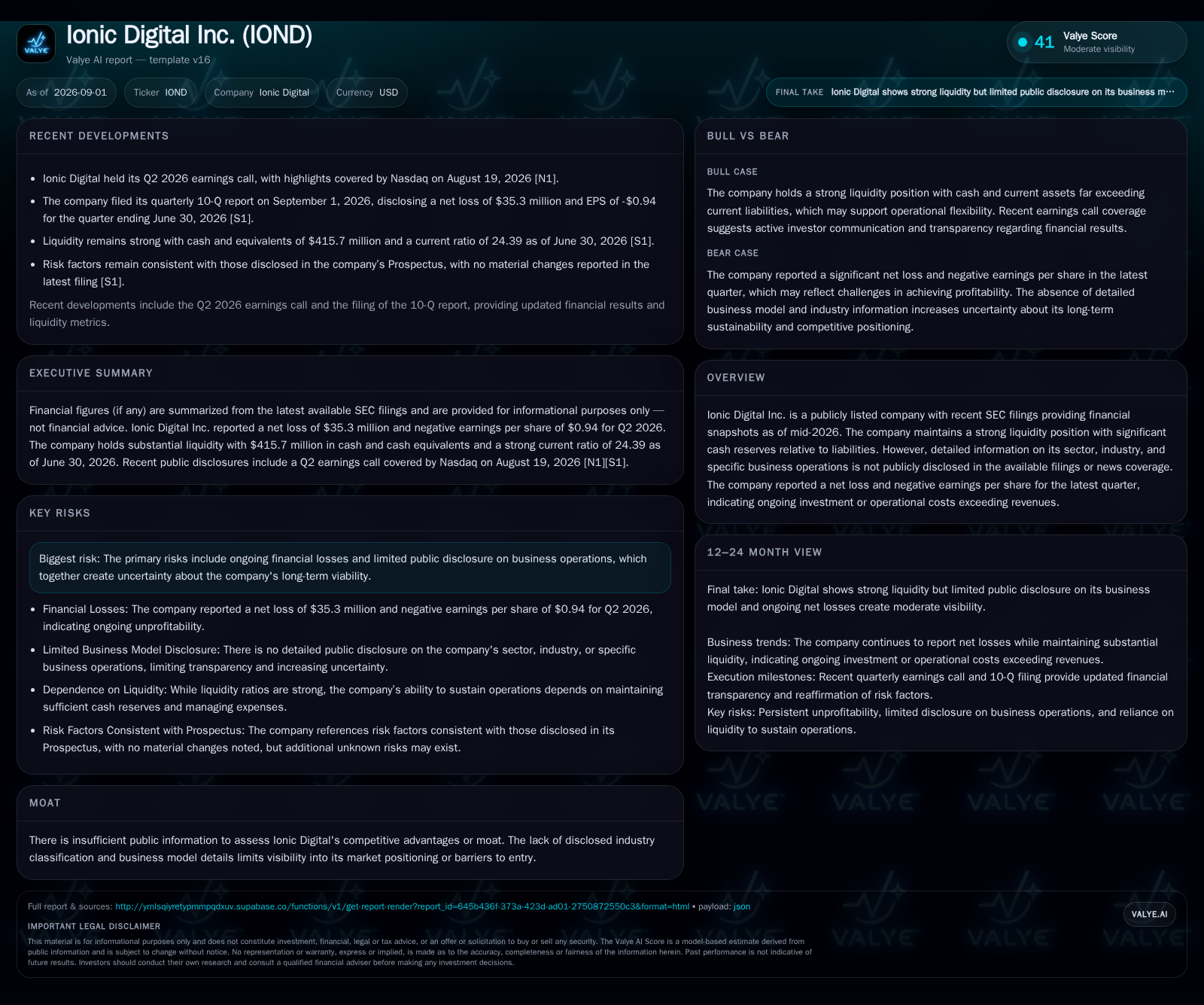
As of mid-2026, Ionic Digital reported $415.7 million in cash with a current ratio above 24, underscoring a reported liquidity position profile. However, a net loss of $35.3 million and negative EPS of $0.94 for Q2 2026 highlight continued profitability challenges. The company’s opaque business segment and operational details limit insights into its revenue drivers, competitive moat, and capital intensity, leaving investors reliant on liquidity endurance and management execution to unlock value.
Ionic Digital Inc. stands out in mid-2026 for its exceptional liquidity profile, holding over $415 million in cash and equivalents with minimal short-term liabilities. This financial buffer affords the company operational flexibility and potential runway to execute strategic initiatives. However, the firm reported a substantial net loss of $35.3 million for Q2 2026, accompanied by a negative EPS of $0.94, signaling that expenses continue to outpace revenues. Compounding the challenge, the company has not disclosed its industry sector or detailed business model publicly, restricting insight into its economic drivers, competitive positioning, and path to profitability. Understanding Ionic Digital’s prospects requires analyzing its economic structure, competitive environment, and potential strategic pathways amid these informational gaps.
Latest Operating Snapshot
As of June 30, 2026, Ionic Digital reported cash and cash equivalents of $415.7 million and current assets of $642.6 million against current liabilities of just $26.3 million, resulting in a current ratio of 24.39 and an exceptionally high cash ratio of 15.78 [S1]. These liquidity metrics far exceed typical industry standards, implying the company is not under immediate financial distress and has substantial flexibility to fund operations or investments without external capital.
Despite this liquidity strength, Ionic Digital recorded a net loss of $35.3 million and a basic and diluted EPS of -$0.94 for Q2 2026 [S1]. The loss suggests ongoing operational expenses or investments in growth that are not yet generating sufficient revenue. The company’s August 2026 earnings call, summarized by Nasdaq, indicates continued investor engagement, though no new strategic disclosures were highlighted [N1]. Risk factors remain consistent with prior filings, signaling no newly emerged material risks but ongoing uncertainties inherent in the business [S1].
Business Model and Unit Economics
Ionic Digital’s lack of publicly disclosed information on its sector, products, or services obscures analysis of its business model and unit economics. Without specifics, one can only infer that the company’s current net losses may reflect high fixed costs or R&D investment phases common in technology or digital service firms. The substantial cash reserves suggest a capital-intensive model or a strategic decision to build a war chest for scaling or R&D before reaching operational breakeven.
Pricing, volume, and mix dynamics remain unclear absent revenue segmentation or customer data. The company’s liquidity implies it can absorb negative operating leverage in the short term, but sustainable profitability likely depends on achieving scale or improved pricing power. If Ionic Digital operates in a platform or software model, recurring subscription revenue could eventually drive margin expansion and operating leverage, but confirmation requires disclosure. Capital intensity and fixed-cost structure will determine how quickly incremental revenue translates to profit growth.
Moat, Competition and Counterforces
The absence of industry classification and detailed operational disclosures impedes assessment of Ionic Digital’s competitive moat. Without clarity on product offerings or customer base, it is difficult to evaluate barriers to entry, switching costs, or network effects that could secure durable advantages. If the company is in a nascent or emerging technology sector, first-mover advantages or intellectual property could constitute moat elements, but these are unconfirmed.
Competitive pressure from established incumbents or fast followers could erode pricing power if Ionic Digital’s value proposition is not differentiated. Additionally, the lack of disclosed partnerships, platform ecosystems, or multi-year contracts diminishes evidence of customer stickiness or switching frictions. The reported liquidity position position might help the company withstand competitive threats by funding innovation or marketing, but the long-term sustainability of this advantage depends on translating investment into market traction.
Bull Case
In a positive scenario, Ionic Digital leverages its reported liquidity position to invest aggressively in R&D, product development, and go-to-market execution, enabling it to capture meaningful market share in a growing digital or technology niche. Successful commercialization could trigger rapid revenue scaling, improving unit economics through higher volumes and better pricing power, thereby unlocking operating leverage. Transparency and consistent investor communication may foster investor confidence, supporting valuation expansion.
Confirming evidence would include subsequent filings revealing revenue growth, improving margins, customer acquisitions, or strategic partnerships. Early signs of recurring revenue streams or platform adoption would reinforce this path. A falsification test would be sustained or worsening losses without evidence of revenue traction or the need for repeated capital raises, suggesting liquidity is being depleted without clear progress.
Base Case
The base case envisions Ionic Digital maintaining its liquidity cushion while gradually progressing toward operational scale. Modest revenue growth offsets some expenses, but profitability remains elusive as investments in product development and market expansion continue. The company manages risk factors consistently without material surprises, maintaining steady but slow improvement in financial metrics. Transparency and investor communication remain steady, supporting a patient market assessment.
Under this scenario, operating leverage may begin to emerge late in the forecast horizon as fixed costs stabilize and incremental revenue improves margins. However, no sharp inflection in profitability or competitive position is anticipated absent major structural changes. A falsification test would be a rapid move into profitability or significant contract wins that accelerate growth, which would push this scenario into the bull case.
Bear Case
In a downside scenario, Ionic Digital’s net losses persist or deepen as investments fail to translate into sustainable revenue growth or competitive differentiation. The company’s liquidity, while robust, could erode faster than expected if operating cash burn accelerates without offsetting inflows. Limited business model transparency might mask structural weaknesses or market saturation, raising concerns about long-term viability.
Confirming signals would include continued widening losses, negative cash flow from operations, or indications of impaired assets or restructuring. Failure to provide clearer disclosures or to improve investor confidence could erode valuation and limit access to capital. Conversely, if liquidity remains stable or improves through strategic adjustments, this could falsify the bear case.
What Matters Next
Key performance indicators to watch include revenue growth and composition, which would illuminate the company’s ability to monetize its offerings and scale operations. Gross and operating margins would signal whether operating leverage is materializing and costs are being controlled. Cash flow from operations and burn rate metrics will reveal sustainability of liquidity over time.
Other critical milestones are disclosures clarifying Ionic Digital’s industry, customer base, and business model to reduce opacity and enable more precise valuation. Updates on strategic partnerships, product launches, or contract wins could provide evidence of market acceptance. Finally, monitoring any changes in risk factors or capital raises will offer insight into the company’s financial health and strategic direction.
Disclaimer: This is research-only, informational analysis and not investment advice. It may include AI-generated interpretation and general industry context. Always verify important details using primary sources.

Comments