
Fly-E Group, Inc. (FLYE) Equity Analysis: Navigating Restructuring Amidst Market Challenges
Fly-E Group operates in the competitive electric mobility sector with a diversified product portfolio and urban-focused rental offerings but faces significant operational, financial, and regulatory headwinds. This analysis explores the company’s business model, competitive positioning, and plausible future scenarios amid restructuring and litigation risks.
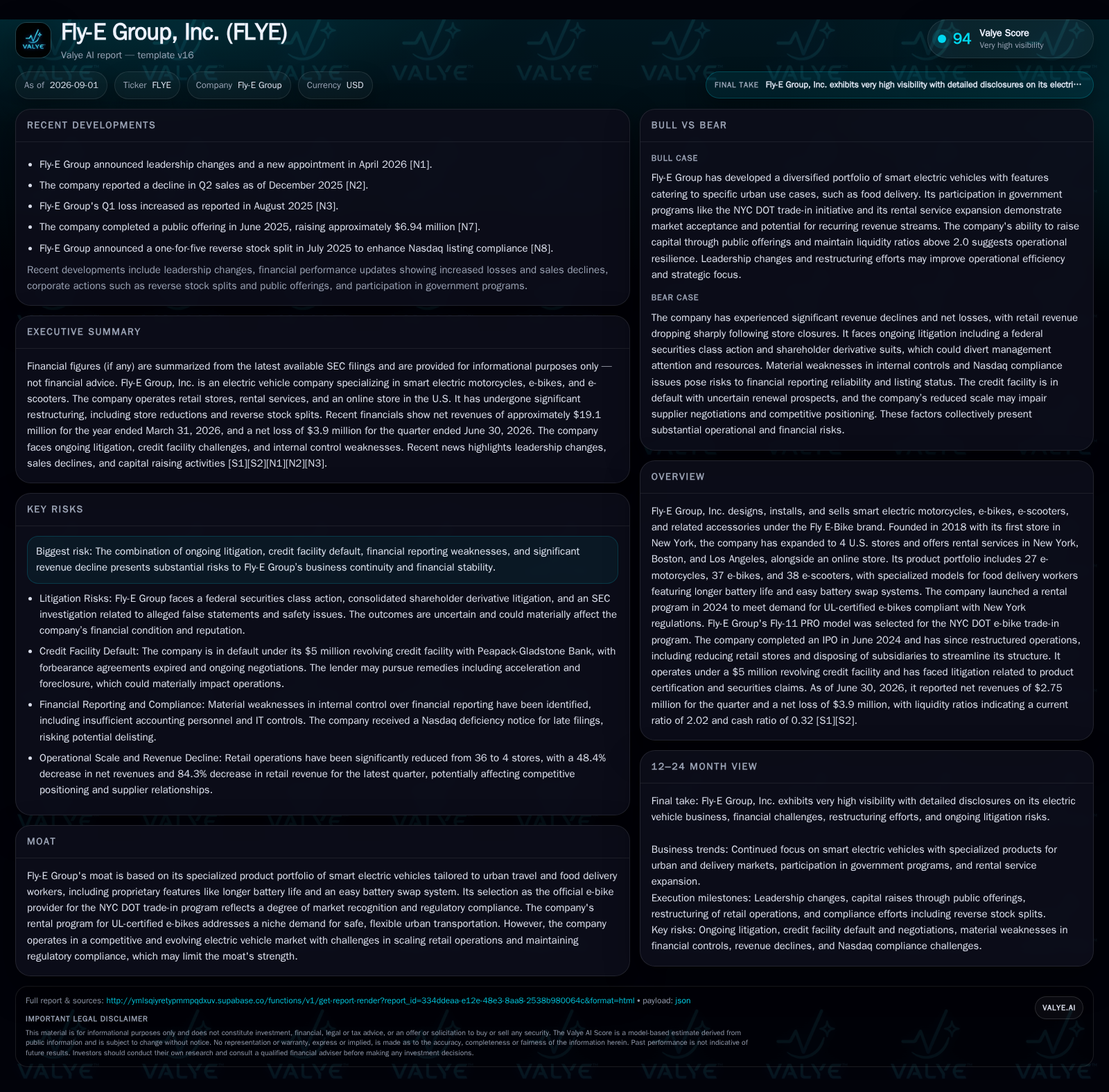
Fly-E Group, Inc. designs and sells smart electric motorcycles, e-bikes, and e-scooters with a focus on urban transportation and delivery use cases. Despite a broad product line and participation in government programs, the company’s financial performance is challenged by declining retail revenues, operational downsizing, litigation, and credit facility defaults. Its business model hinges on product diversification and rental services, yet execution risks and regulatory compliance remain key hurdles. The company’s future depends on stabilizing its financial footing, leveraging its niche product advantages, and successfully navigating competitive and legal pressures.
Fly-E Group, Inc. is positioned in the dynamic but competitive electric mobility market with a comprehensive product lineup of smart electric motorcycles, e-bikes, and scooters designed for urban transport and delivery applications. Since its IPO in 2024, the company has undergone significant restructuring, including a major reduction in retail stores and disposal of subsidiaries aimed at streamlining operations. Despite winning government-backed contracts and expanding rental services, Fly-E faces steep revenue declines, mounting losses, credit facility defaults, and litigation risks that cloud its near-term outlook. Understanding the company’s business model economics and competitive dynamics is critical for assessing its trajectory and potential inflection points.
Latest Operating Snapshot
As of mid-2026, Fly-E Group’s reported net revenues for the quarter ended June 30 stood at approximately $2.75 million, with retail sales plunging by 84.3% following reduction of physical stores from 36 to 4 since mid-2024 [S1][S2]. Wholesale revenues constitute the majority of sales at $11.6 million annually, while rental services, launched in late 2024, remain nascent at $0.6 million yearly. The company’s liquidity remains constrained, holding roughly $2.54 million in cash and equivalents with a current ratio of 2.02 but a low cash ratio of 0.32, signaling limited immediate liquidity [S1].
Fly-E Group faces ongoing regulatory and legal headwinds, including securities litigation related to allegedly misleading revenue and safety disclosures, and a $5 million revolving credit facility in default with Peapack-Gladstone Bank as of June 2026 [S1]. The company has also encountered internal control weaknesses in financial reporting and Nasdaq compliance issues, recently filing a late quarterly report to regain compliance. These operational and financial challenges underscore risks to both short-term viability and long-term strategic execution [S1][N1][N2].
Business Model and Unit Economics
Fly-E Group generates revenue primarily through wholesale sales to distributors and retail sales via its stores and online platform, supplemented by rental services targeting urban commuters. The diversified product portfolio—27 e-motorcycles, 37 e-bikes, and 38 e-scooters—caters to distinct customer segments, including specialized models for food delivery workers featuring longer battery life and battery swap capabilities, which could command premium pricing or higher utilization rates [S1]. Pricing dynamics likely depend on product category, regulatory certification status (e.g., UL certification), and service elements such as rentals.
The business appears capital intensive with considerable fixed costs related to physical retail stores, inventory management, and product development. The sharp reduction in store count reflects a strategic move to lower fixed overhead and better align costs with sales volumes, though at the expense of geographic reach and customer engagement. Operating leverage may emerge if wholesale and rental volumes grow sufficiently to absorb fixed costs, but recent revenue declines indicate this remains a challenge. Rental services could enhance recurring revenue stability if scaled but currently contribute a minimal portion of total revenues. The company’s capital structure is pressured by credit facility defaults and limited cash reserves, constraining investment capacity.
Moat, Competition and Counterforces
Fly-E Group’s competitive advantage chiefly rests on its comprehensive product range tailored to urban mobility needs and regulatory compliance, exemplified by its Fly-11 PRO model’s selection for the NYC DOT e-bike trade-in program and its rental fleet’s UL certification. These attributes differentiate Fly-E from competitors focusing solely on either mass-market electric scooters or motorcycles without urban delivery specialization. The battery swap system and long battery life on delivery models address operational pain points, potentially increasing customer loyalty and switching costs.
However, the electric vehicle market is highly competitive with numerous incumbents and startups targeting overlapping segments, including established motorcycle manufacturers, dedicated e-bike firms, and micromobility providers. Scale is critical for cost efficiency, supplier bargaining power, and brand recognition; Fly-E’s retail downsizing and financial constraints may weaken its position. Regulatory complexity and safety certification add barriers but also risks, as evidenced by litigation and UL settlement. The moat is thus conditional and susceptible to erosion by larger players or technological substitution, such as more efficient batteries or alternative urban transport modes.
Bull Case
In a positive scenario, Fly-E Group successfully leverages its differentiated product portfolio and regulatory partnerships to capture a growing share of urban mobility demand, particularly among delivery workers and city commuters valuing certified, reliable electric vehicles. The rental business expands through the Go Fly app and additional city launches, generating recurring revenue streams with higher margins and better customer data insights. Operational restructuring yields improved cost discipline and streamlined supply chains, facilitating margin expansion as sales volumes recover.
Capital raised via public offerings and debt negotiations provides sufficient runway to invest in product innovation and marketing. Leadership changes lead to sharper strategic focus and enhanced execution capabilities. Confirming evidence would include stabilized or growing revenues, improved operating cash flow, successful credit facility renewal, and positive customer adoption metrics in rental and fleet programs. Falsification would be persistent revenue declines, inability to resolve credit issues, failure to comply with Nasdaq, or loss of key government contracts.
Base Case
The base case envisions Fly-E Group maintaining its current product breadth and urban-focused niche but with modest top-line growth and ongoing margin pressure. Retail sales remain depressed due to limited store presence but are partially offset by stable wholesale relationships and slow growth in rental services. Operational losses persist but narrow gradually as fixed costs are controlled and some scale benefits emerge from streamlined operations.
The company manages to extend or restructure its credit facility, avoiding liquidity crises, though with limited capacity for aggressive expansion. Ongoing litigation is resolved without catastrophic financial or reputational damage, and regulatory compliance stabilizes. This scenario assumes competitive pressures keep pricing and volumes constrained, limiting operating leverage. Key indicators would include flat to slightly positive revenue trends, reduced net losses, absence of new material legal issues, and manageable debt servicing. Failure to achieve these milestones would tilt toward downside risk.
Bear Case
The downside scenario involves continued erosion of Fly-E Group’s commercial foothold, with retail and wholesale revenues declining further due to intensified competition, loss of government partnerships, or negative market perception from litigation fallout. Rental services fail to scale meaningfully, leaving the company reliant on declining legacy sales. Operating losses deepen, draining cash reserves and forcing asset sales or additional dilutive financings.
Credit facility default triggers aggressive lender actions, including foreclosure on assets, disrupting operations. Nasdaq delisting occurs due to repeated compliance failures, restricting capital market access and investor confidence. Material weaknesses in financial controls remain unresolved, undermining reporting reliability. Confirming evidence would be sustained quarterly revenue shrinkage, negative cash flow trends, adverse litigation rulings, and failure to secure financing. A turnaround in these metrics would falsify this scenario.
What Matters Next
Key performance indicators to monitor include quarterly revenue trends segmented by retail, wholesale, and rental services to assess recovery or further decline; gross and operating margins to gauge cost control and pricing power; and rental fleet utilization rates reflecting market acceptance and recurring revenue potential. Tracking changes in store count or expansion plans would indicate strategic shifts in physical presence.
Liquidity and capital structure milestones are critical: status and terms of credit facility negotiations, cash runway estimates, and any new equity or debt capital raises. Litigation updates including settlement progress, regulatory investigations, and compliance improvements will materially affect risk perception. Finally, leadership and organizational changes, along with product innovation announcements or new government contracts, will signal potential inflection points for Fly-E’s operational turnaround.
Disclaimer: This is research-only, informational analysis and not investment advice. It may include AI-generated interpretation and general industry context. Always verify important details using primary sources.

Comments