
Ross Stores Inc. (ROST) Deep Dive: Off-Price Retailing with Expansion and Margin Tailwinds
Ross Stores leverages its scale and efficient merchandising to drive growth in the off-price apparel sector, supported by tariff benefits and disciplined capital deployment. Key challenges include sustaining margin advantages, managing expansion execution, and navigating regulatory risks.
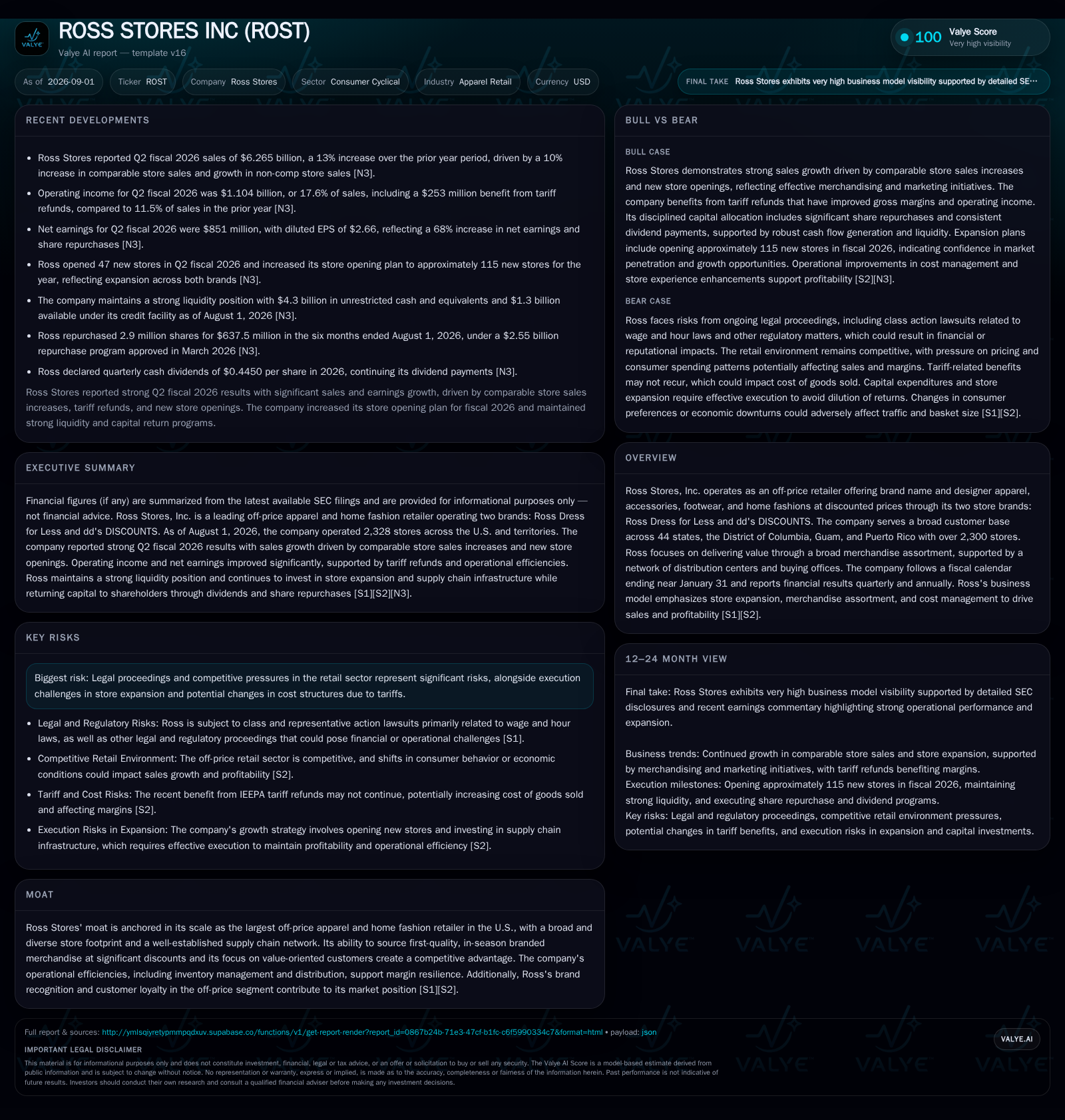
Ross Stores, a leading U.S. off-price apparel and home fashion retailer, reported robust Q2 2026 results with 13% sales growth and expanded store openings. Its business model capitalizes on sourcing branded merchandise at deep discounts and operational efficiencies, generating strong margins and cash flow. While tariff refunds have recently boosted profitability, their sustainability is uncertain, and Ross faces legal and competitive risks. Execution of aggressive store expansion and supply chain investments will be critical to maintaining growth and margin trends. Monitoring comparable store sales, merchandise margin, and capital efficiency will be vital to assessing the company’s trajectory.
Ross Stores, Inc. stands as the largest off-price apparel and home fashion retailer in the U.S., operating two distinct brands—Ross Dress for Less and dd’s DISCOUNTS—that cater to value-conscious consumers across more than 2,300 locations. The company’s strategy centers on sourcing brand-name, in-season merchandise at deeply discounted prices, leveraging scale and supply chain efficiency to deliver compelling value. Recent quarterly results underscore solid top-line and margin expansion driven by a favorable retail environment, tariff refunds, and an accelerated store rollout. However, sustaining these gains hinges on continued operational execution, margin resilience post-tariff benefits, and managing legal and competitive headwinds in a dynamic retail landscape.
Latest Operating Snapshot
In Q2 fiscal 2026, Ross Stores reported sales of $6.265 billion, marking a 13% increase over the prior year period. This performance was propelled by a 10% rise in comparable store sales alongside growth from new store openings, signaling robust demand in the off-price apparel segment [S2][N3]. Operating income surged to $1.104 billion, representing 17.6% of sales, notably boosted by a $253 million benefit from tariff refunds, which materially enhanced gross margins and profitability [S2][N3].
The company expanded its store base by opening 47 new locations during the quarter and raised its full-year store opening target to approximately 115 stores, reflecting confidence in market expansion and penetration strategies. Ross also demonstrated strong capital discipline, repurchasing 2.9 million shares for $637.5 million under an ongoing $2.55 billion buyback program, while maintaining quarterly dividends of $0.4450 per share. Liquidity remains robust with $4.3 billion in unrestricted cash and $1.3 billion available credit, supporting both growth initiatives and shareholder returns [S2][N3].
Business Model and Unit Economics
Ross Stores operates on a classic off-price retail model, procuring first-quality, in-season branded apparel and home fashion merchandise at significant discounts from department and specialty retailers. The company then sells these goods at steep markdowns—approximately 20% to 60% below department store prices for Ross Dress for Less, and 20% to 70% discounts for dd’s DISCOUNTS—catering to price-sensitive consumers seeking brand value [S2]. This discounting strategy drives high inventory turnover and strong traffic, with volume growth supported by expanding store count and comparable store sales improvements.
From a cost structure perspective, Ross’s model benefits from relatively low fixed costs compared to full-price retailers due to its asset-light real estate strategy and lean store operations. Variable costs such as merchandise procurement and supply chain expenses dominate, but the company’s scale allows significant bargaining power with suppliers and efficient distribution networks. Operating leverage emerges as same-store sales grow without proportional cost increases, enhancing profitability. Capital expenditure intensity centers on store openings and supply chain modernization, with planned FY 2026 investments around $1.1 billion. Maintaining disciplined capital allocation is critical to ensuring returns do not dilute amid expansion.
Moat, Competition and Counterforces
Ross's competitive advantage largely stems from its scale as the largest off-price apparel retailer in the U.S., operating a broad footprint of 2,328 stores across diverse geographies. This scale underpins superior buying leverage, enabling access to high-quality branded goods at favorable prices, which in turn supports attractive consumer value propositions and loyalty. The company’s efficient supply chain and inventory management systems enhance margin resilience and product freshness, building switching frictions for customers who rely on Ross for value shopping.
However, the off-price retail landscape is intensely competitive, with peers such as TJX Companies, Burlington Stores, and emerging e-commerce off-price platforms vying for consumer attention. Competitive pressures can erode pricing power and compress margins, especially if consumer spending slows or shifts away from discretionary apparel. Furthermore, the temporary benefit from tariff refunds constitutes a counterforce that may reverse, increasing cost of goods sold. Legal and regulatory risks related to wage and hour class action lawsuits could impose financial and reputational costs, challenging moat durability.
Bull Case
In an optimistic scenario, Ross leverages its scale and operational expertise to sustain comp store sales growth in the mid-to-high single digits, driven by effective merchandising, enhanced store experiences, and expanding brand awareness of dd’s DISCOUNTS. Continued disciplined sourcing and supply chain improvements allow the company to maintain or even improve gross margins despite inflationary pressures. The tariff refund benefit, while significant in 2026, could be partially offset by other cost efficiencies, preserving margin expansion.
Aggressive but well-executed store expansion—targeting approximately 115 new locations—broadens market penetration and captures incremental customer segments without diluting returns. Strong cash flows enable ongoing shareholder returns through dividends and buybacks, supporting investor confidence. Confirmation of this bull case would include consistent high single-digit comp sales, stable or improving merchandise margin percentages excluding tariff impacts, and positive trajectory in new store profitability. Conversely, failure to maintain these metrics or margin erosion beyond tariff normalization would falsify this outlook.
Base Case
The base case envisions Ross maintaining solid but more moderate comparable store sales growth around 5% to 7%, reflecting steady consumer demand but tempered by periodic economic or competitive headwinds. Tariff refunds dissipate, causing gross margin percentages to revert closer to historical norms, though partial offsetting cost controls and supply chain efficiencies limit downside. Store expansion proceeds as planned with new locations contributing but at a more normalized ramp-up pace, balancing growth with capital discipline.
Operating margins stabilize in the mid-teens percentage range, supported by leveraging SG&A expenses against expanding sales but constrained by incremental wage and incentive costs. Legal and regulatory challenges remain manageable without material financial impact. Shareholder returns continue, but at a moderated pace relative to cash flow growth. Evidence supporting this base case would include stable comp sales growth, margins consistent with recent multi-year averages post-tariff benefit, and steady capital expenditure execution. Major deviations in any of these areas would call for reassessment.
Bear Case
In a downside scenario, Ross faces significant margin compression as tariff-related benefits vanish and supply chain inflation intensifies, pushing cost of goods sold higher without commensurate selling price increases due to competitive pressure. Comparable store sales growth falters or turns negative amid economic downturns, changing consumer preferences, or increased online competition, reducing traffic and basket size. Expansion plans strain capital and operational bandwidth, leading to suboptimal new store performance and margin dilution.
Additionally, adverse outcomes from ongoing legal and regulatory proceedings could impose material financial charges or reputational damage, affecting customer loyalty and employee morale. Rising wage and hour compliance costs may increase operating expenses beyond current guidance. Confirmation of this bear case would include declining comp sales, margin erosion below historical lows, unexpected litigation expenses, and capital expenditure overruns. A rebound in these metrics or successful mitigation strategies would falsify this negative outcome.
What Matters Next
Key performance indicators to watch include comparable store sales growth, which signals consumer demand sustainability and merchandising effectiveness. Merchandise margin percentage excluding tariff effects will clarify underlying profitability trends amid cost pressures. Operating margin trajectory will reflect the company’s ability to leverage sales growth and control expenses.
Capital expenditure efficiency and new store return on investment are critical to assessing the viability of aggressive expansion plans. Monitoring share repurchase completion pace and dividend sustainability will indicate potential financial flexibility and shareholder capital return commitment. Legal developments related to wage and hour lawsuits should be tracked for potential financial impact or changes in operational practices. Finally, inventory turnover and packaway inventory levels provide insight into supply chain efficiency and merchandise freshness, affecting customer experience and margin.
Disclaimer: This is research-only, informational analysis and not investment advice. It may include AI-generated interpretation and general industry context. Always verify important details using primary sources.

Comments