
MongoDB Inc (MDB) Equity Analysis: Cloud-Enabled Modern Data Platform with AI Integration Amid Competitive and Macroeconomic Risks
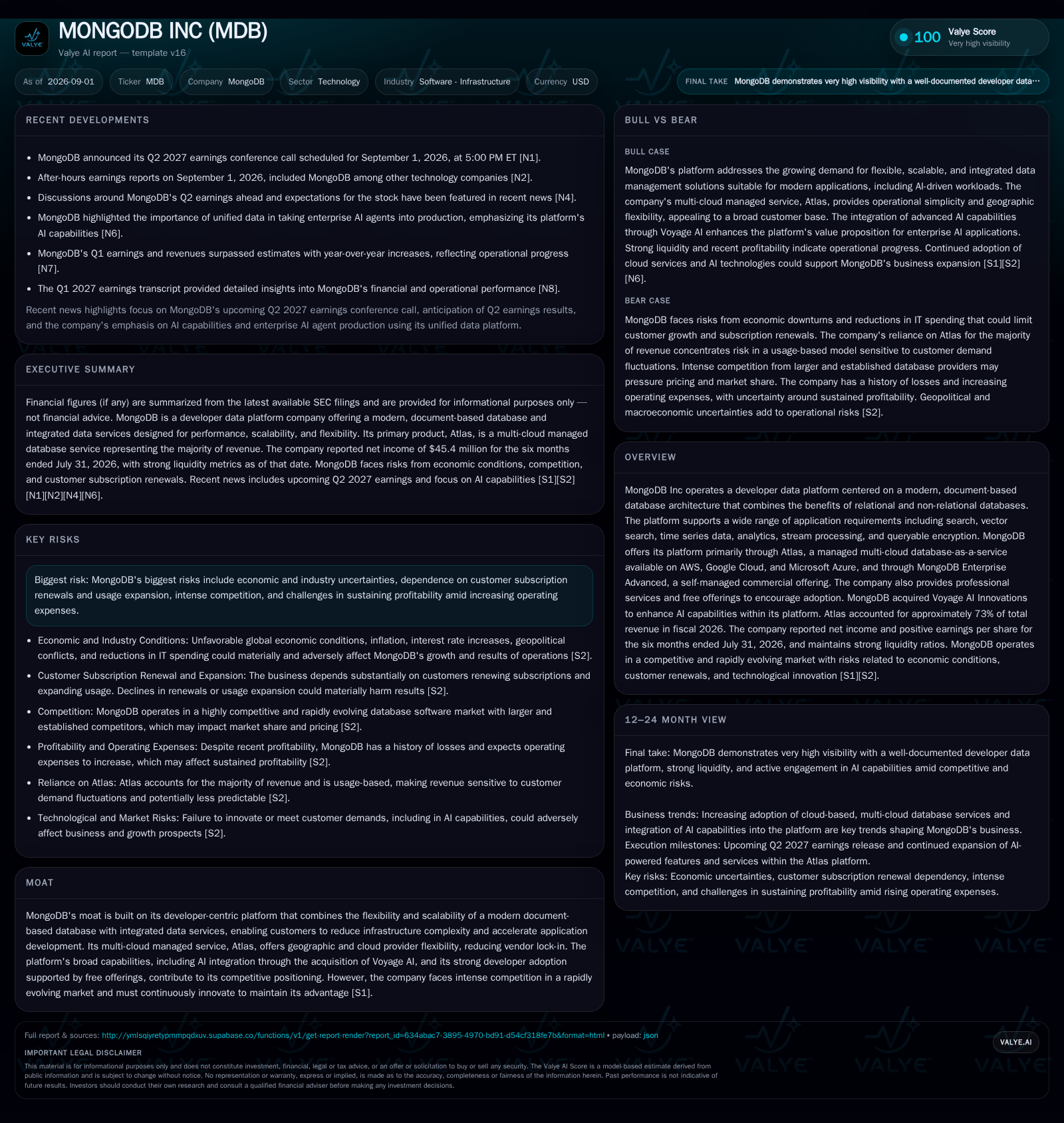
MongoDB operates a modern, document-oriented database platform primarily via its multi-cloud managed service, Atlas, addressing evolving application workloads including AI-driven use cases. reported liquidity position and early profitability mark operational progress, but dependence on subscription renewals, competitive pressure, and macroeconomic uncertainties pose challenges.
MongoDB’s strategic focus on a flexible, scalable, multi-cloud database platform combined with embedded AI capabilities positions it to capture growth from modern application development trends. Atlas, representing nearly three-quarters of revenue, leverages usage-based pricing that scales with customer adoption but introduces revenue volatility risks. The company’s moat derives from developer-centric platform design, cloud provider neutrality, and integrated data services, augmented by AI-focused acquisitions. However, sustaining growth and profitability depends on navigating intense competition, maintaining high subscription renewal and expansion rates, and managing costs amid economic uncertainties. Key milestones include upcoming Q2 2027 earnings and further AI integration rollout.
MongoDB Inc stands at the intersection of cloud database innovation and AI integration, operating a developer-centric platform that blends relational and non-relational database strengths. Its flagship multi-cloud managed service, Atlas, not only reduces infrastructure complexity for customers but also provides a scalable, flexible foundation for modern application development, including AI workloads. Recent strategic moves such as the acquisition of Voyage AI Innovations underscore MongoDB’s commitment to embedding advanced AI capabilities directly in its platform. While MongoDB has achieved positive net income and maintains reported liquidity position, the company faces a dynamic competitive environment and macroeconomic uncertainties that could impact subscription renewals and usage expansion. The upcoming Q2 2027 earnings release will be a crucial indicator of execution momentum and market reception.
Latest Operating Snapshot
MongoDB’s revenue mix is dominated by its Atlas platform, which accounted for approximately 73% of total revenue in fiscal 2026, underscoring the strategic importance of its multi-cloud managed database service across AWS, Google Cloud, and Azure [S1]. The platform’s breadth includes advanced capabilities such as Atlas Search, Vector Search, Data Federation, and Stream Processing, enabling customers to simplify infrastructure while supporting diverse workloads. This multi-cloud presence reduces vendor lock-in risks and appeals to enterprises seeking flexibility.
Financially, the company reported net income of $45.4 million for the six months ended July 31, 2026, a notable milestone given its historical losses, and maintains reported liquidity position with $1 billion in cash and equivalents and a current ratio of 4.87 [S2]. This financial strength supports ongoing investments, including the February 2025 acquisition of Voyage AI Innovations, which integrates embedding and reranking AI models into MongoDB’s platform to improve generative AI accuracy and reduce hallucinations [S1]. Recent news highlights also emphasize the company’s focus on unified data for enterprise AI agent deployment, reflecting strategic positioning at the AI-data intersection [N6].
Business Model and Unit Economics
MongoDB generates revenue primarily through subscription contracts for Atlas and MongoDB Enterprise Advanced. Atlas, the multi-cloud managed service, employs a usage-based pricing model that scales with customer data volume, compute, and feature utilization. This variable revenue component allows MongoDB to capture expansion revenue as customers increase workloads, but also introduces sensitivity to demand fluctuations. MongoDB Enterprise Advanced, a self-managed offering, contributes less than a quarter of revenue, providing some revenue diversification. Professional services remain a minor revenue stream.
From a cost structure perspective, MongoDB’s model includes fixed expenses for platform development, data center infrastructure partnerships, and R&D, alongside variable costs tied to cloud usage and customer support. Operating leverage could emerge if subscription usage growth accelerates faster than expense growth, improving margins. However, rising operating expenses, particularly in AI integration and global sales efforts, pose a risk to margin expansion. Capital intensity is moderate given reliance on cloud infrastructure partners rather than owning data centers, allowing flexibility but also dependency on third-party cloud economics and pricing.
Moat, Competition and Counterforces
MongoDB’s competitive moat rests on its modern, document-based database architecture that blends relational and non-relational features, designed for flexibility, scalability, and developer friendliness. Atlas’s multi-cloud managed service model mitigates vendor lock-in, a strong selling point for enterprises adopting hybrid and multi-cloud strategies. The platform’s integrated data services, including advanced search and AI capabilities, differentiate it from traditional database providers and open opportunities in emerging AI and analytics workloads.
Despite these strengths, MongoDB faces intense competition from major cloud providers’ native database offerings (e.g., AWS DynamoDB, Azure Cosmos DB), established database vendors (Oracle, Microsoft SQL Server), and open-source alternatives. The database market is rapidly evolving, with competitors also expanding AI integrations and multi-cloud support. Pricing pressure and feature parity risks loom, requiring continuous innovation and execution. Switching costs for customers remain moderate to low since databases are foundational but can be migrated with effort, increasing competitive vulnerability.
Bull Case
In a favorable scenario, MongoDB capitalizes on accelerating enterprise adoption of cloud-native, multi-cloud database architectures combined with growing AI workloads requiring flexible, scalable data platforms. The integration of Voyage AI’s embedding and reranking capabilities strengthens MongoDB’s platform as a go-to solution for enterprise AI agent deployment, driving increased usage and subscription expansion. Operational leverage emerges as fixed costs grow slower than usage-based revenues, improving profitability sustainably.
Confirming evidence would include continued strong adoption metrics for Atlas, expanding average revenue per user (ARPU), high subscription renewal and expansion rates, and increasing traction of AI-powered features in customer deployments. A falsification test would be stagnation or decline in Atlas usage growth, margin compression from rising expenses, or loss of key customers to competitors offering more integrated AI solutions or lower-cost alternatives.
Base Case
MongoDB maintains steady growth driven by continued adoption of cloud-managed databases and gradual integration of AI capabilities. Usage-based subscription revenues grow moderately with some customer churn offset by new customer wins. Operating expenses rise in line with revenue growth, keeping profitability stable but limiting margin expansion. The company’s reported liquidity position cushions against macroeconomic downturns, while its diversified cloud deployment options sustain customer retention.
This scenario assumes competitive pressure constrains pricing power and slows market share gains, but MongoDB’s differentiated platform and developer community sustain a loyal customer base. AI features add incremental value but do not dramatically accelerate growth. Confirmation would come from consistent subscription renewal rates, modest usage growth per customer, and stable operating margins. Signs of faltering growth, rising churn, or inability to sustain innovation would challenge this outlook.
Bear Case
Adverse macroeconomic conditions trigger IT spending cuts, reducing new customer acquisitions and causing existing customers to limit usage growth or not renew subscriptions. MongoDB’s heavy reliance on Atlas’s usage-based model results in volatile and declining revenues. Increased competition, especially from cloud providers bundling native database services with other cloud offerings at lower prices, erodes MongoDB’s market share and pricing power.
Operating expenses outpace revenue growth, driving losses and pressuring liquidity despite a strong starting cash position. Failure to deliver meaningful AI-related differentiation or to integrate acquired AI capabilities effectively weakens MongoDB’s competitive position. Falsification would be unexpected usage growth during economic stress or successful new partnerships expanding market reach and technology leadership.
What Matters Next
Key performance indicators to watch include Atlas revenue growth and its contribution margin, subscription renewal and expansion rates, average revenue per user (ARPU), and usage growth metrics reflecting customer adoption and platform engagement. Monitoring operating expense trends relative to revenue informs on operating leverage and profitability sustainability.
Milestones include the upcoming Q2 2027 earnings report and management commentary on AI integration progress and product roadmap execution. External conditions such as macroeconomic indicators, IT spending trends, and competitive developments in cloud database services and AI platforms will materially impact MongoDB’s trajectory. Additionally, customer case studies or announcements highlighting AI use cases powered by MongoDB’s platform would signal validation of strategic direction.
Disclaimer: This is research-only, informational analysis and not investment advice. It may include AI-generated interpretation and general industry context. Always verify important details using primary sources.

Comments