
NetApp, Inc. (NTAP) Equity Analysis: Navigating Intelligent Data Infrastructure in a Hybrid Cloud Era
NetApp’s transformation into a software-led, cloud-integrated data infrastructure provider positions it uniquely amid growing AI and multi-cloud adoption, but fixed cost structures and competitive pressures pose execution risks.
NetApp leverages its ONTAP software and hybrid cloud expertise to serve enterprise data needs spanning on-premises to public clouds. Its strategic focus on AI-ready infrastructure and subscription Storage-as-a-Service could drive growth and margin expansion, though fixed expense commitments and evolving competition temper near-term visibility.
NetApp, Inc. stands at a critical inflection point as it evolves from a traditional storage hardware provider to a software-driven, cloud-centric Intelligent Data Infrastructure company. Anchored by its ONTAP data management platform, NetApp offers unified hybrid and public cloud storage solutions integrated with major hyperscalers. This transformation is geared to capitalize on secular trends such as multi-cloud adoption, data growth, and AI workload acceleration. While recent quarterly revenue and earnings demonstrate solid performance, the company navigates operational risks tied to fixed costs and inventory exposure amid a competitive and rapidly shifting market. Understanding NetApp’s business model dynamics, competitive moat, and execution challenges is essential to assessing its medium-term growth and margin trajectory.
Latest Operating Snapshot
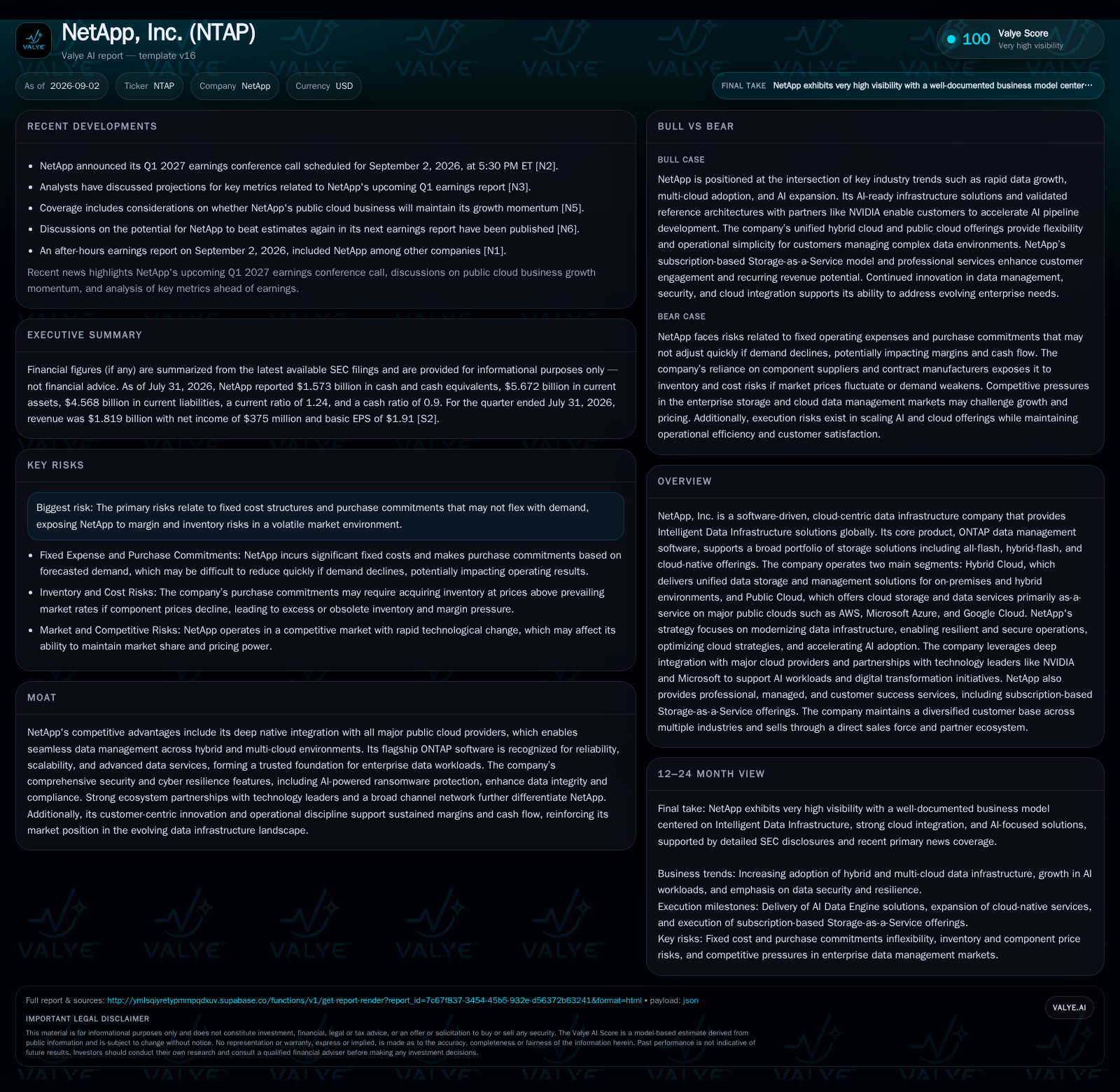
As of July 31, 2026, NetApp reported cash and cash equivalents of $1.573 billion and a current ratio of 1.24, reflecting solid near-term liquidity to support operations and investment [S2]. For the quarter ended July 31, 2026, revenue reached $1.819 billion with net income of $375 million and an EPS of $1.91, underscoring consistent profitability [S2]. The company’s balance sheet includes $2.5 billion of senior notes due between 2027 and 2035 and an undrawn $1 billion revolving credit facility maturing in 2030, providing potential financial flexibility [S2].
NetApp’s segment mix comprises Hybrid Cloud solutions delivering unified on-premises and hybrid storage, and Public Cloud offerings primarily delivered as-a-service on hyperscalers like AWS, Azure, and Google Cloud. Recent news highlights ongoing discussions about sustaining momentum in the Public Cloud business and expectations for the Q1 2027 earnings report, signifying investor focus on cloud growth and AI integration [N1][N2][N3][N5][N6]. These elements matter as they reflect the company’s strategic positioning in a market shifting towards hybrid multi-cloud architectures and AI-driven data workloads.
Business Model and Unit Economics
NetApp’s revenue derives from a blend of hardware sales, software licenses, subscription services, and professional/managed services. ONTAP software is central, enabling data management across all-flash, hybrid-flash, and cloud-native storage arrays, which creates value through unified data services, efficiency, and security. Pricing strategies likely combine upfront capital expenditures for hardware/software and recurring revenue streams from subscriptions such as NetApp Keystone Storage-as-a-Service, which smooth revenue volatility and enhance lifetime customer value.
The company’s cost structure features significant fixed expenses related to R&D, sales, and manufacturing commitments, alongside variable costs tied to component procurement and service delivery. Capital intensity remains moderate due to reliance on contract manufacturers and focus on software-led innovation. Operating leverage may emerge if subscription and cloud services scale faster than fixed costs, but could be constrained if fixed purchase obligations limit flexibility during demand fluctuations. The hybrid approach creates complexity but also multiple points for margin expansion via software and services mix improvement.
Moat, Competition and Counterforces
NetApp’s moat primarily rests on its deep, native integrations with leading cloud hyperscalers — AWS, Microsoft Azure, and Google Cloud — which facilitate seamless hybrid and multi-cloud data management. This integration drives switching costs by embedding ONTAP into customers’ cloud-native workflows and infrastructure. The company’s flagship ONTAP software is recognized for its reliability, advanced data services, and security features including AI-powered ransomware protection, which enhance data resilience — a critical consideration for enterprise clients.
However, competitive pressures come from multiple fronts: traditional storage hardware vendors diversifying into cloud services, cloud-native storage providers embedding data management in hyperscaler platforms, and emerging AI infrastructure specialists. The market’s rapid technology evolution and commoditization risks challenge NetApp’s pricing power and require continual innovation. Additionally, fixed cost structures and purchase commitments reduce nimbleness, potentially weakening the company’s ability to respond swiftly to competitive or demand shifts.
Bull Case
In the bull case, NetApp capitalizes fully on multi-cloud and hybrid cloud adoption trends, with its ONTAP platform becoming the foundational data management layer for enterprises seeking operational simplicity and flexibility. The company’s collaboration with technology leaders like NVIDIA accelerates AI workload support, positioning NetApp as a preferred AI data infrastructure provider. Successful scaling of its Storage-as-a-Service subscriptions boosts recurring revenues, improving margin stability and customer stickiness.
Confirming evidence would include accelerating revenue growth in the Public Cloud segment, higher subscription uptake, expanding AI Data Engine deployments, and improving gross margins driven by software and services mix. A falsification test would be sustained weakness or deceleration in cloud business growth, stagnant subscription adoption, or margin compression driven by price competition or cost overruns.
Base Case
The base case envisions steady growth driven by hybrid cloud demand and incremental AI workload adoption, with ONTAP maintaining relevance but facing increasing pricing pressures. Subscription services contribute growing but moderate recurring revenue without dramatically altering overall profitability dynamics. The company manages fixed costs prudently but encounters episodic inventory risks that modestly impact margins.
Evidence supporting this scenario would be stable revenue and profit growth consistent with market expectations, moderate cloud segment expansion, and incremental improvements in AI-related offerings. Falsifying this view would require either a breakthrough scaling of cloud and AI services driving outsized growth or significant margin erosion and revenue stagnation from competitive disruptions.
Bear Case
In a bear scenario, NetApp struggles with overhang from fixed expense commitments and purchase obligations amid softening demand, resulting in inventory write-downs and margin pressure. Competitive advances by cloud hyperscalers embedding native data management services and aggressive pricing by rivals erode NetApp’s market share. Execution missteps in scaling AI infrastructure solutions and subscription offerings lead to customer churn and reduced operating leverage.
Confirming evidence would include declining revenue or profitability, rising inventory levels, negative cash flow impacts, and loss of hyperscaler partnership momentum. Conversely, signs of effective cost control, renewed innovation, or resilience in cloud business growth would falsify this downside scenario.
What Matters Next
Key performance indicators to monitor include: (1) revenue growth rates in the Public Cloud and Hybrid Cloud segments to gauge adoption momentum; (2) subscription Storage-as-a-Service bookings and continued-adoption indicators to assess recurring revenue trajectory; (3) gross and operating margin trends, particularly driven by software and services mix; (4) AI Data Engine deployment metrics reflecting traction in AI workloads; (5) inventory levels and purchase commitment flexibility as risk buffers; (6) R&D spend and innovation pipeline updates relating to cloud-native and AI infrastructure capabilities; (7) cash flow generation and leverage ratios indicating financial health; and (8) partnership developments with hyperscalers and technology leaders signaling ecosystem strength.
Some of these KPIs, such as segment revenues and margins, are disclosed regularly, while others like subscription continued-adoption indicators, AI deployment scale, and purchase commitment flexibility represent useful metrics that could provide deeper insight but may require company disclosures or investor communication to fully assess.
Disclaimer: This is research-only, informational analysis and not investment advice. It may include AI-generated interpretation and general industry context. Always verify important details using primary sources.

Comments