
DocuSign Advances Digital Agreement Leadership with AI-Enhanced Platform and Global Expansion
DocuSign’s Intelligent Agreement Management platform leverages AI innovation and a broad partner ecosystem to deepen enterprise penetration and diversify beyond eSignature, while navigating competitive and operational risks in scaling international markets.
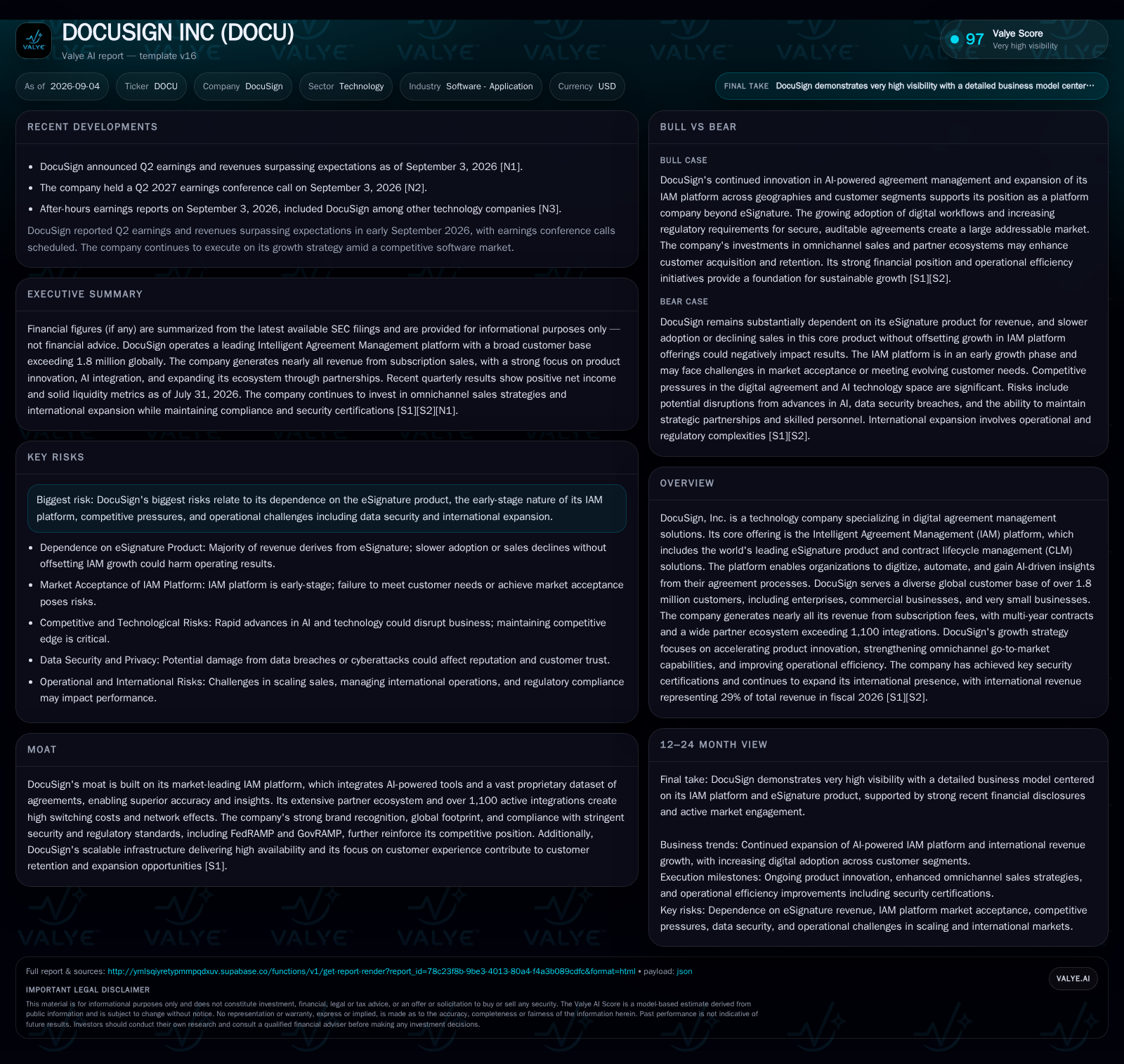
DocuSign remains a key player in digital agreement management, anchored by its leading eSignature product and growing Intelligent Agreement Management (IAM) platform. The subscription-based business model, supported by a large global customer base and extensive integrations, underpins recurring revenue with high visibility. Innovation in AI-powered workflow tools and strategic omnichannel sales expansion provide avenues for growth. Yet, challenges from reliance on eSignature revenue, competitive pressure in AI adoption, and operational complexity in international expansion pose execution risks. Key to DocuSign’s trajectory will be IAM adoption success, ecosystem leverage, and managing security and regulatory demands.
DocuSign has solidified its position as a leading provider of digital agreement solutions through its Intelligent Agreement Management platform, which integrates AI capabilities with its dominant eSignature offerings. With over 1.8 million customers worldwide and subscription revenues comprising 98% of its business, DocuSign demonstrates high recurring revenue visibility. Recent quarterly results beating expectations underscore operational progress and market acceptance. However, the company’s growth hinges on expanding adoption of its nascent IAM platform, managing competitive pressures from evolving AI technologies, and scaling international operations amid complex regulatory environments. This analysis explores DocuSign’s business economics, competitive positioning, and plausible growth pathways over the next two years.
Operational Momentum and Expanding Digital Agreement Ecosystem
As of January 31, 2026, DocuSign serves over 1.8 million global customers, including approximately 280,000 direct enterprise and commercial clients, with no single customer contributing more than 10% of total revenue [S1]. The company’s Intelligent Agreement Management platform integrates leading eSignature solutions with AI-driven tools such as Navigator, Maestro, and DocuSign Iris, broadening the product scope beyond simple electronic signatures [S1].
Subscription sales accounted for 98% of fiscal 2026 revenue, with terms typically ranging from one to three years and payments largely made annually, providing strong revenue visibility and predictability [S1]. The company has also achieved important security certifications, including FedRAMP Moderate and GovRAMP authorizations, enabling penetration into government and security-sensitive sectors [S1]. Recent Q2 2027 earnings surpassed market expectations, reflecting effective execution of product innovation and omnichannel go-to-market strategies [N1][N2].
Subscription-Driven Revenue with Operating Leverage Emerging from AI-Enabled Platform Expansion
DocuSign generates nearly all its revenue from subscription-based contracts, which create a recurring revenue base with multi-year duration. This model supports high revenue visibility and smoother cash flow. Pricing likely involves volume tiers and product bundles, with a mix weighted towards enterprise customers who drive higher contract values and longer durations. Operating leverage arises from spreading fixed costs of platform development and infrastructure over a growing base of subscribers, particularly as the company upsells IAM capabilities to existing eSignature customers.
Capital intensity is moderate, concentrated on R&D investments in AI and workflow automation to enhance platform capabilities, and on maintaining secure, compliant cloud infrastructure. Variable costs primarily involve customer support and sales commissions tied to new business acquisition and renewals. The broad partner ecosystem—over 1,100 active integrations—creates indirect sales channels that can improve customer acquisition efficiency and reduce direct sales costs, enhancing margin scalability if partner penetration deepens.
A critical aspect of DocuSign's subscription model is the interplay between customer acquisition costs (CAC) and lifetime value (LTV), which fundamentally governs the unit economics sustainability. While the platform's multi-year contracts and high continued-adoption indicators suggest strong LTV, the intensifying competition in AI-driven agreement management could pressure CAC upward, especially as competitors invest heavily in sales and marketing to capture enterprise clients. Monitoring the ratio of LTV to CAC over time would provide insight into whether DocuSign can maintain profitable growth as it scales IAM offerings. Additionally, the pace at which existing customers adopt higher-tier IAM functionalities versus new customer acquisition impacts operating leverage realization, as upselling typically incurs lower incremental costs than new sales.
Platform Leadership Supported by AI Innovation and Ecosystem Integration amid Intensifying Rivalry
DocuSign’s moat derives from its market-leading IAM platform that integrates AI-powered contract lifecycle management tools and a vast partner ecosystem, including Microsoft, SAP, and Salesforce [S1]. This integration breadth increases switching costs by embedding DocuSign’s solutions deeply into customers’ digital workflows. Additionally, the proprietary data from millions of agreements enhances AI accuracy and insight capabilities, potentially differentiating the platform.
However, the company faces significant competitive pressure from established software vendors expanding into agreement management and AI-driven contract analytics, as well as emerging specialized startups leveraging AI. The core eSignature product remains the largest revenue contributor but is susceptible to commoditization. Maintaining innovation pace, securing strategic partnerships, and managing regulatory compliance—especially in international markets—are critical to sustaining competitive advantage.
IAM Adoption Accelerates Platform Scale and High-Margin Revenue Growth
In a favorable scenario, DocuSign successfully accelerates adoption of its AI-powered IAM platform, with existing customers upgrading from eSignature-only contracts to broader workflow and contract lifecycle management solutions. This expansion boosts average contract value and lengthens customer lifetime, leveraging the high operating leverage inherent in subscription SaaS models.
Further, deepening integration with strategic partners and increased penetration in regulated government and enterprise sectors—enabled by FedRAMP and GovRAMP certifications—could open substantial new addressable markets. Confirmation would come from accelerating IAM ARR growth exceeding 20% year-over-year and improved gross margins reflecting higher software mix. Failure to see meaningful IAM adoption acceleration or partner ecosystem expansion would invalidate this scenario.
The competitive landscape not only challenges DocuSign on feature innovation but also tests its moat through potential commoditization of core eSignature services. As AI capabilities become more widespread and accessible, competitors might integrate similar functionalities into broader enterprise software suites, eroding DocuSign's differentiation. Moreover, the risk of platform lock-in weakening arises if customers perceive alternative providers offer comparable AI-powered contract management with easier integration or better pricing. To counter these pressures, DocuSign’s ability to continuously enhance proprietary AI models using its unique agreement data and to expand its partner ecosystem depth will be crucial. Furthermore, regulatory compliance complexity, especially in diverse international jurisdictions, could act as a barrier to entry that reinforces DocuSign’s position if managed effectively, but also as a moat vulnerability if compliance lapses occur.
IAM Growth Continues Alongside Stable eSignature Revenue and International Expansion
The most plausible trajectory envisions steady but measured growth in IAM platform adoption, offsetting some deceleration in pure eSignature product sales as market saturation increases. Subscription renewals remain high, supporting recurring revenue, while new customer acquisition benefits from an omnichannel strategy combining direct, partner, and self-service channels.
International revenue expands at a moderate pace, driven by targeted investments in civil law jurisdictions and data residency compliance. Operational efficiency gains from streamlined sales and product development offset rising costs from competitive pressure and regulatory compliance. The company’s ability to maintain security certifications and avoid major data breaches supports stable customer retention. Confirming evidence includes consistent revenue growth in single-digit to low double-digit percentages, with IAM representing an increasing but still minority share of ARR. A sudden drop in continued-adoption indicators or regulatory setbacks would challenge this outlook.
The acceleration of IAM adoption not only increases revenue but also enhances margin profiles due to the higher software mix and lower incremental costs associated with AI-driven automation. This dynamic could create a virtuous cycle where improved margins enable greater reinvestment into R&D and partner ecosystem expansion, further entrenching DocuSign’s platform leadership. Additionally, success in regulated sectors through FedRAMP and GovRAMP certifications could unlock premium pricing opportunities and longer contract durations, amplifying customer lifetime value. However, this scenario depends on seamless integration of AI tools into existing workflows, requiring effective change management and customer education to overcome adoption inertia. Confirmation of this pathway would also involve observing improvements in net dollar retention and expansion revenue metrics, reflecting customer willingness to deepen platform usage.
IAM Adoption Challenges and Competitive Pressures Threaten Revenue and Margin Growth
In a downside case, the IAM platform fails to gain significant traction due to customer reluctance to migrate away from legacy processes or competing AI solutions offering superior features or lower prices. This stalls revenue diversification, leaving the company heavily dependent on eSignature sales, which may face pricing pressure and commoditization in a crowded market.
Simultaneously, increased operational complexity and costs from international expansion fail to produce proportional revenue gains, while security incidents or regulatory non-compliance damage customer trust and retention. Evidence for this scenario includes declining or stagnant IAM ARR, erosion of eSignature pricing power, rising churn rates, and failure to renew key partner agreements. Conversely, quick recovery in IAM uptake or strong contract renewals could falsify this outcome.
IAM Platform Uptake and Customer Retention Metrics Will Clarify Growth Sustainability
Key metrics to monitor include the annual recurring revenue (ARR) growth rate of the Intelligent Agreement Management platform, which currently accounts for approximately 10.8% of ARR [S1]. Accelerating IAM ARR growth beyond 20% annually would signal successful platform expansion.
Customer retention and net dollar retention rates, particularly in enterprise segments where contract sizes are larger, would indicate the strength of customer loyalty and the effectiveness of cross-selling IAM add-ons.
Monitoring the mix of subscription contract lengths and continued-adoption indicators helps assess revenue visibility and customer commitment. Additionally, tracking the number and depth of partner integrations, especially with strategic partners, would reveal ecosystem traction.
International revenue growth and the company’s ability to maintain compliance certifications like FedRAMP and GovRAMP are critical as DocuSign expands globally. Finally, observing any reported security incidents or regulatory challenges is essential to evaluate risks to reputation and customer trust.
Disclaimer: This is research-only, informational analysis and not investment advice. It may include AI-generated interpretation and general industry context. Always verify important details using primary sources.

Comments