
Quanex Expands Global Presence While Managing Operational Risks in a Cyclical Industry
Quanex Building Products leverages its expanded product portfolio and geographic reach post-Tyman acquisition to capitalize on residential remodeling and new construction trends, yet faces execution challenges from internal control remediation and AI adoption risks.
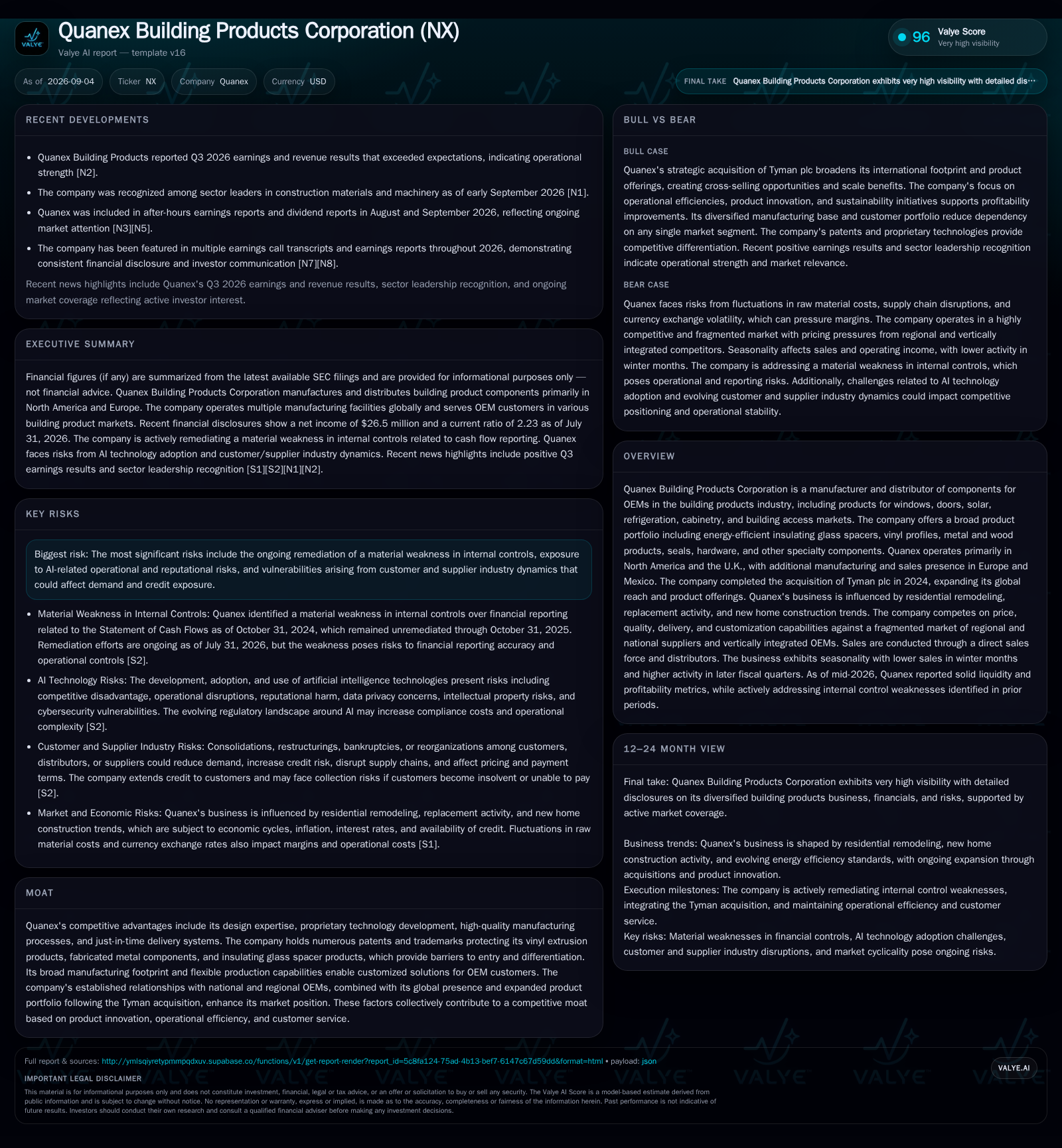
Quanex’s diversified building components business benefits from broad manufacturing scale and a global OEM customer base, supported by recent acquisition-driven expansion and strong Q3 2026 financial results. The company’s economics hinge on volume-driven manufacturing leverage and competitive differentiation via proprietary technologies. However, seasonal demand swings, fragmented competition, and ongoing internal control weaknesses pose operational risks. Strategic success depends on integrating Tyman, navigating AI-related uncertainties, and maintaining cost discipline amid raw material and currency pressures.
Quanex Building Products Corporation has solidified its role as a key supplier of building product components through strategic expansion and operational focus. The 2024 acquisition of Tyman plc markedly extended Quanex’s geographic and product footprint, enhancing its competitive positioning across North America and Europe. While the company benefits from sustained demand in remodeling and new construction, it confronts notable operational risks including a lingering material weakness in internal controls and the evolving impact of artificial intelligence on its industry. The interplay of these factors will critically shape Quanex’s ability to convert scale and innovation into durable profitability and growth.
Expanding Global Reach with Strong Q3 Performance and Operational Challenges
Quanex completed the acquisition of Tyman plc in August 2024, significantly expanding its manufacturing presence across multiple countries and diversifying its product portfolio to include solar, refrigeration, cabinetry, and building access components alongside traditional window and door markets [S1]. This acquisition enhances Quanex’s ability to serve OEM customers globally, creating potential cross-selling synergies and scale economies.
As of July 31, 2026, Quanex reported net income of $26.5 million and a current ratio of 2.23, reflecting solid liquidity and profitability metrics [S2]. However, the company continues to remediate a material weakness in internal controls related to cash flow reporting identified in 2024, which remains unremediated but is under active management [S2]. Notably, Quanex beat Q3 2026 earnings and revenue expectations, indicating operational strength even as it manages these internal challenges [N2].
Capital-Intensive Manufacturing and Seasonal Demand Create Operating Leverage Potential
Quanex’s business model centers on manufacturing and distributing customized components for OEMs in the building products sector. The company’s revenue derives from volume sales of products such as insulating glass spacers, vinyl profiles, and metal and wood components, where pricing is influenced by raw material costs, customer specifications, and competitive pressures [S1]. The capital-intensive manufacturing footprint, encompassing 34 U.S. facilities and several international plants, imposes significant fixed costs that create operating leverage if utilization rates remain high.
Seasonality is a key factor, with demand typically weaker in winter months and peaking in the third and fourth quarters, aligning with construction cycles [S1]. Operating leverage thus depends on smoothing production and sales through these cycles. The acquisition of Tyman has broadened product mix and geographic reach, potentially improving capacity utilization and pricing mix. However, managing raw material cost volatility, currency risks, and the impact of fluctuating construction activity is critical to maintaining margin stability.
The capital-intensive nature of Quanex’s manufacturing operations also necessitates a nuanced approach to capacity planning and capital expenditure. Given the cyclical nature of the construction industry, the company must carefully balance investments in new equipment or facility upgrades against the risk of underutilization during downturns. This dynamic creates a tension between maintaining technological competitiveness and preserving potential financial flexibility. Moreover, the geographic dispersion of manufacturing sites introduces complexity in managing capacity across regions with potentially asynchronous demand cycles, requiring sophisticated demand forecasting and supply chain coordination to avoid bottlenecks or excess inventory accumulation.
Furthermore, the company's exposure to raw material cost volatility, particularly for commodities like aluminum, vinyl, and glass, underscores the importance of effective procurement strategies and supplier relationships. Implementing hedging mechanisms or long-term contracts may help stabilize input costs, but these approaches also carry risks if market conditions shift unexpectedly. Currency fluctuations add another layer of complexity given Quanex's international footprint, affecting both input costs and the competitiveness of exported products. The ability to pass through cost increases to OEM customers without eroding volume is a critical factor influencing margin resilience in this environment.
Patents, Customization, and Delivery Capabilities Anchor Quanex’s Competitive Advantage
Quanex’s competitive advantage stems from its design expertise, proprietary technologies, and patented products in vinyl extrusion and insulating glass spacers, combined with high-quality manufacturing and just-in-time delivery systems [S1]. These factors create switching frictions for OEM customers who require reliable, customizable components that meet precise specifications. The company’s broad product portfolio and expanded global footprint following the Tyman acquisition enhance its ability to serve diverse customer needs and reduce dependency on any single market segment.
Nevertheless, the building products market is highly fragmented, with competition from regional suppliers, vertically integrated OEMs, and national players vying on price, quality, and delivery reliability [S1]. Price sensitivity and product commoditization risk remain persistent challenges, especially in metal, vinyl, and wood product categories. Sustaining differentiation through innovation and operational excellence is essential to defend market share and pricing power.
Seamless Integration and Innovation Propel Sustainable Profit Growth
In a favorable scenario, Quanex successfully integrates Tyman’s operations and product lines, realizing cross-selling opportunities and operational synergies that improve capacity utilization and reduce overhead costs. Enhanced scale enables more efficient raw material procurement and supply chain management, mitigating cost pressures. Concurrently, Quanex leverages its R&D capabilities and patent portfolio to innovate energy-efficient and sustainable building components, capturing growing demand driven by tightening energy standards and environmental regulations.
Evidence supporting this scenario would include steady margin expansion, increasing customer orders from diversified segments, and successful product launches that gain OEM adoption. Additionally, remediation of internal control weaknesses would bolster investor confidence and operational stability. Conversely, failure to realize synergy targets or continued operational disruptions would falsify this positive outlook.
Growth Prospects Amid Market Cyclicality and Operational Enhancements
The most plausible scenario envisions Quanex maintaining steady, moderate growth driven by stable residential remodeling and new home construction activity, offsetting seasonal fluctuations. The company continues to benefit from its broad product portfolio and geographic diversification but faces ongoing margin pressure from raw material cost variability and competitive pricing dynamics. Incremental progress in internal control remediation improves financial reporting but does not fully eliminate operational risk in the near term.
Under this scenario, Quanex’s revenue growth tracks closely with underlying construction market trends, and profitability margins fluctuate within a stable range. Confirming evidence would be consistent quarterly earnings without major surprises and controlled cost inflation. Signs of prolonged margin compression or renewed internal control deficiencies would challenge this outlook.
Operational Disruptions and Competitive Pressures Threaten Profitability
A downside scenario involves failure to remediate material weaknesses in internal controls, leading to financial reporting irregularities or increased compliance costs that distract management and undermine investor trust. Concurrently, accelerated AI adoption by competitors could disrupt Quanex’s operational model or erode its competitive position if the company lags in technology integration or faces reputational risks related to AI deployment [S2].
Further, supply chain disruptions, customer consolidations, or bankruptcies could negatively impact demand and credit risk. Persistent raw material inflation combined with intensified price competition from integrated OEMs and regional suppliers may compress margins significantly. Evidence for this scenario would include ongoing audit qualifications, declining order volumes, margin erosion, or loss of key OEM customers. Conversely, successful mitigation of these risks would falsify this downside path.
Indicators to Assess Integration Success, Operational Efficiency, and Market Position
Metrics that would help assess Quanex’s trajectory include quarterly capacity utilization rates across manufacturing plants, which indicate operating leverage realization and fixed cost absorption. Monitoring the progress and final outcome of internal control remediation efforts would provide insight into financial reporting reliability and operational discipline.
Tracking product mix evolution and new product adoption rates by OEM customers could reveal the effectiveness of innovation and cross-selling post-Tyman acquisition. Additionally, observing raw material cost trends relative to pricing adjustments and margin stability would illuminate Quanex’s pricing power and cost management efficacy.
Customer concentration and credit risk metrics, if disclosed, would indicate exposure to industry consolidations or financial stress. Finally, shifts in sales seasonality patterns or geographic revenue distribution could signal changing market dynamics or competitive pressures.
Disclaimer: This is research-only, informational analysis and not investment advice. It may include AI-generated interpretation and general industry context. Always verify important details using primary sources.

Comments