
Snowflake's AI Data Cloud Fuels Revenue Growth Despite Profitability Challenges
Snowflake's consumption-based AI Data Cloud platform leverages multi-cloud scalability and industry focus to fuel strong revenue growth, yet its path to sustainable profitability hinges on managing competitive pressures, consumption variability, and AI execution complexity.
Snowflake reported robust revenue growth in Q2 2026, powered by its AI-enhanced Data Cloud platform and expanding enterprise adoption. The company’s consumption-based model aligns pricing with usage, creating growth leverage but also forecasting challenges. Snowflake’s multi-cloud, multi-region architecture and industry-specific solutions differentiate its platform amid intense competition. Continued innovation and ecosystem expansion underpin upside potential, while profitability remains elusive due to investment demands and operational complexity. Key risks include competition from hyperscalers, AI strategy execution, and regulatory compliance. Monitoring consumption patterns, customer expansion, AI integration progress, and margin trends will be critical to evaluating Snowflake’s maturation.
Snowflake Inc. continues to capitalize on its cloud-native AI Data Cloud platform, reporting a strong 35% revenue surge in Q2 2026 alongside narrowing losses. The company’s technology supports diverse data workloads across multiple public clouds with a consumption-based pricing model that aligns revenue with customer usage. While this model drives robust growth and customer flexibility, it also introduces variability that complicates forecasting and profitability. Snowflake’s multi-cloud, multi-region architecture combined with industry-tailored solutions and developer tools positions it well in a highly competitive landscape dominated by hyperscalers and specialized AI entrants. The key question is whether Snowflake can sustain innovation and expand its ecosystem to convert growth advantages into durable profitability and market leadership.
Q2 2026 Earnings Highlight Strong Growth and AI-Driven Momentum
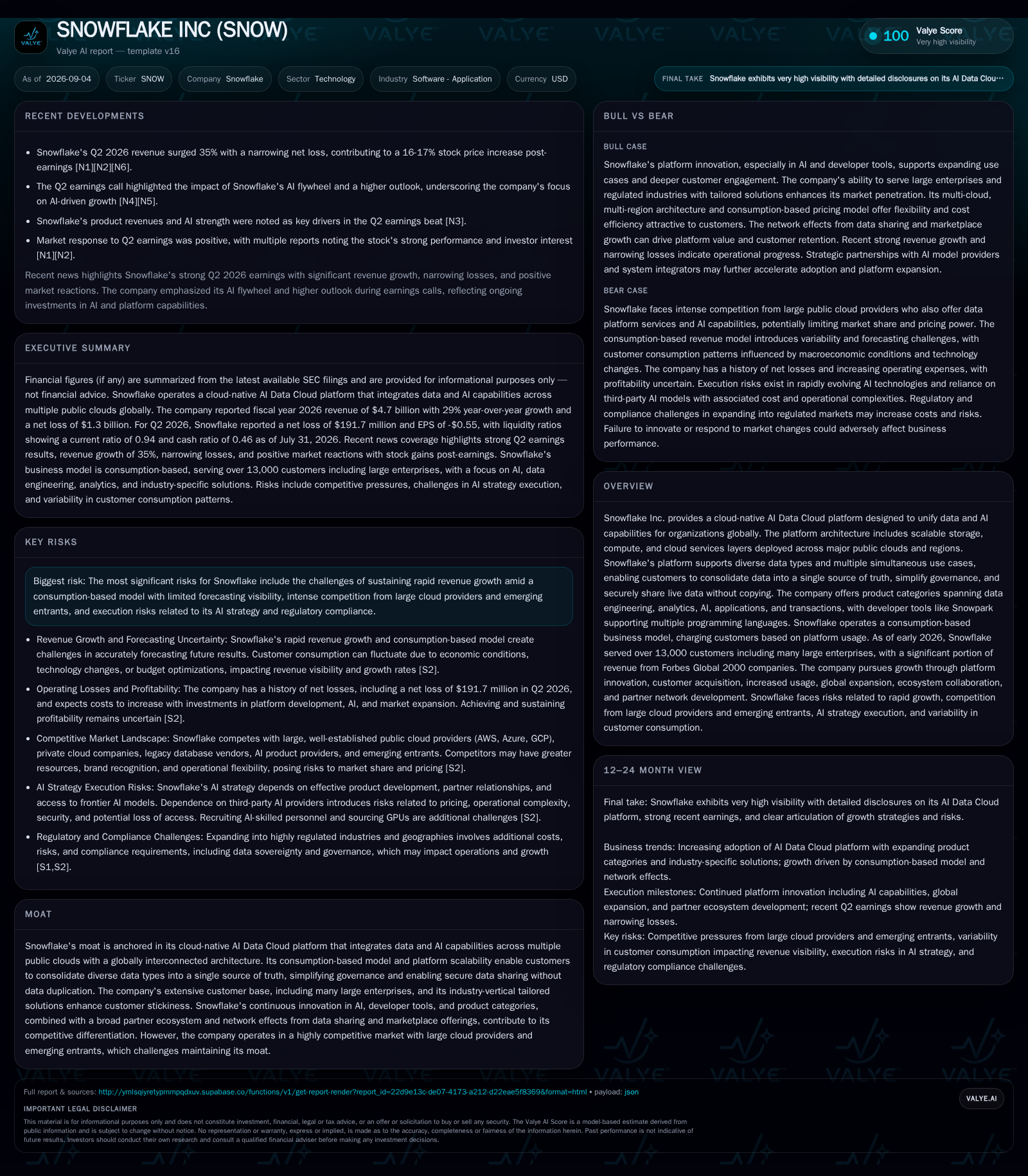
Snowflake reported fiscal year 2026 revenues of $4.7 billion, marking a 29% year-over-year increase, with Q2 2026 revenue growth accelerating to 35% [S1][N1][N6]. Despite this expansion, the company posted a net loss of $191.7 million in Q2, narrowing from prior periods, reflecting ongoing investment in AI and platform development [S2][N6]. The stock responded positively to these results, gaining approximately 16-17% post-earnings, signaling market approval of the growth trajectory and improving financial metrics [N1][N2].
The Q2 earnings call emphasized the 'AI flywheel' effect—Snowflake’s ability to embed AI capabilities deeply into its platform to attract more usage and increase customer value [N4][N5]. The company’s platform supports multi-cloud deployment with 53 regional interconnected cloud nodes, enabling flexibility and compliance across geographies [S1]. Snowflake serves over 13,000 customers, including 790 Forbes Global 2000 enterprises, which contributed about 43% of its revenue, underscoring penetration into large regulated industries [S1].
Consumption-Based Pricing Enables Growth Leverage but Challenges Visibility
Snowflake’s primary revenue driver is its consumption-based business model, whereby customers pay according to actual usage of storage, compute, and cloud services layers rather than fixed subscriptions [S1]. This aligns incentives for customers to expand usage organically as their data workloads grow, leading to expanding revenue within existing accounts and reducing upfront sales friction. However, this model inherently introduces variability, as customer consumption can fluctuate with economic cycles, project timing, or technology adoption patterns, complicating forecasting and revenue visibility [S2].
From an operating leverage perspective, Snowflake’s architecture with independently scalable storage and compute layers allows for flexible capacity management, which can improve gross margins as usage scales. However, significant investments in R&D, AI capabilities, and global expansion contribute to high operating expenses and net losses to date [S2]. The key to sustainable operating leverage will be balancing growth-driven fixed-cost absorption with moderating incremental spending, especially in AI infrastructure (e.g., GPUs) and sales/marketing to manage customer acquisition and retention costs.
Multi-Cloud Architecture and Vertical Focus Differentiate Amidst Hyperscaler Rivalry
Snowflake’s platform is designed to operate natively across AWS, Azure, and Google Cloud, with a globally interconnected footprint of 53 regional deployments. This multi-cloud, multi-region strategy reduces customer lock-in risks and supports compliance with local data sovereignty requirements, which is increasingly important for regulated industries such as financial services and healthcare [S1]. The company’s emphasis on industry-specific solutions and developer tools like Snowpark enhances customer value by tailoring offerings to vertical needs and programming flexibility.
Nevertheless, Snowflake competes against formidable incumbents—hyperscalers who offer integrated cloud infrastructure and data services (AWS Redshift, Azure Synapse, Google BigQuery), legacy database vendors, and emerging AI-focused platforms [S2]. These competitors benefit from broader cloud service portfolios, scale economies, and established customer relationships. Snowflake’s ability to maintain differentiation depends on continuous platform innovation, embedding AI capabilities, seamless data sharing without duplication, and expanding its partner ecosystem to build network effects that increase switching costs.
AI Integration and Ecosystem Expansion Accelerate Platform Adoption and Profitability
In a favorable scenario, Snowflake successfully leverages its AI flywheel by integrating frontier AI models via Snowpark Container Services, enabling customers to rapidly develop and deploy AI-powered data applications at scale. This deep AI integration drives increased consumption across compute and storage layers, expanding revenue within existing customers and attracting new enterprise accounts seeking advanced analytics and AI capabilities [N3][N4]. Industry-specific solutions further entrench usage in regulated sectors, which tend to have higher switching costs and longer sales cycles.
Simultaneously, Snowflake grows its data marketplace and external sharing ecosystem, creating network effects where customers derive incremental value from live data collaboration without duplication. This increases platform stickiness and reduces churn. Economies of scale improve gross margins and operating leverage, while streamlined sales and support driven by platform maturity reduce CAC and operating expenses. Confirming evidence would include sustained acceleration in large customer consumption, expansion of AI workload share, improving gross margins, and stable or declining net losses. Conversely, failure to expand AI capabilities or ecosystem engagement would weaken this upside thesis.
Growth Balances Consumption Variability and Competitive Pressures
The most plausible scenario is that Snowflake continues to grow revenue at a healthy but moderated pace (mid-to-high 20% range) as its consumption-based model delivers organic expansion within a large customer base, offset by macroeconomic and competitive headwinds. AI integration progresses incrementally, with some enhancement to product offerings but limited immediate impact on usage expansion. Customer growth remains strong in existing verticals, although new vertical penetration is gradual due to regulatory and sales-cycle complexities.
Operating losses narrow slowly as investments in AI and global expansion continue, balanced against improving efficiency gains in cloud infrastructure costs and sales productivity. Competitive pressures from hyperscalers limit pricing power and market share gains. Revenue visibility remains challenging but manageable through conservative guidance. Confirming evidence includes steady consumption growth trends, incremental product enhancements, stable gross margins, and moderate improvement in operating losses. A falsification test would be sudden margin compression or a material deceleration in customer usage growth.
AI Execution Missteps and Competitive Erosion Stall Growth and Profitability
In a downside case, Snowflake faces challenges executing on its AI strategy due to reliance on third-party AI model providers, increasing costs, operational complexity, and potential loss of access or security issues [S2]. This undermines the AI flywheel, limiting new workload growth and reducing the appeal of the platform for advanced use cases. Simultaneously, hyperscale cloud providers deepen integration of their AI and data services, leveraging superior scale and bundled offerings to pressure Snowflake’s pricing and customer retention.
The consumption-based model exacerbates revenue volatility as budget-constrained customers curb usage or switch platforms. Regulatory compliance costs and market expansion efforts strain resources without commensurate revenue returns. Operating losses widen as sales and R&D investments fail to translate into growth, raising concerns about business viability. Confirming evidence includes decelerating revenue growth, expanding net losses, customer attrition in key verticals, and negative AI adoption indicators. Conversely, stabilization or renewed AI product momentum would challenge this downside thesis.
Customer Usage Patterns and AI Integration Progress Inform Outlook
Key metrics that would help test Snowflake’s investment thesis include: (1) growth rate and expansion of consumption within top-tier enterprise customers, particularly Forbes Global 2000 accounts, to assess revenue base quality; (2) adoption and usage metrics of AI-related platform features such as Snowpark Container Services, indicating AI flywheel traction; (3) gross margin trends to evaluate operating leverage and cost efficiencies amid scaling compute and storage costs; (4) customer retention or churn rates if disclosed, critical for judging platform stickiness in a competitive environment; and (5) sales efficiency metrics like customer acquisition cost and payback periods to monitor capital deployment effectiveness.
Additional useful indicators include pipeline growth in regulated industry verticals, progress in expanding the data marketplace and partner ecosystem, quarterly guidance consistency reflecting consumption predictability, and R&D spending allocation to AI versus other platform components. Monitoring regulatory developments affecting data governance and cross-border data sharing would also provide insights into operational risks impacting growth.
Disclaimer: This is research-only, informational analysis and not investment advice. It may include AI-generated interpretation and general industry context. Always verify important details using primary sources.

Comments