
Project-Driven Growth Meets Execution and Credit Challenges at Perma-Pipe International
Perma-Pipe’s Q2 2026 results highlight the upside and volatility of its project-centric business model, as regional volume surges are offset by margin pressures, rising debt, and a notable receivable write-off. The company’s next phase hinges on execution in new facilities and disciplined credit risk management.
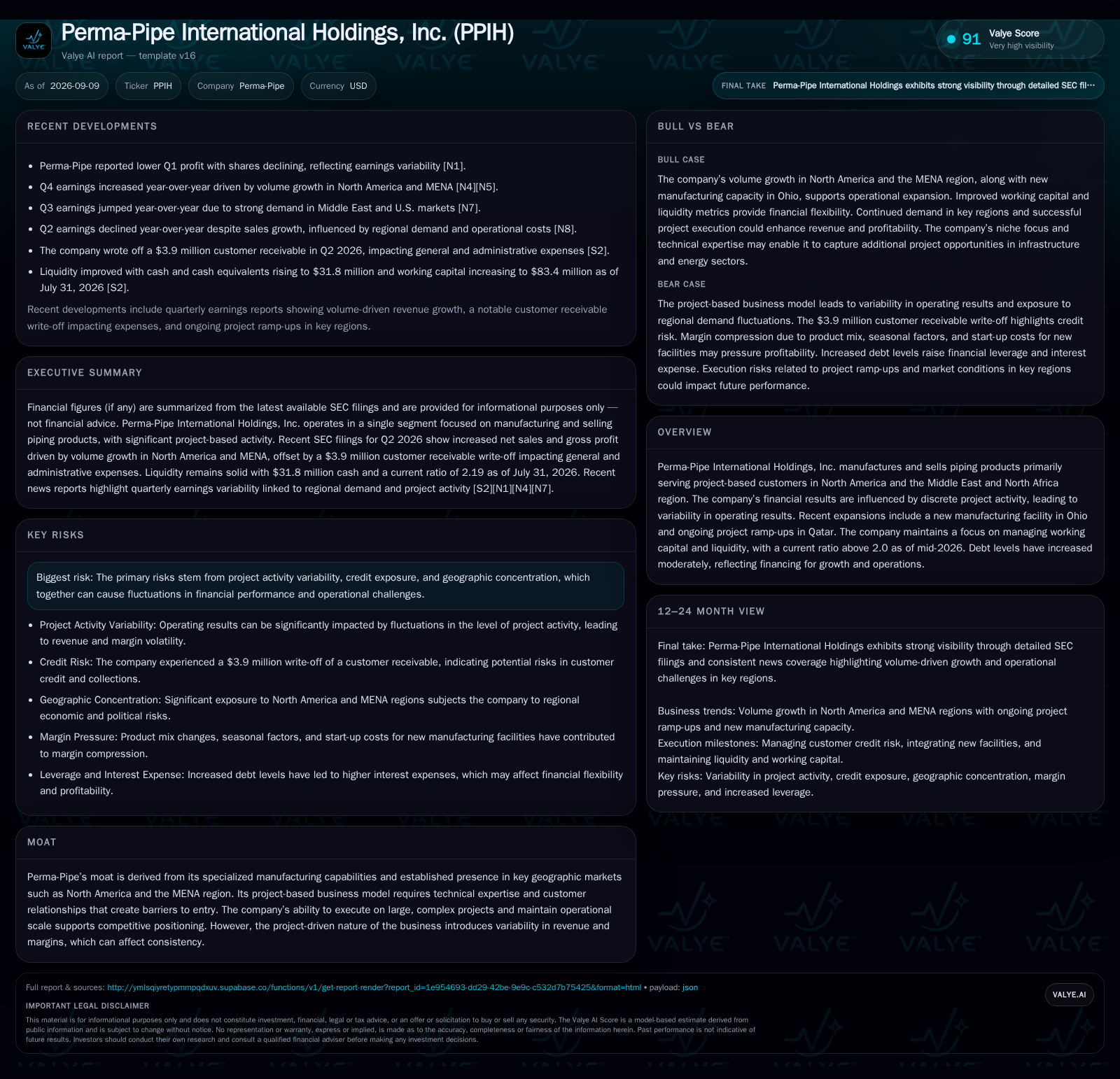
Perma-Pipe International’s strong Q2 2026 revenue growth in North America and MENA underscores its position in infrastructure-focused piping solutions, but a $3.9 million receivable write-off and increased debt levels reveal the risks inherent in a project-based model. Margin stability depends on execution, customer discipline, and regional demand cycles, as the company ramps up new capacity and navigates a variable project pipeline. The company reported $31.8 million in cash and a current ratio of 2.19 as of July 31, 2026, reflecting improved liquidity, but exposure to credit losses and operating leverage will be key swing factors for future profitability and resilience. [S2]
Perma-Pipe International’s latest results capture the dual nature of its business: robust revenue momentum from infrastructure and energy projects in North America and the Middle East, alongside the operational and financial volatility that comes with a project-centric, capital-intensive model. While Q2 2026 saw strong top-line growth and stable gross margins, the period was also marked by a significant receivable write-off and rising debt, underscoring the importance of execution, customer vetting, and working capital discipline. The company’s ability to convert new manufacturing capacity and regional demand into sustainable profit will depend on how it manages these inherent risks and the variability of its project pipeline.
Recent Results Reveal Both Growth Momentum and Underlying Exposures
Perma-Pipe reported Q2 2026 net sales of $59.6 million, up from $47.9 million in the prior year, propelled by higher sales volumes in North America and the MENA region. Gross profit rose to $17.4 million, with a margin of 29%, essentially holding steady despite increased project activity. However, the quarter also featured a $3.9 million write-off of a customer receivable, which drove general and administrative expenses up to $11.9 million, compared to $10.0 million a year ago. Debt climbed to $36.1 million, reflecting both new facility investments and working capital needs. As of July 31, 2026, the company reported $31.8 million in cash and a current ratio of 2.19, indicating improved liquidity compared to earlier in the year. These headline positives are tempered by evidence of credit risk and the costs of expansion. [S2]
How Project Timing, Mix, and Credit Shape Profitability
Perma-Pipe’s revenue model is anchored in large, project-based contracts—primarily for insulated piping systems used in infrastructure, energy, and district heating/cooling applications. This structure can yield meaningful operating leverage when plant utilization is high, as seen in periods of strong regional demand. However, the fixed cost base for manufacturing and the need to scale up or idle capacity in response to project cycles create inherent volatility in both revenue and margins.
Gross margins have hovered near 29% in recent quarters, but are sensitive to project mix, start-up costs for new facilities (such as the recent Ohio plant), and occasional low-margin or loss-making jobs. The $3.9 million receivable write-off in Q2 2026 underscores another economic reality: customer concentration and credit exposure can quickly erode profitability. As debt levels rise to fund growth or working capital, net interest expense also ticks up, as seen in the increase from $0.4 million to $0.5 million quarter over quarter. The company’s ability to generate free cash flow is thus tightly linked to project execution, customer payment discipline, and careful expansion pacing.
Specialization and Regional Reach Provide Advantages—But Not Immunity from Cyclicality
Perma-Pipe’s competitive edge comes from its technical expertise in insulated piping solutions and its established presence in North America and the MENA region. Barriers to entry in this niche include the engineering complexity of systems, customer qualification processes, and the scale required to bid competitively on large projects. However, the market is not without substitutes: traditional piping, modular prefab solutions, and alternative energy infrastructure approaches can constrain pricing power, especially in commoditized segments or in regions with aggressive local competition.
The company’s project-driven model also means customer relationships and reputation for execution are crucial—repeat business and prequalification for bids can create a moat, but only if execution remains consistent. Regional diversification between North America and MENA helps manage some demand risk, but geographic concentration also exposes the company to local economic and political disruptions. While new capacity in Ohio and project ramp-ups in Qatar strengthen the company’s platform, they also heighten exposure to execution risk and fixed cost absorption challenges if demand falters.
If Project Pipeline and Credit Discipline Align, Profitable Growth Could Accelerate
A favorable scenario would see Perma-Pipe successfully ramping new manufacturing capacity in Ohio and executing major MENA projects on schedule, leading to sustained high plant utilization and improved operating leverage. If the company can tighten credit standards and collections, reducing the risk of further large receivable write-offs, then margin stability could follow even as volumes grow. Regional infrastructure investment cycles, particularly in energy and district heating, could provide tailwinds, and a steady stream of awarded projects would increase revenue visibility.
Evidence supporting this scenario would include: a further rise in quarterly sales and gross profit without additional material receivable write-offs; stable or improving gross margins despite higher volumes; and working capital discipline that keeps liquidity robust even as debt levels are managed or reduced. Confirming signals would be successful project completions in new geographies and customer wins that diversify the revenue base.
Volatility Persists as Growth and Risk Counterbalance Each Other
The most likely outcome is continued volume-driven revenue growth punctuated by periodic margin compression and credit events. New facility ramp-ups in Ohio and Qatar will support higher sales, but the costs of integration, fluctuating product mix, and episodic bad debt write-offs will limit sustained margin expansion. Interest expense may tick higher if debt is used to finance working capital or new projects.
Over time, Perma-Pipe is likely to deliver mid-to-high single-digit sales growth, with gross margins oscillating around current levels. Earnings volatility will remain a feature, reflecting the timing of large projects and the company’s exposure to customer payment risk. This scenario would be confirmed by ongoing sales growth but periodic spikes in G&A or working capital usage, and by net income figures that bounce quarter-to-quarter rather than trend smoothly upward.
Credit Losses, Project Delays, or Execution Missteps Could Trigger Profit Erosion
A more adverse path would see Perma-Pipe facing further large customer defaults, additional bad debt write-offs, or project execution issues that lead to cost overruns and revenue slippage. Start-up costs at new facilities could run above plan if demand fails to materialize, pushing fixed cost absorption below break-even and compressing margins. Regional demand shocks—such as energy price declines in MENA or infrastructure spending cuts in North America—could further reduce project flow.
Indicators for this scenario would include: repeated or rising levels of receivable write-offs, gross margin falling below 25% for multiple quarters, cash balances declining despite higher sales, or the need to take on additional short-term debt to fund operations. Persistent negative net income or a deteriorating current ratio would also signal distress.
Milestones That Will Determine the Next Phase for Perma-Pipe
Quarterly gross margin trends: Sustained improvement or further compression will reveal whether the company is managing product mix and start-up costs effectively.
Receivable write-offs and days sales outstanding: Any recurrence of large bad debt events would confirm ongoing credit risk exposure.
Utilization rates at new Ohio and Qatar facilities (if disclosed): High utilization would support operating leverage, while underutilization would pressure margins.
Net sales growth by region: Monitoring whether North America and MENA can both deliver volume growth, or if one region falters.
Quarterly net income and earnings volatility: Persistent swings would underscore the continued impact of project timing and customer mix.
Debt and liquidity metrics: Watch for rising leverage or deteriorating current/cash ratios as a signal that growth is straining the balance sheet.
Project backlog and awarded contracts (if disclosed): A growing, diversified backlog would support revenue visibility and reduce volatility.
Customer concentration metrics: A useful metric would be the proportion of revenue from the top five customers, to gauge dependency and risk.
Disclaimer: This is research-only, informational analysis and not investment advice. It may include AI-generated interpretation and general industry context. Always verify important details using primary sources.

Comments