
Lakeland Industries Confronts Margin Pressure as Tariffs and Global Complexity Alter Protective Apparel Economics
Recent revenue outperformance has not offset mounting cost and margin headwinds for Lakeland Industries. As trade friction and international input costs intensify, the company’s ability to defend profitability in specialized protective markets is under scrutiny.
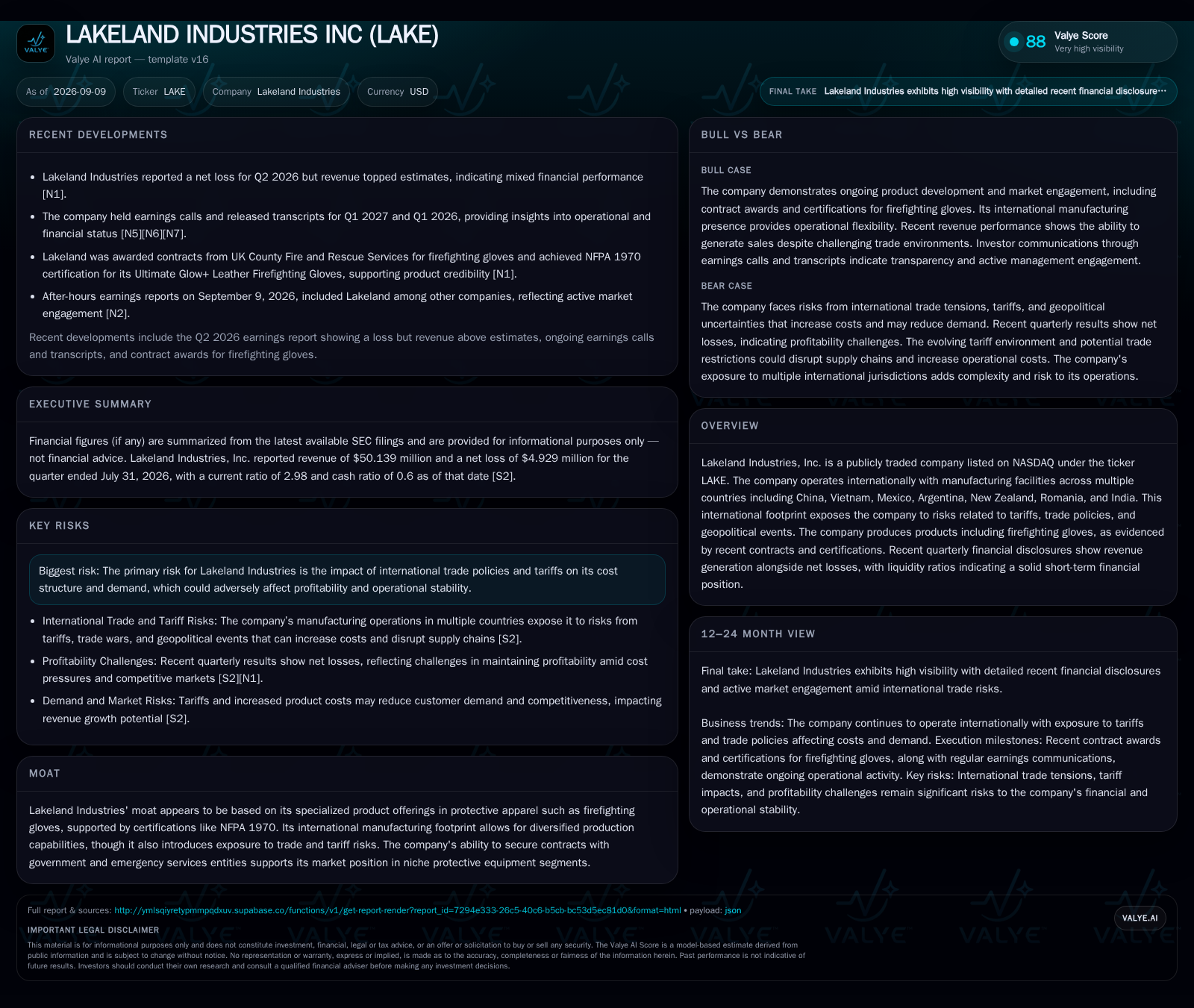
Lakeland Industries reported a net loss of $4.929 million for the quarter ended July 31, 2026, despite revenue of $50.139 million that topped estimates, reflecting ongoing margin pressure [S2] [N1]. While contract wins in firefighting gloves and product certifications support its niche positioning, sustained profitability will depend on managing input costs and navigating global trade risks. Key watchpoints include gross margin trends, tariff impacts, and the durability of demand from institutional customers [S2] [N1].
Lakeland Industries, a global provider of protective clothing and accessories, continues to generate revenue above expectations but remains challenged by escalating costs tied to tariffs and international manufacturing complexity. Despite recent contract awards from UK County Fire and Rescue Services for firefighting gloves and NFPA 1970 certification for its Ultimate Glow+ Leather Firefighting Gloves, Lakeland Industries reported a net loss of $4.929 million for Q2 2026 [N1] [S2]. As Lakeland’s extensive international footprint exposes it to ongoing trade and cost volatility, investors must weigh the resilience of its niche product strategy against the persistent drag on profitability and the uncertain trajectory of global trade policy [S2] [N1].
Revenue Beats Accompanied by Ongoing Losses from Tariff-Related Cost Pressures
Lakeland Industries reported revenue of $50.139 million for the quarter ending July 31, 2026, topping analyst estimates, but the company still posted a net loss of $4.929 million, with basic and diluted EPS of -$0.50 [S2] [N1]. This result highlights the company’s ongoing struggles with profitability, as increased costs from tariffs and global supply chain complexities continue to erode margins.
Recent developments include contract awards from UK County Fire and Rescue Services for firefighting gloves, as well as NFPA 1970 certification for the Ultimate Glow+ Leather Firefighting Gloves, which supports product credibility and potential future demand [N1]. Reported liquidity position, with a current ratio of 2.98 and cash ratio of 0.6 as of July 31, 2026, but the persistence of losses puts pressure on the company to demonstrate a sustainable path to profitability [S2].
Protective Apparel Margins Tightened by Global Sourcing and Tariffs
Lakeland Industries generates revenue primarily through the manufacture and sale of industrial protective clothing and accessories, targeting end markets such as fire services, industrial manufacturing, and government agencies. The company’s international manufacturing base—spanning China, Vietnam, Mexico, Argentina, New Zealand, Romania, and India—offers cost diversification but also amplifies exposure to tariffs and shifting trade policies [S2]. When tariffs rise or supply chains are disrupted, both input costs and lead times can increase, compressing gross margins and potentially reducing order volumes if customers balk at higher prices.
The business model features a mix of direct sales and distribution partnerships, with institutional contracts providing some revenue predictability. However, profitability is sensitive to fluctuations in raw material costs, freight, and regulatory compliance expenses. Fixed costs associated with maintaining global manufacturing capacity could limit operating leverage if volumes decline or if the company is unable to pass on cost increases to customers. The capital requirements are moderate for manufacturing but can spike if inventory builds up or if the company invests in new certifications and product development.
Niche Certifications and Institutional Contracts Compete with Global Apparel Rivals
Lakeland’s competitive edge rests on its portfolio of certified protective products—such as NFPA 1970-compliant firefighting gloves—and its ability to win contracts with government and emergency service agencies [N1]. Certifications provide a barrier to entry in specialized segments, as institutional buyers require proven compliance and reliability. However, this moat is not absolute; larger global protective apparel firms and regional specialists can compete aggressively on price, especially if they have more localized manufacturing or lower exposure to tariffs.
The company’s broad international manufacturing base can be a strength if it enables flexible sourcing and cost arbitrage, but it also increases complexity and vulnerability to regulatory shifts. Distribution partnerships and direct sales to large end-users help Lakeland maintain relevance, but switching costs for many institutional customers may be modest if competitors can match certifications and pricing. The durability of Lakeland’s niche depends on continuous product innovation, contract renewal success, and its ability to adapt to evolving compliance standards.
Cost Containment and Institutional Demand Support Margin Improvement
In a favorable scenario, Lakeland offsets tariff and cost headwinds through supply chain optimization—potentially shifting production to lower-tariff jurisdictions or renegotiating supplier terms. New product certifications (such as the recent NFPA 1970 for firefighting gloves) help secure multi-year contracts with government and industrial customers, providing higher-margin, recurring revenue streams [N1]. If the company is able to pass through cost increases or leverage its certifications to win premium pricing, gross margins could stabilize or improve.
Confirmation would come from a sustained rebound in gross margin percentage, a return to net profitability, and public disclosure of significant contract wins or renewals. This scenario would be falsified if margin compression persists, if order volumes decline due to uncompetitive pricing, or if new tariffs or supply disruptions offset operational improvements.
Managing Persistent Margin Pressure with Targeted Growth
The most plausible scenario is that Lakeland continues to experience margin pressure from elevated input costs and tariffs, but maintains modest revenue growth thanks to ongoing contract wins and product certifications. The company’s liquidity position allows it to absorb short-term losses while it seeks efficiencies and negotiates better terms with suppliers or customers [S2]. Product innovation and compliance with evolving standards keep Lakeland in the running for institutional contracts, but price competition and cost volatility limit profitability improvements.
Evidence for this scenario would be quarterly results that show stable or slightly improving revenue but continued thin or negative margins, and periodic announcements of new certifications or contract awards. It would be challenged if the company either breaks out of its margin rut (suggesting upside) or sees a material decline in revenue or contract renewals (suggesting downside).
Rising Trade Barriers and Cost Shocks Threaten Core Business
In a negative scenario, further tariff increases, supply chain disruptions, or geopolitical events drive up input costs beyond what Lakeland can pass on to customers. If institutional buyers shift to lower-cost or more locally sourced alternatives, the company could face declining volumes and contract losses, exacerbating operating leverage and deepening net losses [S2]. Inventory write-downs or cash burn could follow if demand weakens or if the company is forced to discount products to retain business.
This scenario would be confirmed by a drop in revenue, widening net losses, and disclosure of lost contracts or order cancellations. It would be challenged if Lakeland demonstrates the ability to quickly adapt its supply chain, secure new business despite cost pressures, or if trade policy risks abate.
Assessing Lakeland’s Resilience: Margins, Contracts, and Global Trade Dynamics
Gross margin trends: Sustained improvement or further erosion would signal the effectiveness of cost management and pricing power.
Tariff and trade policy impacts: Any changes in international trade agreements, tariff rates, or supply chain disruptions could materially affect costs and competitiveness.
Contract awards and renewals: Announcements of significant new or renewed institutional contracts—especially with government or emergency services—would help gauge future revenue visibility.
Certification pipeline: Progress on additional product certifications or regulatory approvals would support differentiation and access to new markets.
Disclaimer: This is research-only, informational analysis and not investment advice. It may include AI-generated interpretation and general industry context. Always verify important details using primary sources.

Comments