
Braze’s Multi-Channel Platform Fuels Growth Despite Profitability and Competitive Challenges
Braze’s rapid revenue expansion underscores demand for integrated customer engagement tools, but persistent operating losses and intensifying competition pose significant challenges to sustainable profitability and market leadership.
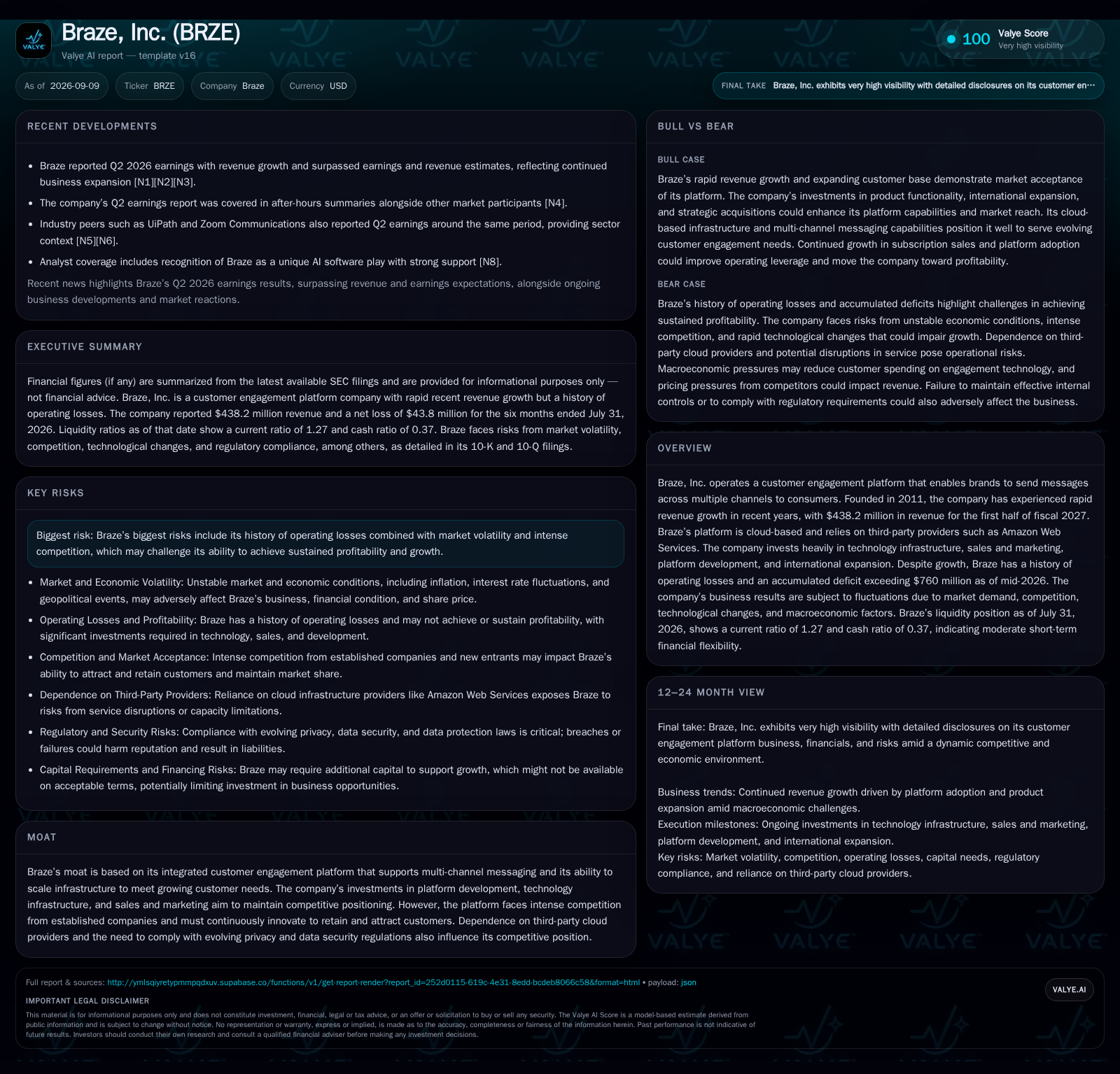
Braze, Inc. reported strong revenue growth of $438.2 million for the first half of fiscal 2027, fueled by expanding subscriptions and platform capabilities [S2] [N1]. Despite the top-line momentum, the company recorded a net loss of $43.8 million over the same period and carries a substantial accumulated deficit exceeding $760 million, reflecting ongoing investment and scale-up costs [S2]. Braze’s cloud-based multi-channel customer engagement platform benefits from increasing demand for personalized marketing automation but faces intense competition, reliance on third-party cloud providers, and regulatory challenges. The company’s operating economics hinge on scaling subscription volume and improving retention to leverage its fixed technology and infrastructure costs, with profitability dependent on balancing growth investments against margin pressures. Key uncertainties include sustaining customer acquisition and retention amid pricing competition and evolving data privacy regulations.
Braze, Inc. demonstrated robust revenue growth in the first half of fiscal 2027, reaching $438.2 million, a 28% increase from the prior year, signaling strong demand for its cloud-based multi-channel customer engagement platform [S2] [N1]. This performance reflects successful expansion in subscription sales and continued investment in platform functionality, marketing, and international reach. However, Braze’s financials also reveal ongoing operating losses and a sizable accumulated deficit, underscoring the challenges of scaling profitably amid fierce competition and evolving technology and regulatory landscapes. The company’s future hinges on its ability to convert top-line momentum into sustainable margins through efficient customer acquisition, retention, and operational leverage.
Recent Earnings Highlight Growth Momentum Despite Persistent Losses
Braze reported $438.2 million in revenue for the first six months of fiscal 2027, up from $342.2 million in the same period of 2025, reflecting a roughly 28% annual growth rate [S2] [N1]. This acceleration in revenue was accompanied by surpassing analyst earnings and revenue estimates in Q2 2026, signaling continued market acceptance of its customer engagement platform [N2] [N3]. The company’s Q2 results were notable against peers like UiPath and Zoom Communications, both of which also posted strong earnings in the period, emphasizing sector-wide interest in SaaS-based engagement solutions [N5] [N6].
Despite growth, Braze recorded a net loss of $43.8 million in H1 2027 and maintained an accumulated deficit exceeding $760 million, highlighting the ongoing cost structure pressures from investments in sales, marketing, platform development, and international expansion [S2]. Liquidity as of July 31, 2026, includes a current ratio of 1.27 and a cash ratio of 0.37, reflecting the company's reported short-term financial position without implying runway or investment capacity [S2]. These facts underscore a classic high-growth SaaS profile balancing rapid top-line expansion against sustained operating deficits.
Subscription-Driven Revenue Growth Supported by Fixed Platform Costs
Braze generates revenue primarily through subscription fees for access to its customer engagement platform, which enables brands to send personalized messages across multiple channels, such as email, push notifications, SMS, and in-app messaging [S1]. Pricing is likely structured on a volume or usage basis, potentially including tiers based on message volumes, number of active users, or feature bundles, although precise pricing mechanics are not disclosed. Volumes and customer acquisition are key revenue drivers, while pricing power depends on differentiated platform capabilities and switching costs.
Operating economics are characterized by substantial fixed costs tied to technology infrastructure, including reliance on third-party cloud providers like Amazon Web Services, and significant ongoing expenses in sales, marketing, and R&D [S1] [S2]. This cost structure creates operating leverage potential, whereby incremental revenue growth can disproportionately improve margins if fixed costs are absorbed. However, the need for continuous product innovation and international expansion investments tempers near-term margin gains. Variable costs linked to cloud infrastructure usage and customer support scale with volume, but the platform’s core scalability supports leveraging fixed overhead with higher subscription volumes.
Platform Differentiation in a Highly Competitive SaaS Engagement Market
Braze’s competitive advantage rests on its integrated multi-channel messaging platform that combines several engagement channels within a single cloud-based solution, facilitating personalized customer journeys at scale [S1]. This integration supports higher switching costs and customer retention if execution is strong, especially as brands value unified data and automation workflows. Investments in platform development and expanding international presence aim to deepen differentiation and broaden addressable markets [S2].
However, the customer engagement SaaS space is highly competitive, with numerous established players offering similar functionalities, including marketing automation suites from large cloud providers and specialized messaging platforms. Competitors can exert pricing pressure and seek to lure Braze’s customers, challenging its growth and margin expansion [S2]. Moreover, dependence on AWS and other cloud providers introduces operational risk, and rapid innovation cycles require continuous R&D investment to maintain relevance. Regulatory compliance demands, especially around privacy and data security, add complexity to sustaining competitive positioning.
Scaling Subscription Growth and Improving Retention Propel Profitability Prospects
In a favorable scenario, Braze leverages its integrated platform and product enhancements to accelerate new customer acquisition and deepen penetration within existing accounts, driving subscription volume growth beyond current trends [S2]. Successful international expansion broadens the addressable market, while strategic acquisitions or partnerships augment platform capabilities and customer reach. These factors combine to increase average revenue per user and reduce churn, enhancing lifetime value.
As subscription scale rises, Braze benefits from operating leverage, absorbing fixed infrastructure and development costs more efficiently, leading to margin expansion and eventual profitability. Confirmation would come from sustained revenue acceleration, stabilization or improvement in net loss margins, and consistent improvements in subscription renewal rates and customer retention metrics. Falsification would occur if revenue growth stalls, churn accelerates, or cost escalation outpaces revenue gains, undermining margin improvement.
Revenue Growth Continues with Investment Constraints on Profitability
The most plausible scenario is continued solid revenue growth driven by expanding subscription sales and product functionality, offset by ongoing investments in sales, marketing, and technology infrastructure needed to maintain competitive positioning and comply with evolving regulatory requirements [S2]. Customer acquisition and retention improve gradually but face pressure from competitive pricing and macroeconomic uncertainty affecting marketing budgets.
Operating losses persist in the mid-term as Braze balances growth investments against margin improvement efforts. The company maintains moderate liquidity but may need to raise capital under acceptable terms to fund expansion. Confirmation would be steady revenue growth at mid-to-high teens percentages, stable or slowly improving adjusted EBITDA margins, and incremental gains in customer retention metrics. A falsifying outcome would be material revenue deceleration, margin compression, or capital market access difficulties.
Competitive Pressures and Market Volatility Weigh on Growth and Capital Access
In a downside case, intensifying competition leads to pricing erosion and increased customer churn, limiting subscription revenue growth. Macroeconomic headwinds reduce customer budgets for marketing technology, further damping demand and renewal rates [S2]. Braze’s inability to keep pace with technological innovation or regulatory compliance exacerbates customer attrition.
Operating losses widen as fixed costs remain elevated while revenue growth slows, straining liquidity and forcing the company to seek capital under unfavorable terms or curtail investments. Operational disruptions due to dependence on third-party cloud infrastructure or failure to remediate internal control weaknesses damage reputation and customer trust. Confirmation would include declining revenue, increased net losses, and negative cash flow trends. Falsification would be revenue stabilization or growth and successful cost management.
Subscription Retention, Pricing Trends, and Capital Needs Indicate Trajectory
Key metrics to monitor include Braze’s subscription renewal and churn rates, which would provide insight into customer satisfaction and platform stickiness. A rising renewal rate or declining churn would suggest strengthening market acceptance and support margin expansion.
Average revenue per user or average contract value trends would help gauge pricing power and upsell success, particularly in the face of competitive pricing pressures. Monitoring geographic revenue mix and growth in international markets would test the effectiveness of expansion efforts.
Operating margin trends, particularly adjusted EBITDA margins excluding one-time items, would illuminate whether operating leverage is materializing as the company scales. Cash burn rate and available liquidity levels, alongside any capital raises, will indicate financial flexibility and risk.
Progress on internal control remediation and absence of significant operational disruptions from third-party providers are critical operational indicators. Lastly, regulatory compliance developments, especially related to data privacy laws, could materially affect future growth and risk profile.
Disclaimer: This is research-only, informational analysis and not investment advice. It may include AI-generated interpretation and general industry context. Always verify important details using primary sources.

Comments