
UiPath’s AI-Led Platform Strategy: Subscription Momentum, Margin Stability, and the Real Test of Automation Scale
UiPath’s growth narrative hinges on its AI-enhanced automation platform, robust recurring revenue, and disciplined cost management—but faces mounting competitive, macroeconomic, and cost-structure headwinds. The next phase depends on converting platform innovation into durable adoption and margin expansion.
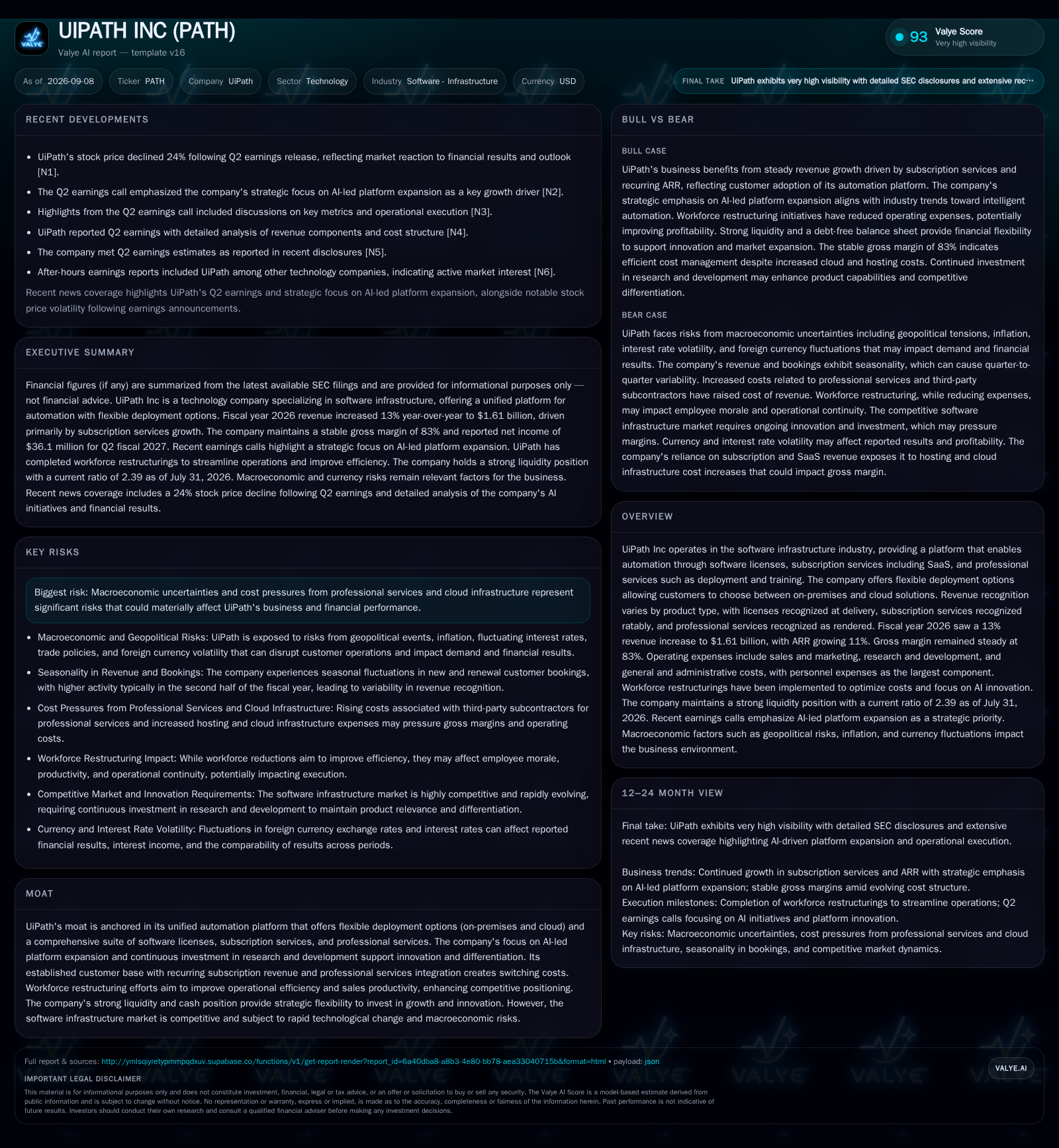
UiPath’s fiscal 2026 results show 13% revenue growth to $1.61 billion, with subscription services as the primary driver and annual recurring revenue up 11%. Gross margins remain steady at 83%, and the company holds a reported liquidity position. The strategic emphasis is on AI-led platform expansion, but cost pressures from professional services and macroeconomic risks could test the sustainability of current momentum. A 24% post-earnings stock price drop highlights market skepticism about near-term operating leverage and competitive differentiation. Key metrics to watch include ARR growth, subscription mix, and the impact of AI-driven product initiatives on customer retention and margins. [S2] [N1]
UiPath’s latest financial results underscore the company’s transition from high-growth disruptor to established automation platform provider. While top-line expansion continues—driven primarily by growth in subscription services and recurring revenue—market reaction to Q2 2027 results was sharply negative, reflecting concerns about margin sustainability, competitive intensity, and the ability to translate AI-led platform innovation into durable, profitable growth. As the automation software industry matures and customers become more discerning, UiPath’s challenge will be to demonstrate that its focus on AI and operational streamlining can deliver not just growth, but also meaningful operating leverage and defensible differentiation in a crowded landscape.
Recent Results Signal Subscription-Led Growth—and Market Skepticism
UiPath reported fiscal 2026 revenue of $1.61 billion, up 13% year-over-year, with annual recurring revenue (ARR) climbing 11% to $1.85 billion. Subscription services led this growth, rising 19% year-over-year, while license sales grew only 3%. Gross margin held steady at 83% despite a shift in revenue mix, and net income for Q2 2027 was $36.1 million. The company concluded Q2 with a reported liquidity position, holding $607.4 million in cash and $676.6 million in short-term investments, yielding a current ratio of 2.39. Notably, after Q2 results and an AI-focused earnings call, UiPath’s stock price dropped 24%, reflecting investor doubts about the near-term payoff from platform expansion and operational streamlining. [S2] [N1] [N2]
How Automation Software Economics Play Out for UiPath
UiPath’s business model is centered on a mix of software licenses (point-in-time revenue), subscription services (ratable, recurring revenue), and professional services (time-and-materials or fixed-price contracts). The subscription segment is now the primary growth engine, reflecting broader industry migration to SaaS and recurring models. This shift typically enhances revenue visibility and retention, but may compress margins if cloud-hosting and support costs scale faster than pricing power. License sales, while higher-margin, are becoming a smaller share.
Gross margin stability at 83% in fiscal 2026 suggests that increased subscription revenue is offsetting the lower mix of high-margin licenses, but cost of revenue rose 10%—mainly from higher professional services and subcontractor expenses. This implies that while the core software business remains lucrative, services delivery could be a margin drag if not tightly managed. Sales and marketing costs fell 7% after workforce restructuring, indicating a push for greater efficiency. However, future operating leverage will likely depend on the company’s ability to grow ARR and expand wallet share without proportionate increases in support and services costs.
The company’s reported liquidity position (cash and equivalents plus short-term investments) provides flexibility for continued R&D investment, potential tuck-in acquisitions, or further operational streamlining. However, rising hosting and cloud infrastructure costs could pressure future margins if not offset by pricing or operational gains.
UiPath’s Defenses: Platform Breadth, Switching Costs, and the AI Race
UiPath’s competitive position is built on its unified automation platform, flexible deployment (cloud and on-premises), and deep integration of professional services such as training and deployment. The company’s pivot to AI-led automation aims to stay ahead of rivals in a market that includes both established enterprise software vendors and emerging AI-native automation startups.
Switching costs may be meaningful for customers deeply embedded in UiPath’s workflow, especially where automation is integral to business processes and custom integrations. Professional services and customer education further entrench the platform, but also risk eroding margin if service delivery becomes too resource-intensive.
The competitive landscape is intensifying as incumbent enterprise software providers, cloud hyperscalers, and niche automation specialists all chase the same automation and AI opportunity. While UiPath’s breadth and installed base offer some defensibility, long-term advantage will depend on the pace of AI innovation, the ability to deliver measurable customer outcomes, and the stickiness of platform integrations. Rapid technological change and customer appetite for best-of-breed solutions mean that platform lock-in is never absolute.
AI Platform Success Translates into Durable ARR and Margin Expansion
UiPath’s bullish scenario rests on the company successfully leveraging its AI-led platform to drive deeper automation adoption, expand use cases, and increase wallet share among existing customers. If AI-powered features meaningfully enhance customer productivity, reduce manual intervention, and deliver tangible ROI, UiPath could see accelerated ARR growth and improved retention. This, in turn, could enable better pricing power and a higher mix of high-margin subscription revenue.
Margin expansion could result if investments in AI and automation tooling reduce the need for labor-intensive professional services, or if operational streamlining from workforce reductions proves durable. Confirmation for this scenario would include sustained double-digit ARR growth, improving gross margin (despite cloud cost headwinds), and evidence of customers expanding their use of the platform. Falsification would come from stagnating ARR, rising churn, or persistent margin erosion due to escalating service and infrastructure costs.
Subscription Growth Continues, but Margin Gains Remain Elusive
The most plausible scenario is that UiPath continues to grow ARR at a high single-digit to low double-digit pace, driven by ongoing adoption of automation and steady expansion within existing accounts. Subscription revenue remains the anchor, but the mix shift from licenses and the need to support increasingly complex deployments with professional services limit gross margin improvement.
Operating leverage remains modest: cost discipline from sales and marketing restructuring is partially offset by rising services and hosting costs. The company maintains reported liquidity position and continues to invest in AI innovation, but competitive intensity and macroeconomic uncertainty prevent a decisive breakout in profitability or market share. Evidence for this scenario includes stable or slightly improving ARR, gross margins holding in the low-80s, and modest, but not accelerating, net income growth. Falsification would be signaled by a sharp deterioration in gross margin, stagnating ARR, or an inability to control services-related costs.
Cost Structure and Macro Risks Undermine Automation Growth
In the negative scenario, macroeconomic headwinds (such as inflation, currency volatility, and geopolitical tension) combine with rising professional services and cloud infrastructure costs to erode margins and stall ARR growth. Customers may delay or scale back automation projects, especially if ROI is not immediately evident or if budget constraints intensify. Competitive pressures from both larger enterprise software vendors and nimble AI-native entrants could drive pricing down or force higher investment in product development and support.
Confirmation of this scenario would include declining ARR, a drop in renewal rates, shrinking gross margin, and net income falling back into negative territory. Persistent cost inflation in services and infrastructure, combined with stagnant or declining customer adoption, would further validate downside risks.
Milestones That Will Reveal If UiPath’s AI Bet Pays Off
Quarterly ARR growth rate: Sustained double-digit growth would suggest successful expansion and customer retention; deceleration would signal competitive or macro challenges.
Gross margin trend: Any material movement (up or down) in the 83% range will indicate whether subscription scaling or cost pressures are dominating.
Subscription versus license revenue mix: A rising subscription share should improve revenue visibility but could compress margins if not matched by pricing power.
Professional services cost as a percentage of revenue: If disclosed, this would help test whether services delivery is becoming more or less efficient.
Customer churn or renewal rates: A useful metric would be renewal rates for large enterprise accounts, revealing stickiness and competitive positioning.
AI-driven product adoption: If management discloses usage rates or case studies for new AI features, this would indicate customer engagement and differentiation.
Sales and marketing efficiency: Monitoring sales productivity (e.g., revenue per salesperson, if disclosed) will show if recent restructuring delivers lasting benefits.
Cloud hosting and infrastructure expense as a share of subscription revenue: Rising costs here would pressure margins and test the scalability of the SaaS model.
Disclaimer: This is research-only, informational analysis and not investment advice. It may include AI-generated interpretation and general industry context. Always verify important details using primary sources.

Comments