
Samsara’s IoT Platform Seeks Durable Growth as AI Integration and Supply Chain Risks Reshape the Outlook
A 30% revenue surge and quarterly profit highlight Samsara’s operational momentum, but the company’s reliance on Asian suppliers and rapid AI adoption introduce new uncertainties around margins, resilience, and regulatory exposure.
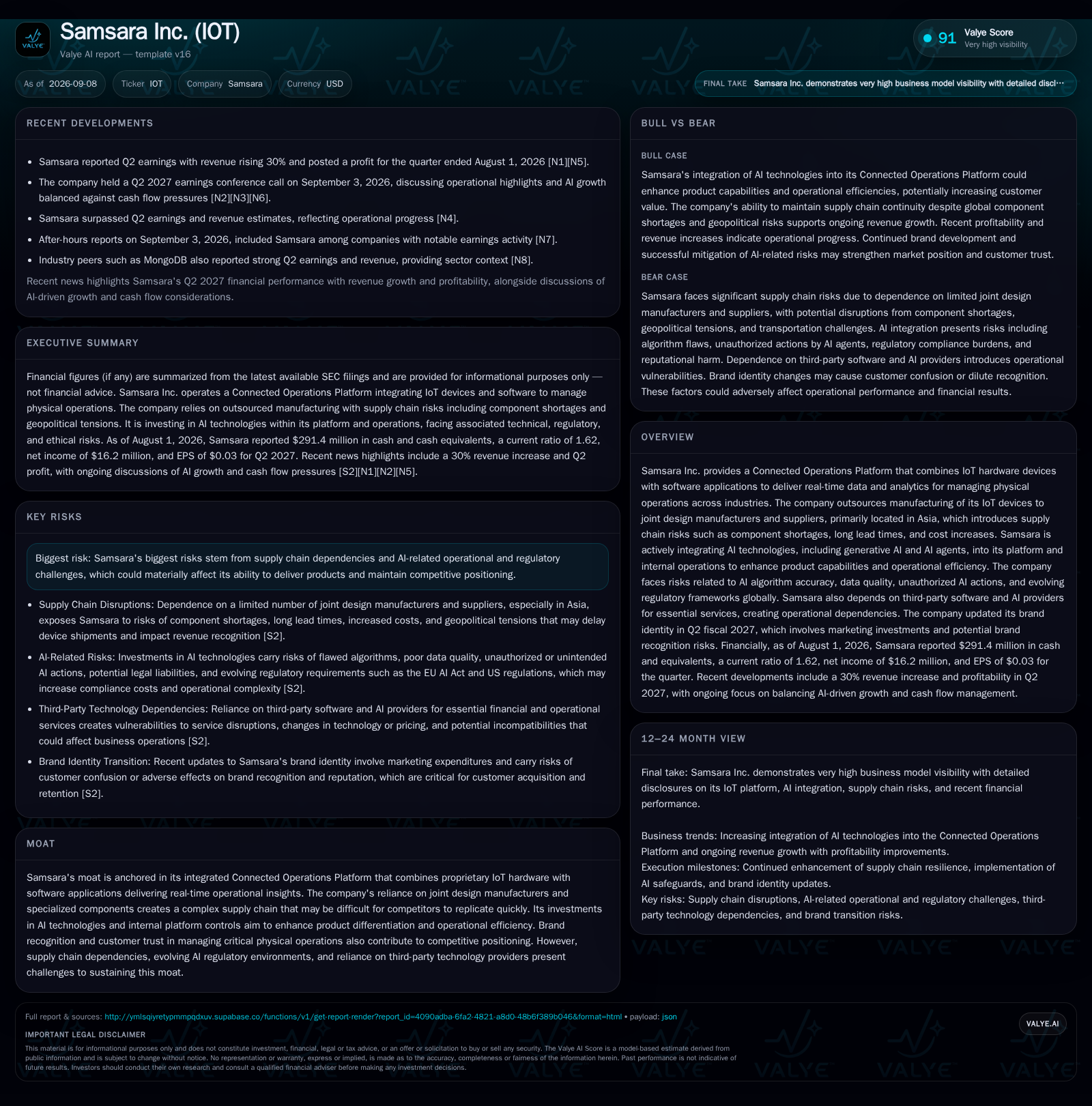
Samsara reported Q2 2027 revenue growth of 30% year-over-year and net income of $16.2 million, reflecting operational progress alongside its Connected Operations Platform [S2] [N1] [N5]. However, ongoing supply chain dependencies—especially in Asia—and the integration of advanced AI present both opportunities for differentiation and risks of disruption, regulatory scrutiny, and cost volatility. The next phase will test whether Samsara’s platform and brand investments can translate AI-driven gains into sustained margin expansion and resilience in a competitive, risk-prone environment. [S2] [N1] [N2] [N5]
Samsara Inc. enters fiscal 2027 with a 30% year-over-year revenue increase and a return to profitability in Q2, highlighting its Connected Operations Platform and ongoing AI integration [S2] [N1] [N2] [N5]. Yet this progress comes with heightened complexity. Samsara’s dependence on joint design manufacturers and suppliers in Asia leaves it exposed to supply chain shocks, while rapid AI adoption introduces fresh regulatory, ethical, and operational risks. As Samsara invests in brand and platform enhancements, the strategic test is whether these moves can secure durable growth and margin improvement—or whether the company’s risk profile will erode its competitive gains in a crowded, evolving market. [S2] [N1] [N2] [N5]
Q2 Profitability and Revenue Growth Signal Stronger Operating Execution
Samsara reported net income of $16.2 million and basic and diluted EPS of $0.03 for the quarter ended August 1, 2026, alongside a 30% increase in revenue year-over-year [S2] [N1] [N5]. This marks a notable return to profitability and a period of accelerated top-line expansion, outpacing consensus estimates and highlighting the company’s ability to scale its Connected Operations Platform. The Q2 2027 earnings call underscored ongoing investments in AI and platform enhancements, while also acknowledging cash flow pressures and supply chain challenges [N2] [N3].
The company’s liquidity position—$291.4 million in cash and a current ratio of 1.62—provides a moderate buffer but does not fully insulate Samsara from the risks posed by its concentrated supplier base and potential component shortages [S2]. The recent brand identity overhaul, involving changes to logo and marketing assets, reflects a strategic push to solidify market presence but introduces possible costs and transitional friction. These developments collectively set the stage for a crucial period of execution, as Samsara seeks to balance innovation-led growth with operational resilience.
IoT Platform Economics: Hardware-Software Mix and Operating Leverage Dynamics
Samsara monetizes its Connected Operations Platform through a combination of proprietary IoT hardware and recurring software subscriptions, enabling customers to manage fleets, assets, and physical operations with real-time analytics. The hardware component is outsourced to joint design manufacturers, primarily in Asia, while software subscriptions provide recurring revenue streams [S2]. The platform’s value proposition hinges on delivering actionable insights and operational efficiencies, which can justify premium pricing and support customer retention.
Operating leverage could emerge as Samsara scales its installed base: incremental software subscriptions and higher device utilization may drive gross margin expansion, provided supply chain costs and component availability remain stable. However, the company’s exposure to component shortages, long lead times, and geopolitical disruptions introduces volatility in hardware costs and delivery schedules, which could compress margins or delay revenue recognition. Capital intensity is moderate, as manufacturing is outsourced, but working capital swings may occur if inventory builds or receivables stretch during supply chain disruptions.
AI-Enabled Differentiation vs. Ecosystem and Supply Chain Vulnerabilities
Samsara’s competitive edge rests on the integration of IoT hardware, cloud-native software, and advanced AI analytics—an offering that addresses complex needs in logistics, transportation, and industrial operations. The company’s platform approach and early adoption of generative AI and AI agents could enhance differentiation by automating insights, reducing manual intervention, and improving operational outcomes for customers. Proprietary device-software integration and accumulated operational data may create switching frictions and raise the cost of migration for enterprise clients.
However, the moat is not unassailable. Competitors include telematics providers, industrial IoT platforms, and cloud software vendors—many with deeper balance sheets, broader ecosystems, or established customer relationships. Samsara’s reliance on a concentrated supplier base for hardware manufacturing is a structural weakness: supply chain disruptions could erode reliability and cede ground to vertically integrated or geographically diversified rivals. Additionally, as AI becomes table stakes across the sector, differentiation may depend less on technology and more on execution, customer service, and regulatory compliance.
AI-Driven Platform Expansion Unlocks Margin and Retention Gains
In a favorable scenario, Samsara’s aggressive integration of AI and automation into its Connected Operations Platform could materially increase customer value, driving higher adoption rates, contract expansions, and pricing power. Enhanced analytics and AI-powered features may enable customers to achieve measurable efficiency gains, deepening loyalty and reducing churn. If supply chain risks are managed—through supplier diversification, inventory strategies, or strategic partnerships—hardware delivery bottlenecks could be minimized, supporting consistent revenue recognition and margin expansion.
Confirmation would come from sustained double-digit revenue growth, rising gross margins, and evidence of expanding multi-year contracts or net retention rates (if disclosed). The thesis would be challenged if AI investments fail to translate into new features or if customer adoption of AI-powered modules stalls, indicating that technology alone is insufficient to drive durable growth.
Balancing AI Innovation with Supply Chain and Compliance Pressures
The most plausible trajectory sees Samsara maintaining robust, but moderating, revenue growth as AI-driven features become increasingly embedded in its platform and customer base. The company may continue to post profits, but margin expansion could be capped by ongoing supply chain volatility, periodic hardware cost spikes, and incremental compliance spending as AI regulations tighten globally. Brand investments may help with customer acquisition, but the risk of customer confusion or dilution during the transition is real.
This scenario would be supported by quarterly results showing steady revenue growth, stable or slightly improving gross margins, and controlled operating expenses relative to revenue. The thesis would be undermined if supply chain disruptions become persistent, leading to missed deliveries, deferred revenue, or customer defections, or if regulatory costs escalate faster than AI-driven operating efficiencies.
Supply Chain Shocks and AI Missteps Undermine Growth and Trust
In a downside case, unresolved supply chain fragility—driven by component shortages, geopolitical events, or supplier concentration—could lead to delayed shipments, lost sales, and margin compression. If Samsara’s AI integration introduces flawed algorithms, security breaches, or regulatory violations, the company could face reputational harm, legal liabilities, and costly remediation. Dependence on third-party software and AI providers may amplify operational vulnerabilities if service disruptions or contract changes occur.
This scenario would be confirmed by negative revenue surprises, declining margins, customer attrition, or major compliance incidents. The downside thesis would be weakened if Samsara demonstrates rapid supply chain adaptation, transparent incident response, or successful mitigation of AI-related risks, preserving customer trust and operational continuity.
Testing the Durability of Samsara’s Platform Amid Volatile Operating Conditions
— Evidence of supply chain diversification, such as new manufacturing partners or regional sourcing shifts, would help assess resilience to shocks.
— Disclosure of customer retention, net revenue retention, or churn rates would clarify the stickiness of Samsara’s platform, especially as AI features roll out.
— Gross margin trends, particularly the hardware vs. Software mix, will signal whether AI and scale are translating into improved profitability.
— Updates on AI-driven product enhancements, including customer adoption rates and real-world operational impact, would test the monetization thesis.
Disclaimer: This is research-only, informational analysis and not investment advice. It may include AI-generated interpretation and general industry context. Always verify important details using primary sources.

Comments