
Chewy Expands Pet Healthcare Ecosystem While Managing Competitive and Liquidity Pressures
Chewy leverages a broad product assortment, proprietary brands, and a growing pet healthcare platform to fortify customer engagement and operational scale. However, ongoing competition and a current ratio below 1 signal execution and liquidity challenges in its expansion journey.
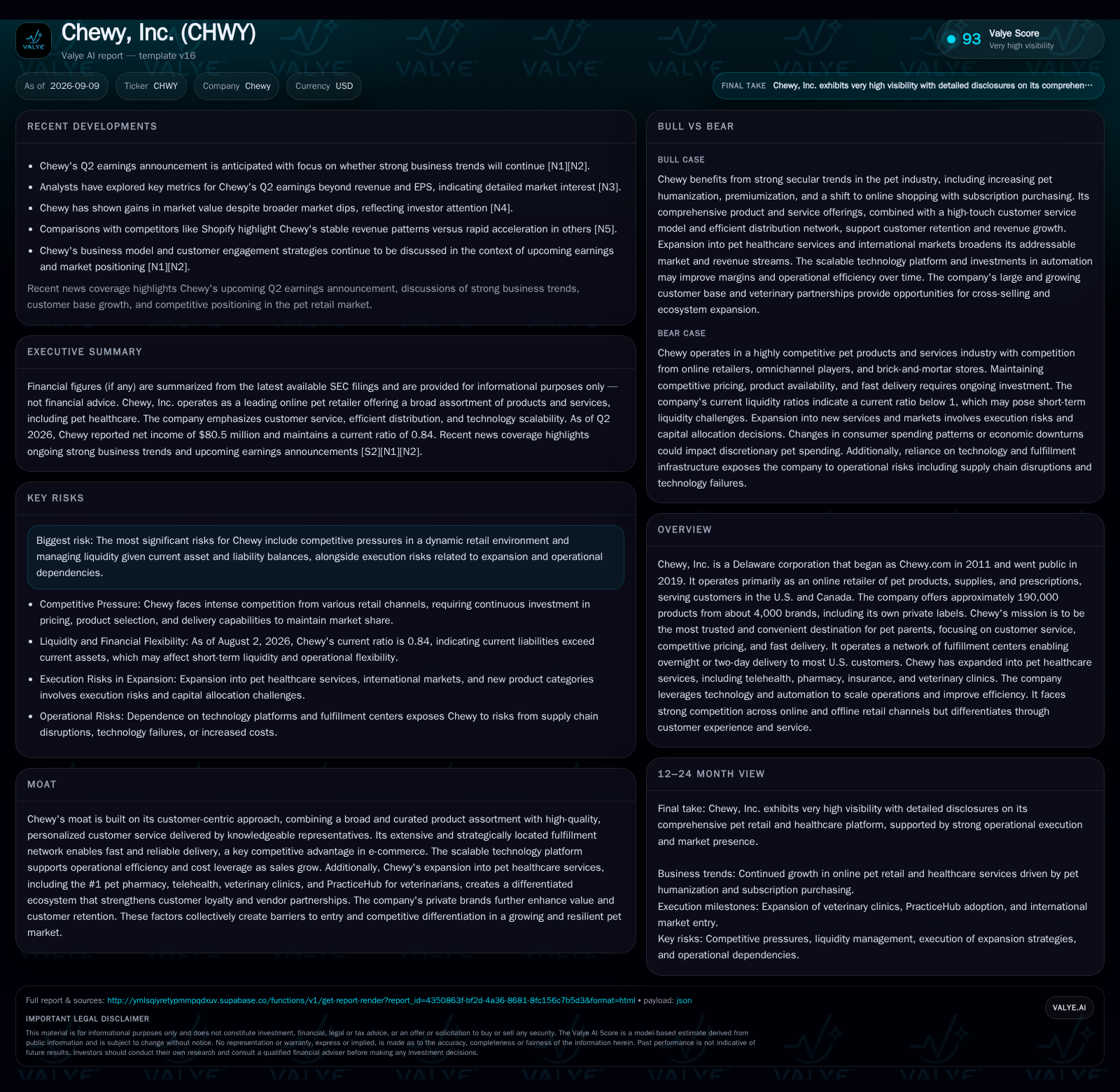
Chewy, Inc. operates a comprehensive online pet retail and healthcare platform with strong customer retention driven by personalized service and a vast product portfolio including private labels. Its highly automated, strategically located fulfillment centers enable fast delivery to most U.S. customers. Expansion into pet healthcare—through pharmacy leadership, telehealth, veterinary clinics, and PracticeHub for vets—broadens revenue streams and deepens ecosystem ties. Despite a Q2 2026 net income of $80.5 million, the company shows liquidity tension with current liabilities exceeding current assets. Competitive pressures and capital allocation choices around new service lines present execution risks. The company’s scalable technology platform and growing veterinary partnerships are key drivers to watch for margin improvement and customer base expansion going forward.
Chewy, Inc., a leading online pet retailer and healthcare services provider, reported solid profitability in Q2 2026, underscoring its operational scale and market presence. The company’s expansive product assortment, proprietary brands, and high-touch customer service model support strong retention and revenue growth. Its pet healthcare ecosystem—including pharmacy leadership, telehealth, veterinary clinics, and PracticeHub for vets—extends its addressable market and deepens customer engagement. However, Chewy faces liquidity constraints with current liabilities exceeding current assets and intense competition requiring continuous investment. Its strategic execution in scaling healthcare services and leveraging its technology-driven distribution network will be pivotal for improving margins and sustaining growth amid evolving pet industry dynamics [S1] [S2].
Strong Q2 Profitability Contrasts with Liquidity and Competitive Challenges
Chewy reported a net income of $80.5 million for Q2 2026, reflecting profitability improvements amid ongoing investments in its business [S2]. Despite this, the company’s current ratio stood at 0.84 as of August 2, 2026, indicating that current liabilities exceed current assets and signaling potential short-term liquidity pressures [S2]. This financial structure may constrain operational flexibility and warrants close monitoring, especially as the company expands capital-intensive healthcare services.
The company continues to build on strong business trends driven by pet humanization and premiumization, with a broad product catalog of roughly 190,000 items sourced from 4,000 brands, including its own private labels. Chewy’s efficient distribution network, enabled by automation and AI, delivers to over 80% of the U.S. population overnight, supporting fast fulfillment and customer satisfaction [S1]. However, intense competition from online and brick-and-mortar retailers pressures pricing and product availability, necessitating sustained investments in customer experience and supply chain efficiency [S1].
Integrated Retail and Healthcare Model with Operational Leverage Potential
Chewy monetizes through direct online sales of pet products, subscriptions, and an expanding array of pet healthcare services. Its pricing power is influenced by a mix of competitive pressures and differentiated private-label offerings, which typically carry higher margins than third-party brands. The subscription model and high retention driven by personalized service create recurring revenue streams, enhancing predictability and lifetime customer value [S1]. Volume growth benefits from rising pet ownership and increasing online penetration, while mix improvements can arise from growing adoption of higher-margin healthcare services and private labels.
The company’s distribution network is capital intensive but designed for scalability. Strategic placement of fulfillment centers combined with investments in automation and AI lowers marginal costs as volume scales, providing operating leverage. However, variable costs such as logistics and customer acquisition remain significant. Expansion into veterinary clinics, telehealth, and PracticeHub adds complexity and capital allocation demands but offers cross-selling opportunities and ecosystem synergies, which could enhance margins if integration executes well. Near-term liquidity constraints could limit large-scale investment, with operating leverage hinging on balancing growth and cost control.
Customer-Centric Service and Healthcare Ecosystem Differentiate Amid Fierce Retail Competition
Chewy’s competitive moat rests on a customer experience differentiated by personalized service through knowledgeable representatives, extensive product assortment including private brands, and rapid delivery enabled by a sophisticated fulfillment network. This combination creates switching frictions and high retention, particularly because many customers subscribe for regular pet supplies. The addition of pet healthcare services—such as the leading pharmacy, telehealth, and veterinary clinics—further deepens customer engagement by expanding the ecosystem and increasing wallet share per pet owner [S1].
Nonetheless, Chewy operates in a highly competitive environment including large online players, specialized pet retailers, and traditional brick-and-mortar stores. Price sensitivity and delivery speed remain critical factors for customer acquisition and retention. Competitors may challenge Chewy’s position through aggressive pricing, product innovation, or localized service models. The company’s ability to maintain technological and operational efficiency, innovate healthcare offerings, and deepen veterinary partnerships via PracticeHub will be key to sustaining durable advantage.
Healthcare Expansion and Technology Scale Drive Margin Expansion and Market Share Gains
In a favorable scenario, Chewy successfully integrates its pet healthcare offerings with retail, creating a seamless customer ecosystem that increases cross-selling and customer lifetime value. The expansion of veterinary clinics and PracticeHub enrollment accelerates, capturing a majority of U.S. vet practices and enabling data-driven personalized marketing and service. Telehealth and pharmacy services scale profitably, benefiting from growing pet humanization and convenience trends. These factors drive mix improvement towards higher-margin services and private-label products.
Simultaneously, continued investments in automation and AI in fulfillment centers lower marginal costs, unlocking operating leverage as sales volume grows. This margin expansion supports increased marketing and innovation spending without diluting profitability. Confirmation would come from expanding subscription penetration, rising healthcare revenue as a percentage of total sales, and improving adjusted EBITDA margins. Falsification occurs if healthcare services fail to gain traction or if logistics costs rise faster than sales growth, compressing margins.
Growth Outlook Tempered by Competitive Pressure and Execution Risks
The most plausible outcome is steady revenue growth driven by ongoing pet industry tailwinds and gradual expansion of healthcare services balanced against intense competition and operational challenges. Chewy maintains solid customer retention through service quality and product breadth but faces margin pressure from investments required to sustain delivery speed and service levels. Its proprietary brands grow modestly, providing some margin benefit but not dramatically altering the cost structure.
Healthcare offerings expand incrementally but do not achieve rapid scale, constrained by capital allocation and the complexity of integrating veterinary services. The fulfillment network remains efficient but sees limited incremental operating leverage as logistics cost inflation and competitive pricing pressure offset gains. Confirmation of this scenario would include stable or slightly improving margins, consistent subscription growth, and modest healthcare revenue contribution. Evidence against would be accelerating margin expansion or a material deterioration in customer retention or fulfillment efficiency.
Liquidity Strain and Competitive Erosion Undermine Growth and Profitability
In a downside case, Chewy’s liquidity pressures worsen, limiting its ability to invest in critical fulfillment infrastructure and healthcare expansion. Working capital constraints force trade-offs between inventory levels and service quality, leading to stockouts or slower delivery that damage customer satisfaction and retention. Competitive pricing pressures intensify as online and omnichannel rivals cut prices or improve service, eroding Chewy’s market share.
Healthcare service initiatives face execution setbacks, such as slow PracticeHub adoption or underperforming clinics, resulting in higher-than-expected costs and capital write-downs. Operational risks including supply chain disruptions or technology failures raise fulfillment costs and reduce efficiency. Confirmation of this downside emerges through declining customer retention rates, compressing margins, missed healthcare revenue targets, and increasing days sales outstanding or inventory days. Reversal signals would be restored liquidity and operational improvements stabilizing customer metrics.
Key Metrics to Gauge Chewy’s Growth and Financial Health
A key metric to watch is subscription penetration and growth rates, which reflect customer stickiness and recurring revenue stability. Monitoring the revenue contribution and margin profile of pet healthcare services, including pharmacy, telehealth, and clinics, would help assess ecosystem leverage and mix shift.
Fulfillment center operational metrics such as order cycle times, automation utilization rates, and logistics cost per order would provide insight into operating leverage potential and cost control effectiveness. Tracking PracticeHub enrollment growth and engagement rates among veterinary practices would indicate progress in building a durable veterinary ecosystem.
Liquidity measures including current ratio trends, working capital turnover, and cash flow from operations are critical to understanding financial flexibility amid expansion. Customer retention rates and average order value trends would help evaluate service quality and pricing effectiveness. Finally, competitive pricing indices or market share data versus key competitors would signal Chewy’s relative positioning in a dynamic retail environment.
Disclaimer: This is research-only, informational analysis and not investment advice. It may include AI-generated interpretation and general industry context. Always verify important details using primary sources.

Comments