
MIND Technology’s Revenue Volatility Exposes the Limits of Niche Marine Survey Leverage
A sharp decline in backlog and gross margin reflects the company’s exposure to variability in project orders, alongside new product initiatives and facility investments intended to broaden addressable markets [S2].
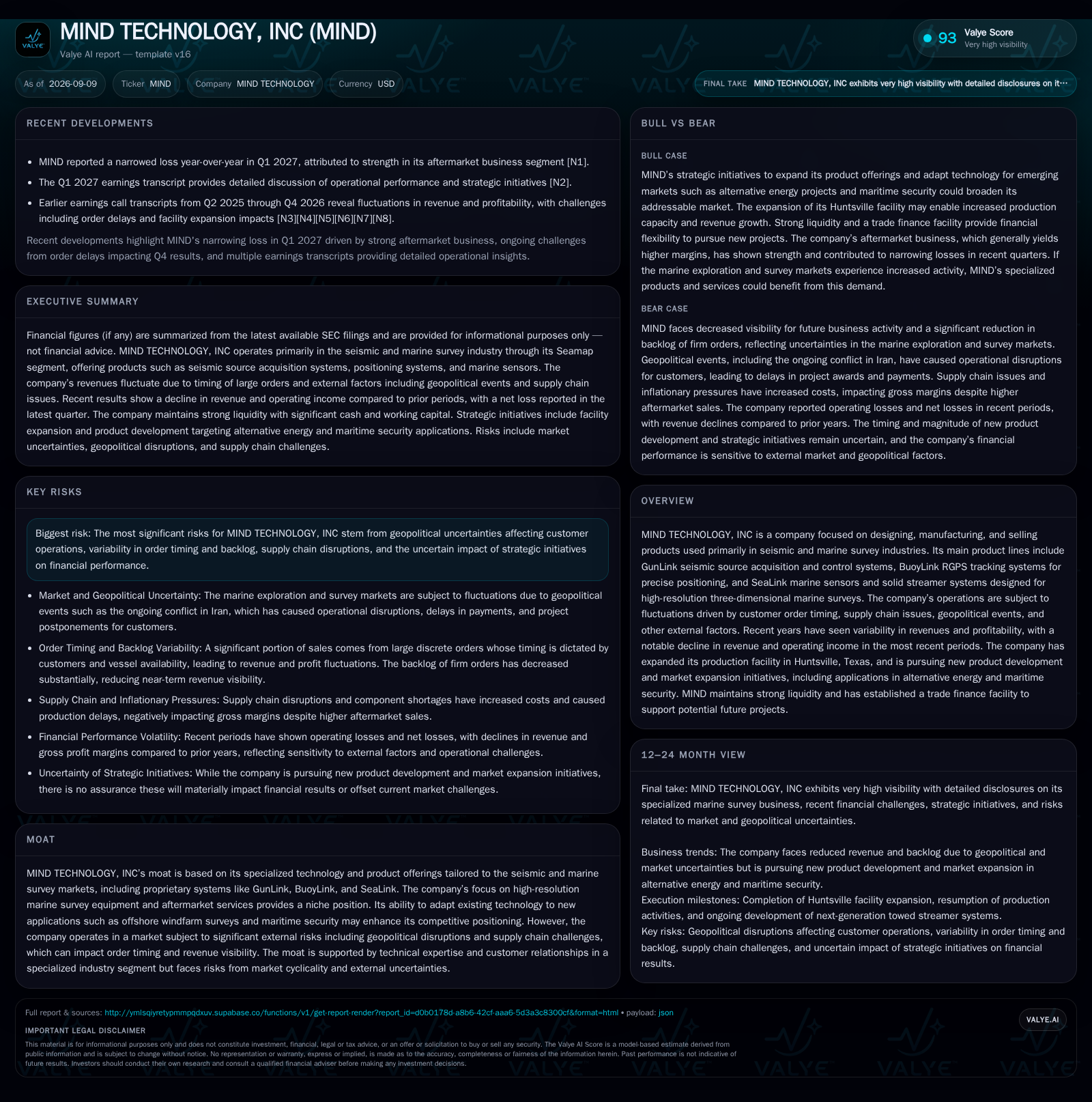
MIND Technology’s recent results reveal the risks of project-based revenue in seismic and marine survey equipment, as a steep drop in backlog and operating losses offset the benefits of higher-margin aftermarket sales. Expansion into new applications and facility upgrades could eventually stabilize performance, but near-term visibility is low and execution risk remains high. Key watchpoints include order intake, margin recovery, and traction in alternative markets.
MIND Technology, a specialist in seismic and marine survey instrumentation, faces acute revenue and margin pressure as project delays and geopolitical uncertainty undermine its core business. Despite maintaining reported liquidity position and resuming operations at its expanded Texas facility, the company’s backlog has declined significantly and gross margins have deteriorated, highlighting the vulnerability of its project-driven model [S2]. While management is investing in new products and alternative market applications, the near-term outlook remains clouded by order timing risk, customer disruptions, and the uncertain payoff from diversification efforts.
Order Delays and Margin Compression Define Recent Results
As of July 31, 2026, MIND Technology reported a steep drop in its backlog of firm orders to $4.8 million, down from $13.9 million at the start of the year, signaling a sharp reduction in near-term revenue visibility [S2]. This contraction stems from uncertainties in the marine exploration and survey markets, compounded by geopolitical events such as the war with Iran and ongoing supply chain disruptions [S2].
Revenue for the first six months of fiscal 2027 fell to $15.3 million from $21.5 million in the prior-year period, while gross margin deteriorated to 40% from 47%, primarily due to under-absorbed overhead despite a higher proportion of aftermarket activity [S2]. The company swung to an operating loss of $1.8 million and reported a net loss of $1.734 million in the most recent quarter [S2]. Although the expanded Huntsville facility has resumed operations, its contribution to incremental revenue is not yet evident in reported figures [S2].
Project-Driven Revenue and Margin Sensitivity to Mix and Utilization
MIND Technology’s business model is anchored in the sale of highly specialized seismic and marine survey systems, such as GunLink and SeaLink, supplemented by aftermarket services that typically generate higher gross margins [S2]. However, the company’s economics are heavily influenced by the timing and size of large, discrete project orders. This creates inherent revenue lumpiness and exposes fixed costs when utilization is low, as seen in the recent gross margin decline despite a favorable aftermarket mix [S2].
The expansion of the Huntsville facility increases fixed overhead and production capacity, but its operating leverage depends on securing sufficient order volume to absorb these higher costs. Working capital needs can spike with project-driven inventory and receivables, while the trade finance facility offers some flexibility for large contracts [S2]. In the absence of recurring revenue streams or long-term service agreements, margin volatility will likely persist unless new product initiatives succeed in smoothing demand or expanding the customer base.
The project-driven nature of MIND Technology's revenue also implies a heightened sensitivity to macroeconomic cycles and capital expenditure trends within the energy and maritime sectors. When end customers delay or reduce spending on exploration and survey projects, the ripple effect can be significant due to the high fixed-cost structure and limited backlog visibility. This cyclical exposure suggests that the company’s financial performance may be prone to sharp swings, with limited ability to smooth revenues through short-term tactical measures. Investors should therefore monitor leading indicators of capital spending in relevant industries as a proxy for future order flow and capacity utilization.
Additionally, the aftermarket segment, while higher margin, may have limited scalability compared to new system sales, as it depends largely on the installed base and recurring maintenance or upgrade cycles. Without significant growth in the installed systems footprint, aftermarket revenue growth could plateau, constraining its ability to offset project volatility. This dynamic underscores the importance of expanding the customer base or developing recurring revenue models, such as service contracts or software subscriptions, which could provide more predictable cash flow and reduce margin variability over time.
Niche Technology, Customer Relationships, and the Threat of Market Cyclicality
MIND’s competitive position is built on proprietary technology and deep relationships within the seismic and marine survey niche, with products like GunLink and BuoyLink serving highly technical customer needs [S2]. The company’s expertise and installed base support its aftermarket business, which can provide partial insulation from new project delays. However, its end markets are cyclical and exposed to external shocks, including geopolitical disruptions and swings in energy sector investment.
Major competitors include diversified industrials and specialist marine technology firms, some of which may possess broader product portfolios or greater scale. MIND’s efforts to adapt its technology for offshore windfarm, carbon capture, and maritime security applications could open new addressable markets, but these are early-stage initiatives without proven commercial traction as of the latest report [S2]. The durability of any moat will depend on the company’s ability to establish technical leadership and recurring customer relationships in these adjacent sectors.
The niche focus of MIND Technology creates both barriers and vulnerabilities. On one hand, deep technical expertise and long-standing customer relationships can foster customer loyalty and reduce price competition. On the other hand, the specialized nature of its products may limit the addressable market size, making growth dependent on market expansion or diversification. Moreover, competitors with broader product portfolios or greater financial resources may be better positioned to weather downturns or invest aggressively in innovation, potentially eroding MIND’s competitive moat if it cannot keep pace.
Furthermore, the company’s attempts to pivot into adjacent markets such as offshore windfarm and carbon capture surveys require not only technical adaptation but also the development of new customer relationships and sales channels. Success in these sectors could mitigate cyclicality and broaden revenue streams, but the timing and scale of penetration remain uncertain. The durability of any competitive advantage will hinge on the company’s ability to demonstrate differentiated technology performance and secure recurring contracts, which may take several years to materialize given the early stage of these initiatives.
Diversification Initiatives Unlock New Revenue Streams
A favorable scenario would see MIND’s investment in new product development and facility expansion translate into successful entry into alternative markets such as offshore windfarm surveys, carbon capture, and maritime security. If the company secures contracts in these sectors—leveraging its technical expertise and existing product platforms—order flow could become more consistent, supporting better utilization of fixed assets and improving gross margins.
Evidence for this scenario would include a rebound in backlog, announcements of contracts or pilot projects in non-traditional end markets, and a return to operating profitability. A falsification test would be the absence of material order wins or continued revenue concentration in legacy seismic exploration, indicating limited diversification traction.
Continued Volatility as Project Lumps and Market Uncertainty Persist
The most plausible scenario is that MIND’s core business remains exposed to the timing of large project orders, resulting in ongoing revenue and margin volatility. While the aftermarket segment continues to provide higher-margin business, it is unlikely to fully offset the impact of delayed or cancelled new system sales. The expanded facility may enable incremental growth if and when order activity resumes, but fixed costs will weigh on profitability during periods of low utilization.
Confirmation of this scenario would come from continued swings in backlog and quarterly results, with sporadic operating losses and only gradual progress in alternative market penetration. A falsification would be a sustained increase in order intake or a step-change in recurring revenue, suggesting a structural shift in demand or business model.
Order Drought and Cost Inflation Drive Prolonged Losses
In a negative scenario, geopolitical instability and weak marine exploration demand persist, leading to a further decline in backlog and revenue. The company’s fixed cost base, now higher due to facility expansion, becomes a drag on margins, while supply chain disruptions and inflation further erode profitability. Without new contracts or successful diversification, cash burn accelerates and the risk of additional restructuring or capital-raising increases.
Confirmation of this scenario would include ongoing net losses, further backlog erosion, and negative operating cash flow. Falsification would require a stabilization in backlog, evidence of cost containment, or early wins in alternative markets supporting a rebound in margins.
Order Intake, Margin Trends, and Market Expansion Remain Decisive
Order intake and backlog replenishment: A sustained rebound in backlog would signal improved visibility and demand recovery. If disclosed, the mix of new orders across traditional and alternative markets would help gauge diversification progress.
Gross margin recovery: A return to historical margin levels, or stabilization above 40%, would indicate better overhead absorption and pricing discipline, especially if driven by aftermarket or new market sales.
Facility utilization rates: Evidence of higher throughput or incremental revenue from the expanded Huntsville site would clarify whether the investment is yielding expected returns.
Alternative market traction: Announcements of contracts or partnerships in offshore windfarm, carbon capture, or maritime security would validate the diversification thesis.
Disclaimer: This is research-only, informational analysis and not investment advice. It may include AI-generated interpretation and general industry context. Always verify important details using primary sources.

Comments