
Lesaka Technologies’ Integrated Platform Strategy Under Expansion and Financial Pressures
Lesaka Technologies aims to unify Southern Africa’s fragmented financial services landscape through a broad fintech platform, but high debt, tax compliance issues, and acquisition integration risks test the durability of its ecosystem strategy.
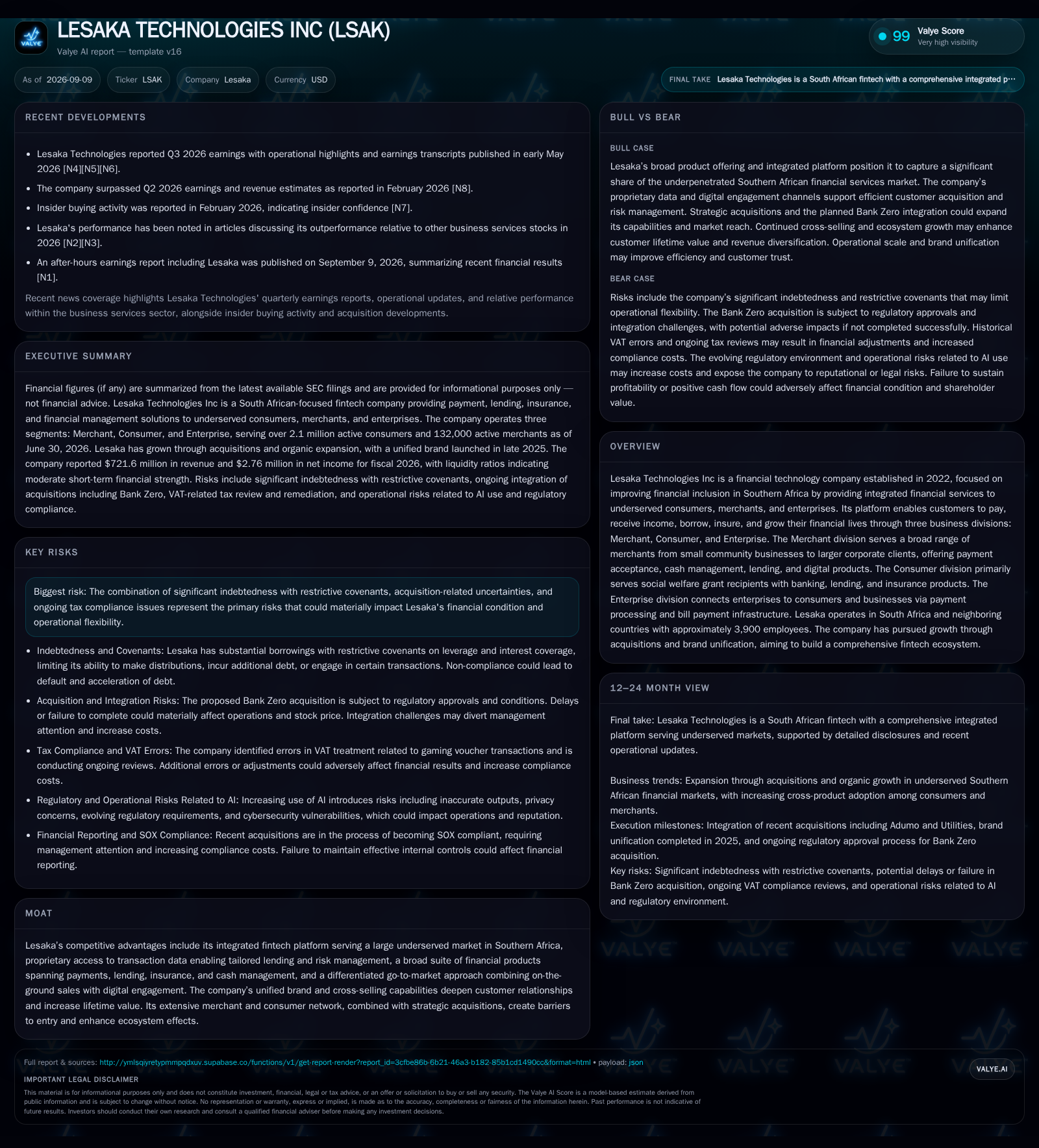
Lesaka Technologies delivers integrated financial solutions to underserved Southern African markets, showing ecosystem traction with strong cross-product adoption and acquisitive expansion. However, significant indebtedness, pending regulatory approval for Bank Zero, and VAT-related compliance reviews pose material risks to operational flexibility and sustained profitability. The company’s ability to deepen ecosystem engagement and manage integration will determine whether it can translate growth into durable value creation. [S1] [S2]
Lesaka Technologies is positioning itself as a unifying fintech platform for Southern Africa’s underserved consumers, merchants, and enterprises. With a rapidly expanding ecosystem, broad product suite, and a series of acquisitions, the company has shown early signs of cross-selling momentum and operational scale. Yet, its ambitious integration plans face headwinds: significant balance sheet leverage, ongoing tax compliance reviews, and the uncertain completion of the Bank Zero acquisition. Whether Lesaka can convert its ecosystem vision into durable profitability hinges on its ability to manage integration complexity, regulatory scrutiny, and the financial constraints imposed by its debt load. [S1] [S2]
Integration Efforts and Compliance Challenges Shape Lesaka’s 2026 Outlook
As of June 30, 2026, Lesaka Technologies operates across five Southern African countries, serving approximately 132,000 merchants and over 2.1 million consumers, with notable cross-product usage—51% of consumers and 46% of merchants use two or more Lesaka products, indicating ecosystem engagement [S1]. The company reported revenue of approximately $721.6 million USD and net income of $2.76 million USD for the fiscal year ended June 30, 2026, with basic and diluted EPS of $0.03 per share [S1].
However, Lesaka’s expansion has come with challenges. The company carries significant indebtedness totaling approximately ZAR 3.5 billion (about $210.7 million USD) as of June 30, 2026, with covenants on net debt to EBITDA and interest coverage ratios, and restrictions on distributions, additional debt, and investments [S1]. The proposed acquisition of Bank Zero is subject to regulatory approvals and other conditions; delays or failure to complete could materially affect operations and stock price [S1]. Additionally, a historical VAT error in the Merchant business is under ongoing review, raising the possibility of further financial adjustments and compliance costs [S2].
Ecosystem Monetization, Cross-Selling, and the Leverage Dilemma
Lesaka’s business model is built on monetizing a broad suite of financial services—payments, lending, insurance, and bill payment—across merchants, consumers, and enterprises. Revenue is generated through transaction fees, interest from lending, insurance premiums, and payment processing charges. The company’s ability to cross-sell multiple products to the same customer base creates potential for higher customer lifetime value and lower marginal acquisition costs, especially as digital engagement and proprietary data allow for more targeted underwriting and risk management.
Operating leverage could emerge if Lesaka succeeds in deepening ecosystem adoption and extracting more value per customer without proportionate increases in sales or support headcount. However, the company’s capital structure is heavily debt-laden, with covenants restricting flexibility. This indebtedness, coupled with the need to integrate recent acquisitions and remediate tax compliance issues, could limit the pace at which Lesaka can invest in product innovation or geographic expansion. The economics of scale are thus conditional on both successful integration and prudent balance sheet management. [S1] [S2]
Platform Reach, Data, and Local Presence: Durable Advantages or Transient Lead?
Lesaka’s competitive proposition rests on its integrated platform, combining digital channels, on-the-ground sales teams, and proprietary data for risk assessment and cross-selling. Its unified brand and ability to serve both small community merchants and larger corporates create a broad addressable market and potential switching frictions for customers embedded in multiple Lesaka products. The company’s extensive biller and merchant network, along with local regulatory expertise, could be significant entry barriers for new fintechs or banks targeting the same segments.
However, the Southern African fintech landscape is dynamic, with established banks, mobile money operators, and emerging digital-first challengers all vying for share. Competitors with deeper pockets or lighter balance sheets may be able to out-invest Lesaka in technology or customer incentives. Moreover, the company’s success with cross-selling and ecosystem engagement could be diluted if integration of acquisitions stalls or if regulatory interventions (such as delayed approval of Bank Zero) disrupt the platform’s cohesion. The durability of Lesaka’s advantage will depend on its ability to maintain high cross-product adoption and operational reliability as it scales.
Ecosystem Synergies Unlock Margin Expansion and Market Share Gains
In a favorable scenario, Lesaka successfully integrates Bank Zero and recent acquisitions, gaining regulatory approval and leveraging unified data to deliver highly tailored financial products. Cross-selling deepens, driving the share of multi-product customers above current levels. As ecosystem engagement increases, customer acquisition costs fall and retention rises, supporting margin expansion. The company’s local sales presence and regulatory credibility reinforce barriers to entry, allowing Lesaka to outpace less entrenched competitors.
Confirmation would come from a sustained increase in cross-product adoption rates, rising average revenue per user (ARPU), and margin improvement without a commensurate rise in headcount or operating expenses. A falsification would be stagnant or declining multi-product usage, persistent integration delays, or margin compression due to rising costs or competitive pricing pressure.
Growth Outlook Influenced by Integration and Compliance Challenges
The most plausible scenario is that Lesaka continues to grow its ecosystem through incremental cross-selling and gradual integration of acquisitions, but faces periodic operational and compliance setbacks. Revenue grows at a moderate pace as new products are adopted and the merchant base expands, yet margin improvement is constrained by ongoing integration costs, tax compliance remediation, and the servicing of substantial debt.
Evidence supporting this scenario would include stable or modestly increasing cross-product usage, continued but measured revenue growth, and periodic charges or restatements related to VAT or acquisition integration. The scenario would be falsified if Lesaka either overcomes these frictions and achieves outsized margin expansion (upside) or suffers a material operational or regulatory setback that erodes profitability (downside).
Debt, Delays, and Compliance Costs Undermine Profitability
In a negative scenario, Lesaka’s debt burden and restrictive covenants limit its ability to invest in technology, sales, or integration, while delays or failure in closing the Bank Zero acquisition disrupt the platform’s growth narrative. Ongoing tax compliance reviews result in material financial restatements or penalties, further eroding trust and consuming management bandwidth. Integration of recent acquisitions stalls, leading to operational inefficiencies and customer attrition.
This scenario would be confirmed by a deterioration in liquidity ratios, negative earnings surprises linked to compliance or integration costs, and a decline in cross-product adoption or merchant/consumer activity. It would be falsified by evidence of successful integration, regulatory resolution, and stabilization or improvement in financial metrics despite the legacy debt load.
Testing Lesaka’s Ecosystem: Integration, Leverage, and Customer Engagement Signals
Progress on Bank Zero acquisition approval and integration milestones—any regulatory delays or failure to close would materially alter the growth outlook.
Updates on VAT/tax compliance reviews and any resultant financial restatements or penalties, which could impact both reported earnings and investor trust.
Trends in cross-product adoption rates for both merchants and consumers; a rising share of multi-product users would validate the ecosystem thesis.
Average revenue per user (ARPU) and margin trends—improvement without proportional cost increases would indicate operating leverage from the platform approach.
Disclaimer: This is research-only, informational analysis and not investment advice. It may include AI-generated interpretation and general industry context. Always verify important details using primary sources.

Comments