
Intuit’s AI Restructuring Pivots Its Software Franchise Toward Assisted Services and Efficiency Gains
A 3,000-person workforce reduction and renewed focus on AI signal a strategic shift for Intuit, as the company seeks to defend its financial software leadership while expanding assisted offerings and managing execution risks.
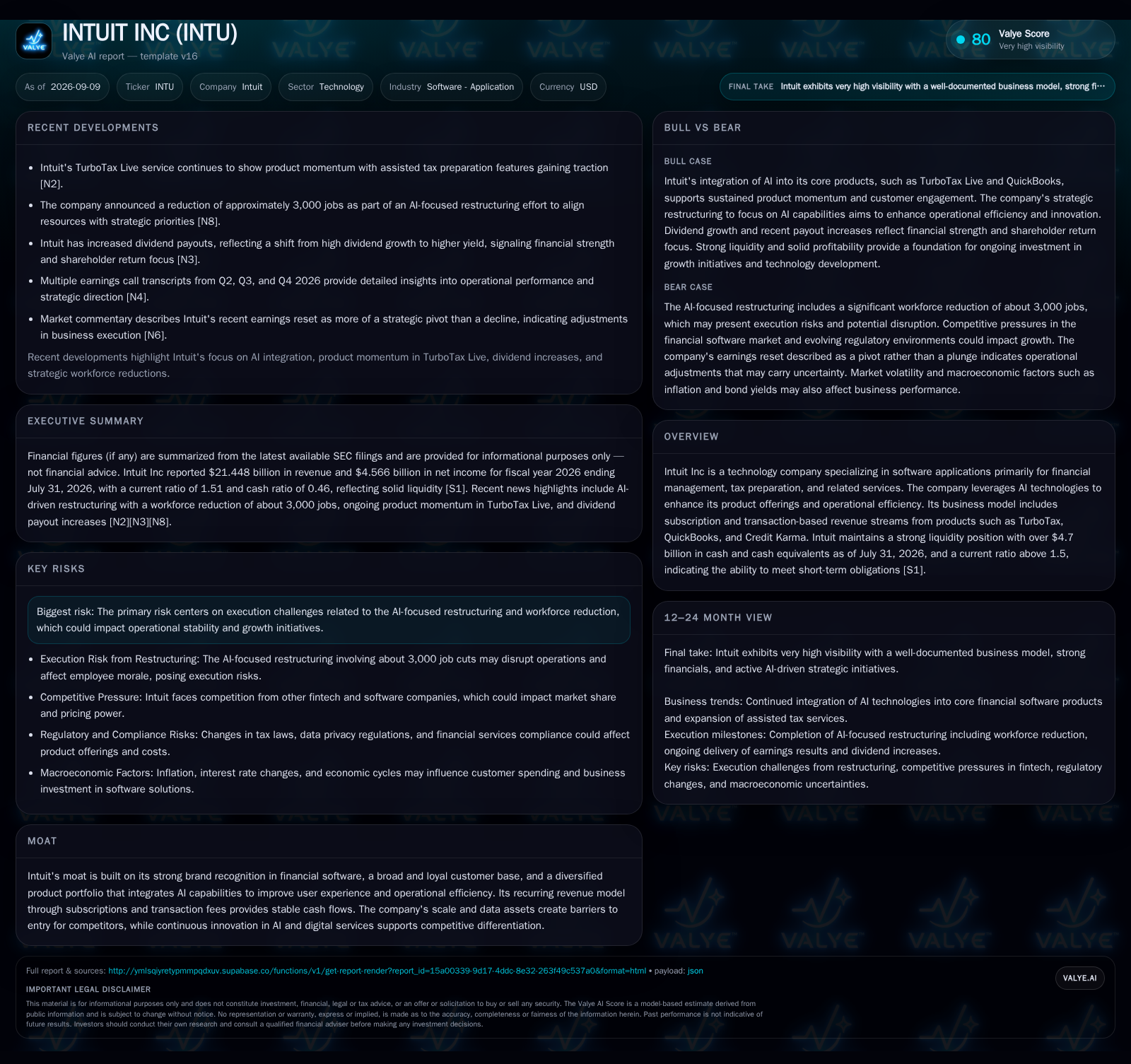
Intuit reported $21.448 billion in revenue and $4.566 billion in net income for fiscal year 2026 ending July 31, 2026, with a current ratio of 1.51 and cash ratio of 0.46, reflecting reported liquidity position [S1]. A major restructuring involving about 3,000 job cuts marks a shift toward AI-driven products and efficiency [N8]. TurboTax Live’s assisted model shows momentum, but execution risks and competitive pressures remain. The company’s stable subscription base, brand, and data scale give it a strong position, but investor focus will be on AI adoption, restructuring progress, and the durability of its product-led growth [S1] [N2] [N8] [N6].
Intuit, long established as a leader in financial management and tax software, is executing a significant strategic pivot. The company reported $21.448 billion in revenue and $4.566 billion in net income for fiscal year 2026 ending July 31, 2026, underscoring its mature, profitable core [S1]. However, a sweeping restructuring—including the elimination of 3,000 jobs—signals a new focus on AI-driven product development and operational efficiency. With TurboTax Live’s assisted offerings gaining momentum, Intuit is betting that hybrid human-digital services and advanced automation can deepen customer engagement and defend its franchise against intensifying fintech competition. The coming quarters will test whether this AI-centric strategy can deliver both growth and margin gains without destabilizing the company’s recurring revenue engine or eroding its brand trust [S1] [N2] [N8] [N6].
AI-Driven Restructuring and TurboTax Live’s Momentum Redefine the Near-Term Landscape
Intuit reported $21.448 billion in revenue and $4.566 billion in net income for the fiscal year ending July 31, 2026, reinforcing its status as a top-tier financial software provider [S1]. Yet the company’s recent announcement of a workforce reduction affecting approximately 3,000 employees marks a decisive shift, with leadership citing an AI-focused restructuring as the rationale [N8]. This move is positioned as a strategic pivot rather than a response to declining fundamentals, suggesting a proactive attempt to reposition the business for future growth [N6].
Meanwhile, Intuit’s TurboTax Live continues to show product momentum, with assisted tax preparation features gaining traction among users [N2]. The combination of robust financial results, ongoing product innovation, and a willingness to make bold structural changes creates a complex operating context. Investors are weighing whether the restructuring will unlock new efficiencies and product capabilities, or introduce near-term disruption and execution risk as Intuit retools its organization and portfolio [S1] [N2] [N6] [N8].
Subscription Economics, Assisted Upsell, and the Leverage Potential of AI Integration
Intuit’s business model includes software applications for financial management, tax preparation, and related services, with a focus on integrating AI technologies [N2] [N8]. This model provides a stable cash flow foundation, with high gross margins typical of mature software companies. The addition of assisted services—such as TurboTax Live—introduces a premium upsell opportunity, as customers pay more for access to expert help, potentially raising average revenue per user (ARPU) and expanding the addressable market for those seeking hybrid solutions [N2].
AI integration may further alter the economics by automating routine support, improving fraud detection, and enabling more personalized product recommendations. If successful, this could reduce variable costs per customer and increase operating leverage, especially as Intuit completes its workforce reduction. However, the transition carries risk: AI development and deployment require significant upfront investment, and the near-term cost savings from job cuts must be balanced against potential disruption in customer service and product delivery [S1] [N8].
Brand, Data Scale, and Product Breadth Underpin Intuit’s Defenses, But Fintech Competition Intensifies
Intuit’s competitive position is anchored by its strong brand recognition, broad customer base, and vast proprietary data accumulated through decades of tax and financial software leadership. These assets create switching frictions for both consumers and small businesses, as migrating financial data and workflows is complex and risky for users. The company’s product breadth—spanning tax, accounting, and credit—enables cross-selling and deepens customer relationships, while its scale supports ongoing investment in AI and compliance infrastructure [S1].
However, the fintech landscape is rapidly evolving. New entrants and established rivals—ranging from cloud-native accounting platforms to niche tax startups—are leveraging modern architectures and aggressive pricing to challenge incumbents. Regulatory changes and open banking standards could lower barriers for competitors to access financial data, eroding Intuit’s moat. The company’s ability to sustain its edge will depend on rapid AI adoption, continued product innovation, and maintaining trust in an era of automation and data sensitivity [N6] [N2].
AI-Led Productivity Gains and Hybrid Offerings Drive Margin Expansion and New Growth
In a favorable scenario, Intuit’s restructuring succeeds in rapidly embedding AI across its product suite, reducing manual support costs and unlocking new automation-driven features. TurboTax Live and similar assisted offerings attract more customers seeking a blend of digital convenience and human expertise, lifting ARPU and expanding share in both consumer and small business segments [N2]. The company’s data scale and brand trust reinforce customer retention, while operational efficiencies from the workforce reduction translate into improved margins and cash flow.
Confirmation would come from rising adoption rates for AI-powered features, sustained or accelerating subscription growth, and evidence of margin expansion in quarterly results. If Intuit can report higher operating leverage and user engagement without a spike in churn or customer complaints, it would suggest the restructuring is delivering both growth and profitability. A falsification would be stagnating or declining user metrics, margin compression, or negative customer sentiment tied to service disruptions [S1] [N2].
Incremental Efficiency with Execution Friction as AI and Assisted Models Scale Gradually
The most plausible path is that Intuit achieves moderate efficiency gains from its AI and restructuring initiatives, but faces near-term execution friction. The transition to more AI-driven workflows and a leaner workforce may temporarily disrupt service quality or slow the pace of new feature launches. TurboTax Live and other hybrid offerings continue to grow, but at a measured pace as customers adapt to new models and competitors respond with their own innovations [N2] [N6].
In this scenario, Intuit maintains its core subscription base and sees steady—if not accelerating—revenue and margin trends. Confirmation would come from stable renewal rates, incremental margin improvement, and continued dividend growth. Falsification would be a material rise in churn, weaker-than-expected product uptake, or operational missteps that erode customer trust or delay product roadmaps [S1] [N6].
Disruption from Restructuring and AI Transition Undercuts Customer Experience and Growth
The principal downside risk is that Intuit’s aggressive restructuring and AI transition introduce more disruption than benefit. Large-scale job cuts could impair customer support, slow response times, or reduce product reliability, resulting in elevated churn or reputational damage. If AI-driven features fail to meet customer expectations or introduce errors, Intuit could face regulatory scrutiny or negative press, amplifying competitive vulnerabilities [N8] [N6].
Confirmation would come from rising customer complaints, declining user metrics, or margin contraction despite reduced headcount. Additional warning signs include missed product delivery milestones, regulatory investigations, or a slowdown in dividend growth. Falsification would be evidence that customer satisfaction and retention remain stable through the transition, with no significant operational hiccups [S1] [N8].
Testing the AI Pivot: Retention, Product Uptake, and Margin Trajectory Will Define Success
Several concrete indicators will determine whether Intuit’s AI-centric restructuring delivers on its promise:
Adoption rates for AI-powered features and TurboTax Live’s assisted services—if disclosed, these would clarify whether customers are embracing the new hybrid model.
Customer retention and churn rates across core products; a useful metric would be renewal rates for QuickBooks and TurboTax subscriptions, especially through tax season.
Operating margin and gross margin trends as the workforce reduction is implemented; improvement would indicate successful efficiency gains.
Disclaimer: This is research-only, informational analysis and not investment advice. It may include AI-generated interpretation and general industry context. Always verify important details using primary sources.

Comments