
Urban Outfitters’ Multi-Brand Engine: Retail Momentum, Distribution Complexity, and the Next Phase of Value Creation
Recent broad-based earnings growth and strong retail segment momentum highlight Urban Outfitters’ operational strengths, but the company’s dependence on automated distribution, evolving ESG demands, and global IP enforcement pose persistent challenges to margin durability and strategic flexibility.
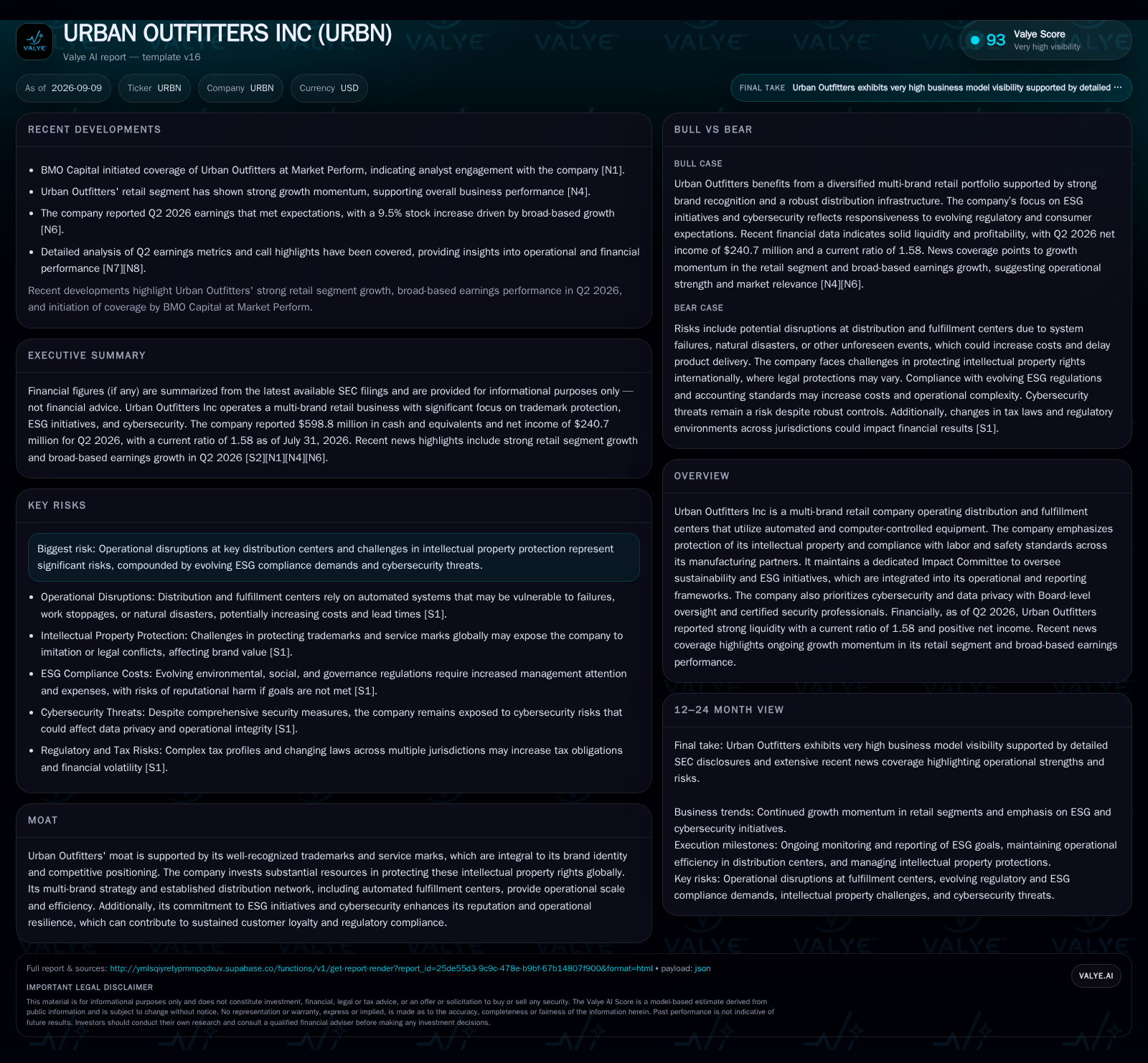
Urban Outfitters reported robust Q2 2026 earnings, driven by strong retail segment momentum and broad-based growth, with shares rising 9.5% on the results [S2] [N6]. The company’s multi-brand strategy and automated distribution infrastructure support operational scale, but risks include system disruptions, rising ESG compliance costs, and global IP enforcement [S1]. The next phase will test whether URBN can sustain growth while managing operational and regulatory complexity.
Urban Outfitters’ latest quarter underscores the strength of its multi-brand retail model, with Q2 2026 earnings meeting expectations and shares climbing nearly 10% on broad-based growth [S2] [N6]. The company’s operational backbone—automated fulfillment centers and a focus on brand protection—has enabled it to capture retail momentum, but introduces new layers of risk from system failures to regulatory complexity. Meanwhile, its ESG and cybersecurity initiatives are no longer optional add-ons but core to both compliance and consumer trust. As the company navigates heightened expectations from investors, regulators, and customers, the central question is whether Urban Outfitters can turn scale and brand equity into durable value while weathering the inherent volatility of modern retail.
Retail Segment Drives Q2 Outperformance, But Complexity Rises
Urban Outfitters reported net income of $240.7 million for Q2 2026, with a current ratio of 1.58 and cash and equivalents of $598.8 million as of July 31, 2026 [S2]. Shares rose 9.5% following these results, reflecting strong retail segment momentum and broad-based earnings growth [N6]. BMO Capital initiated coverage at Market Perform, signaling ongoing institutional engagement [N1].
The company’s recent performance is anchored in the strength of its multi-brand retail portfolio, particularly as segment growth has supported overall results [N4]. However, this operational success is intertwined with mounting complexity: URBN’s reliance on automated, computer-controlled distribution centers introduces new operational risks, while intensifying ESG and regulatory demands increase compliance costs and management focus [S1].
Multi-Brand Retail Economics: Scale, Automation, and Margin Sensitivities
Urban Outfitters generates revenue through a portfolio of brands spanning apparel, lifestyle, and home goods, sold across physical stores and digital channels. This omni-channel, multi-brand approach enables customer diversification and cross-selling, while automated fulfillment centers are designed to drive distribution efficiency and support rapid order fulfillment [S1]. The fixed costs associated with automation and centralized logistics create potential for operating leverage—if throughput continues to rise, incremental sales can yield higher margins.
However, this model is not without vulnerabilities. High fixed costs mean that any disruption—whether from system failures, labor stoppages, or supply chain shocks—can quickly erode profitability. Variable costs remain sensitive to labor, materials, and last-mile logistics, while compliance with evolving ESG and cybersecurity standards adds further overhead. The company’s ability to translate scale into sustained margin improvement will depend on maintaining high utilization of its distribution network and effectively managing these rising compliance and risk-management expenses.
The fixed-cost nature of automated distribution centers means that the company’s margin profile is highly sensitive to volume fluctuations. In periods of demand softness, underutilization of these costly assets can quickly compress margins, highlighting the importance of demand predictability and inventory management. Conversely, peak seasons or promotional events that significantly increase throughput can unlock operational leverage, but only if the systems maintain high uptime and efficiency. Additionally, the integration of automation with labor forces requires continuous investment in workforce training and technology upgrades, which can create a dynamic cost structure that complicates margin forecasting.
From a unit economics perspective, a useful metric to monitor would be the contribution margin per order fulfilled through automated centers versus manual or outsourced fulfillment. This would help test the thesis that automation drives cost efficiency without sacrificing service quality. Moreover, the company’s ability to negotiate favorable terms with last-mile logistics providers and optimize delivery routes will materially impact variable costs, particularly as e-commerce penetration grows. Rising fuel costs or labor shortages in logistics could disproportionately affect these variable expenses, creating margin volatility despite fixed-cost automation benefits.
Brand Equity and Distribution Scale Versus Retail Imitation and Regulatory Drag
Urban Outfitters’ competitive edge is rooted in its portfolio of well-recognized brands and service marks, which support customer loyalty and pricing power [S1]. The company invests heavily in protecting its intellectual property globally, seeking to deter imitation and defend brand value. Its multi-brand structure allows it to address diverse consumer segments and respond quickly to shifts in fashion and lifestyle trends.
Yet, these advantages are not unassailable. Fast fashion competitors, digital-native brands, and global retailers can rapidly copy design trends, eroding differentiation. The complexity of enforcing IP rights internationally, especially in markets with weaker legal protections, exposes URBN to risk of brand dilution. At the same time, rising ESG and cybersecurity requirements—while potentially strengthening customer trust—also create cost disadvantages relative to less-regulated or more agile rivals. The company’s established distribution infrastructure offers scale, but may prove less nimble if consumer preferences shift or if new channels disrupt the current model.
Leveraging Automation and Brand Strength for Sustained Growth
In a favorable scenario, Urban Outfitters successfully leverages its automated fulfillment infrastructure to support continued omni-channel growth, driving higher throughput and extracting operating leverage from its fixed-cost base. Strong brand equity enables premium pricing and customer retention, while effective IP enforcement limits encroachment by imitators. The company’s ESG and cybersecurity initiatives resonate with consumers and regulators, helping to attract new customer segments and reduce reputational risk.
Evidence for this scenario would include sustained double-digit same-store and digital sales growth, margin expansion despite rising compliance costs, and minimal disruption at distribution centers. A falsification would be persistent margin compression, flat or declining comparable sales, or major operational disruptions that offset the benefits of scale.
Managing Growth Amid Operational and Regulatory Complexity
The most plausible scenario is that Urban Outfitters continues to grow, but at a moderated pace as operational and regulatory complexity rise. Distribution automation supports efficiency, but incremental gains are offset by higher ESG compliance costs, cybersecurity investments, and periodic operational hiccups. Brand equity helps maintain share in core segments, but competitive imitation and shifting consumer preferences limit pricing power.
Validation of this scenario would come from steady, mid-single-digit revenue growth, stable but not expanding margins, and ongoing investment in compliance and IT. A falsification would be a sharp inflection in costs (from a major regulatory change or disruption) or a step-change in competitive pressure that erodes revenue or margin more rapidly than expected.
Distribution Disruption or Regulatory Shock Undermines Profitability
In a downside scenario, Urban Outfitters experiences significant operational disruption at its automated fulfillment centers—whether from system failure, natural disaster, or labor issues—leading to delays, increased costs, and lost sales [S1]. Simultaneously, a regulatory or ESG compliance shock (such as a major new environmental mandate or data breach) could drive up costs and trigger reputational harm.
Early warning signs would include unexpected spikes in fulfillment costs, missed delivery windows, or negative headlines regarding ESG or cybersecurity failures. This scenario would be disproven by continued operational resilience, rapid recovery from any disruptions, and stable customer satisfaction scores.
What Will Determine Urban Outfitters’ Next Value Phase?
Frequency and impact of operational disruptions or unplanned downtime at distribution and fulfillment centers—if disclosed, this would clarify the risk-adjusted efficiency of URBN’s logistics model.
Comparable sales growth by brand and channel; sustained outperformance would indicate that brand equity and retail execution are holding up against competitive threats.
Gross and operating margin trends, particularly in relation to rising ESG and cybersecurity compliance costs; margin compression would signal diminishing returns to scale.
Brand protection outcomes, such as legal wins or losses in IP disputes, and the rate of imitation in key markets.
Disclaimer: This is research-only, informational analysis and not investment advice. It may include AI-generated interpretation and general industry context. Always verify important details using primary sources.

Comments