
Destination XL’s Revenue Contraction Tests the Limits of Niche Apparel Retailing
Despite a seasoned management team and integrated-commerce capabilities, Destination XL’s ongoing sales contraction and modest profitability highlight the operational and strategic challenges facing its specialized apparel approach, with uncertainty heightened by a recent acquisition proposal.
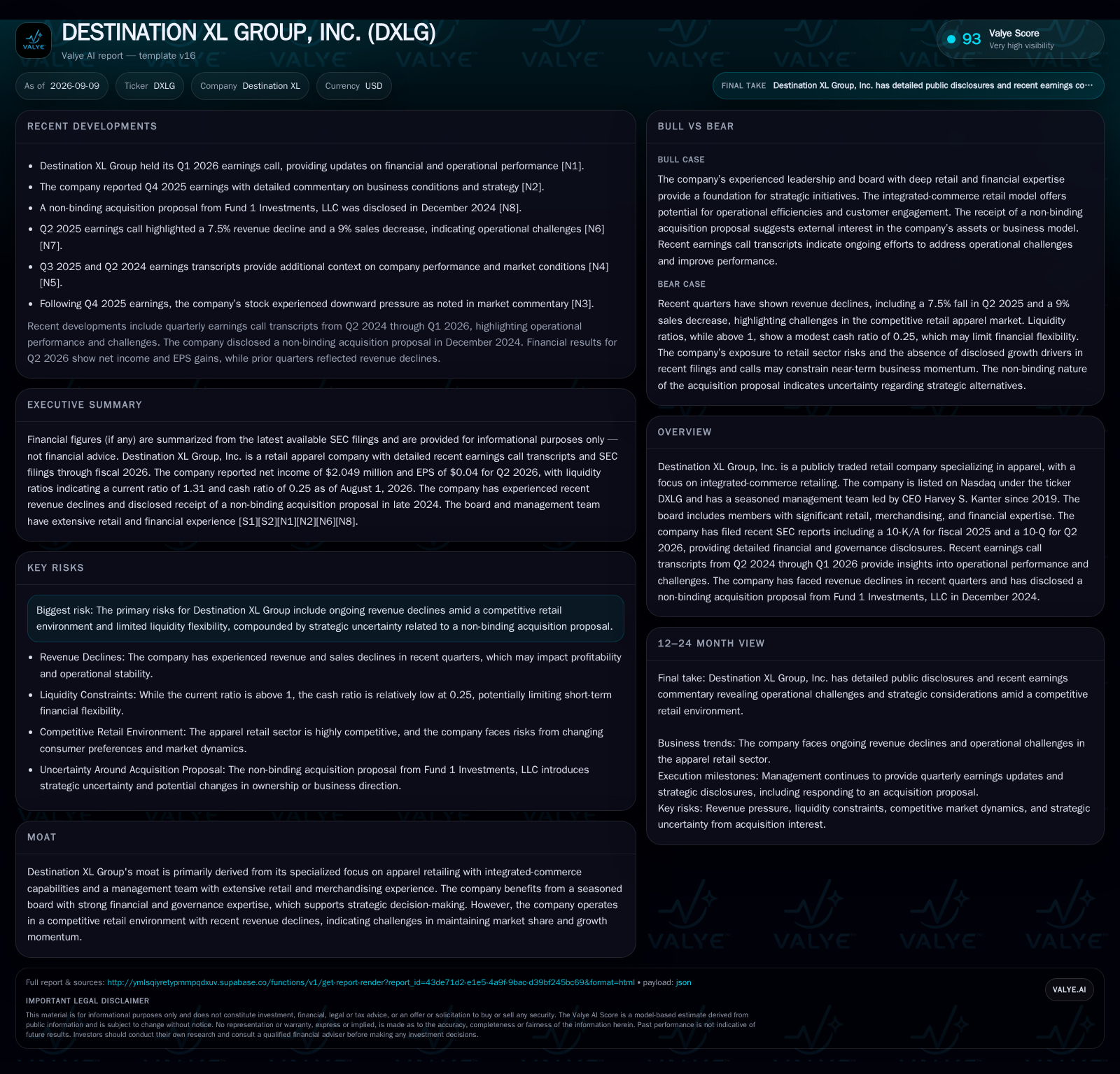
Destination XL Group, a retailer specializing in big-and-tall apparel, continues to report declining revenues despite maintaining profitability in recent quarters. The company’s integrated-commerce model and experienced leadership have not yet reversed the sales downturn, and liquidity remains limited. A non-binding acquisition proposal signals outside interest, but strategic uncertainty persists as the company weighs turnaround efforts against sector-wide headwinds. Key questions center on whether operational adjustments or a potential sale can restore growth and improve competitive positioning. [S2] [N6] [N8]
Destination XL Group, Inc. stands at a crossroads after another quarter of declining sales, even as it posts a modest profit and maintains a seasoned management team. With its integrated-commerce retail model and focus on big-and-tall apparel, the company has long sought to differentiate itself within a fiercely competitive apparel landscape. However, recent quarters have brought persistent revenue contraction and limited improvement in liquidity, raising doubts about the sustainability of its niche strategy. The arrival of a non-binding acquisition proposal adds a layer of strategic uncertainty, leaving investors to weigh whether operational changes or a potential sale can meaningfully alter the company’s trajectory. [S2] [N6] [N8]
Profitability Persists Amid Sales Declines and Strategic Uncertainty
Destination XL reported a net income of $2.049 million and EPS of $0.04 for the quarter ended August 1, 2026, according to its latest 10-Q filing [S2]. This marks ongoing profitability even as the company battles persistent revenue contraction. Notably, prior quarters saw a 7.5% revenue decline in Q2 2025 and a 9% sales drop in the same period, as confirmed by earnings call transcripts and news articles [N6] [N7].
As of August 1, 2026, Destination XL reported $17.022 million in cash, $3.087 million in short-term investments, a current ratio of 1.31, and a cash ratio of 0.25 [S2]. The company also disclosed a non-binding acquisition proposal from Fund 1 Investments, LLC in December 2024, which introduces the possibility of a strategic shift but does not guarantee a transaction [N8]. These developments collectively highlight a business under pressure, balancing modest profitability against declining top-line performance and limited financial flexibility.
Integrated-Commerce Retailing and the Economics of Niche Apparel
Destination XL generates revenue by selling big-and-tall men’s apparel through a mix of physical stores and online channels—a model that blends traditional retail economics with digital integration. The company’s gross margin is shaped by merchandise mix, markdown intensity, and supply chain efficiency, while fixed costs such as store leases and labor create significant operating leverage. In this context, declining sales volumes can quickly erode profitability, as fixed expenses become harder to absorb.
The capital intensity of the business is moderate by apparel retail standards: inventory management, store renovations, and e-commerce investments require ongoing cash outlays, but the company does not face the heavy capital expenditures of manufacturing or vertically integrated peers. If sales continue to decline, the risk is that operating leverage turns negative, with fixed costs outpacing gross profit. Conversely, even modest sales stabilization could restore margin expansion, given the company’s existing infrastructure.
The interplay between fixed and variable costs in Destination XL’s cost structure is critical to understanding its margin dynamics. Fixed costs such as store leases, salaried personnel, and IT infrastructure do not scale down easily with declining sales, thereby magnifying the impact of revenue contraction on operating income. On the variable side, markdowns and promotional spending are tools to stimulate demand but can erode gross margins if overused. Effective inventory turnover management is thus essential; excess inventory not only ties up capital but may force deeper discounts, creating a vicious cycle that pressures profitability. Monitoring inventory days on hand and sell-through rates would help assess whether the company is balancing these competing pressures efficiently.
Specialization as Double-Edged Sword in a Crowded Apparel Market
Destination XL’s core competitive proposition lies in its focus on the underserved big-and-tall segment, supported by an integrated-commerce model and a management team with deep industry experience [S1]. This specialization has historically created brand recognition and customer loyalty, as mainstream retailers often lack comparable assortment or fit expertise.
However, this niche is not immune to broader apparel sector pressures: competition from mass-market chains, e-commerce giants, and direct-to-consumer brands continues to intensify. Barriers to entry are moderate—while fit and assortment matter, customer switching costs are low and digital marketing allows new entrants to reach targeted demographics. Without a clear product or service moat, Destination XL’s differentiation may be eroded by price competition, promotional intensity, and shifting consumer preferences.
The niche focus on big-and-tall apparel confers some moat through specialized product knowledge and tailored customer service, but this advantage is vulnerable to digital disruption. E-commerce platforms with advanced data analytics can personalize offerings and pricing, potentially undercutting Destination XL’s differentiation if it cannot match these capabilities. Additionally, the rise of omni-channel competitors who integrate physical and digital experiences seamlessly may raise customer expectations, increasing the cost of maintaining competitive service levels. The company’s ability to leverage customer data for targeted marketing and inventory planning will be a critical factor in sustaining its competitive position amid intensifying sector fragmentation.
Potential for Turnaround via Operational Discipline and Customer Engagement
A favorable scenario would see Destination XL stabilize sales through targeted merchandising, improved omnichannel execution, and renewed customer engagement. If management leverages its retail expertise to optimize inventory, reduce markdowns, and enhance the in-store and online experience, gross margins could recover—even in a sluggish demand environment. Strategic marketing aimed at reinforcing the brand’s authority in big-and-tall apparel could help recapture share from mainstream and digital-first competitors.
Confirmation of this scenario would include a halt or reversal of revenue declines, sequential improvement in same-store sales, and margin expansion without a significant increase in promotional spend. Evidence against this scenario would be continued sales contraction, further gross margin compression, or customer attrition despite operational initiatives.
Operational improvements could also stem from enhanced supply chain agility, enabling faster response to shifting consumer preferences and reducing markdown reliance. By shortening lead times and improving demand forecasting accuracy, Destination XL could better align inventory with actual sales patterns, thus preserving margin integrity. Moreover, strategic partnerships or exclusive product lines tailored to the big-and-tall segment could deepen customer loyalty and create differentiation that is harder for competitors to replicate. If the company can demonstrate consistent improvements in customer acquisition costs and lifetime value metrics, it would signal that its turnaround efforts are gaining traction beyond short-term promotional tactics.
Navigating Stagnation: Modest Profitability Amid Ongoing Top-Line Pressure
The most plausible scenario is that Destination XL continues to operate profitably but struggles to reignite meaningful sales growth. The company’s integrated-commerce model and experienced management may allow it to manage costs and preserve modest margins, but persistent sector headwinds—such as consumer caution, promotional intensity, and digital competition—could keep revenue flat or slightly declining.
This scenario would be confirmed by stable to slightly declining revenue, continued positive net income, and maintenance of liquidity ratios near current levels. Falsification would require either a marked sales recovery (suggesting a successful turnaround) or a sharp deterioration in profitability and liquidity (indicating that cost controls are failing to offset revenue pressure).
Erosion of Niche Advantage Triggers Margin Compression and Strategic Options
In a downside scenario, sales declines accelerate as competitive pressures intensify and consumer preferences shift further away from Destination XL’s core offering. Fixed operating costs become increasingly burdensome, leading to margin compression or outright losses. Liquidity constraints limit the ability to invest in digital capabilities or store refreshes, and the company is forced to consider store closures, asset sales, or other restructuring measures.
Confirmation would come from a steeper revenue drop, negative net income, deteriorating liquidity ratios, and management commentary indicating urgency around strategic alternatives. Conversely, stabilization of sales or improvement in margins would challenge this scenario and suggest the company is adapting more effectively than feared.
A deteriorating competitive position may also trigger a negative feedback loop where declining sales reduce investment capacity, which in turn undermines the customer experience and brand perception. Reduced store maintenance or delayed technology upgrades can degrade the omnichannel experience, accelerating customer attrition. Furthermore, if liquidity constraints force the company to curtail marketing spend, it risks losing relevance in a segment increasingly influenced by digital engagement. This scenario would be exacerbated if competitors intensify promotional activity, forcing Destination XL into a margin-damaging price war. Tracking changes in customer satisfaction scores and digital engagement metrics would provide early warning signs of such a downward spiral.
Testing the Viability of the Turnaround and Strategic Alternatives
A decisive set of metrics and developments will clarify Destination XL’s trajectory:
Sequential and year-over-year revenue trends—evidence of stabilization or further decline would directly test the effectiveness of operational changes.
Gross margin and promotional intensity—improved margins without excessive discounting would suggest successful merchandising and inventory management.
Same-store sales and e-commerce growth—if disclosed, these would illuminate the health of both physical and digital channels.
Disclaimer: This is research-only, informational analysis and not investment advice. It may include AI-generated interpretation and general industry context. Always verify important details using primary sources.

Comments