
Caseys General Stores Advances Revenue Growth While Managing Leverage in Midwest Convenience Market
Caseys General Stores leverages its extensive footprint in smaller Midwest communities to drive revenue and earnings growth, while managing leverage and competitive headwinds. Key uncertainties include fuel price volatility and evolving regulatory standards.
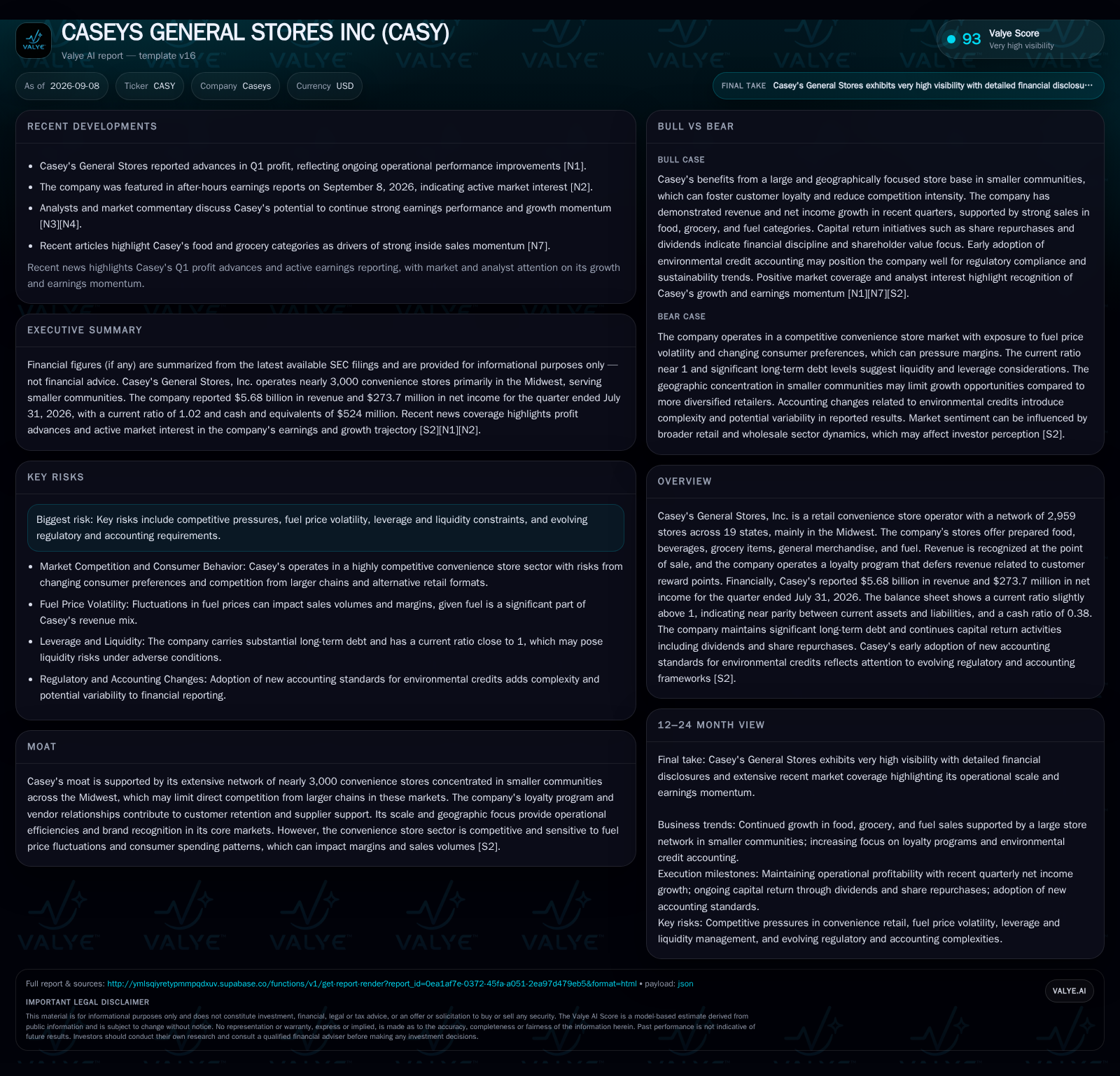
Caseys General Stores Inc operates nearly 3,000 convenience stores primarily in smaller Midwest markets, generating $5.68 billion in quarterly revenue and $273.7 million in net income as of July 31, 2026 [S2]. The company’s operational scale and customer loyalty underpin steady profit advances, though leverage at $2.33 billion long-term debt and competitive pressures from larger chains pose challenges. Early adoption of environmental credit accounting reflects regulatory adaptation. The core question is whether Caseys can sustain growth and margins against fuel price volatility and market competition while maintaining potential financial flexibility.
Caseys General Stores' recent quarterly earnings report highlights operational scale and earnings momentum driven by its extensive convenience store network in smaller Midwest communities, while balancing leverage and competitive pressures. The company reported $5.68 billion in revenue and $273.7 million in net income for Q1 2026, supported by a loyalty program and consistent store operations across 19 states [S2]. However, long-term debt of $2.33 billion and fuel price sensitivity introduce notable risks. The central question is whether Caseys can maintain growth and margin stability amid evolving market dynamics and regulatory changes.
Operational Scale and Revenue Composition in Small-Market Convenience
Caseys General Stores operates a network of 2,959 convenience stores predominantly located in smaller communities with populations under 20,000 across 19 states, mainly in the Midwest [S2]. This geographic focus allows the company to target less densely served markets where customer loyalty can be stronger and direct competition less intense. The diversified revenue streams include prepared foods, beverages, grocery items, general merchandise, and fuel sales, all recognized at point of sale.
A notable feature is the Casey’s Rewards loyalty program, which creates deferred revenue through contract liabilities amounting to approximately $74.7 million as of July 31, 2026 [S2]. This program supports customer retention and provides insight into purchase behavior, which can be leveraged for targeted promotions and sales growth. The loyalty program’s deferred revenue recognition impacts reported top-line timing but underpins recurring customer engagement.
Financially, the company’s first quarter ended July 31, 2026, generated approximately $5.68 billion in total revenue and $273.7 million in net income, with operating expenses of $754 million and cost of goods sold at $4.44 billion [S2]. The basic earnings per share stood at $7.40, with diluted EPS at $7.37 based on about 37 million shares outstanding, reflecting strong profitability on a per-share basis [S2].
Caseys has also adopted ASU 2026-02 for environmental credits early, applying it retrospectively without significant prior period adjustments, positioning the company to better manage emerging regulatory requirements related to renewable identification numbers and sustainability accounting [S2].
Recent Financial Performance and Capital Structure Overview
The quarter ended July 31, 2026, demonstrated revenue growth and profit advances, signaling operational momentum and attracting active market and analyst interest [S2][N1][N2][N3]. This performance underscores the company’s ability to capitalize on its customer base and store network despite competitive retail environments.
Liquidity metrics show cash and cash equivalents of $524 million, current assets of $1.39 billion, and current liabilities of $1.36 billion, resulting in a current ratio of 1.02 and a cash ratio of 0.38 [S2]. These figures indicate balanced short-term liquidity, though the current ratio near unity suggests limited cushion against unexpected operational shocks.
Long-term debt and finance lease obligations net of current maturities total approximately $2.33 billion, reflecting a significant leverage position [S2]. This level of indebtedness necessitates careful management of interest costs and refinancing risks, particularly in a rising interest rate environment or if operating cash flows fluctuate.
Capital return initiatives remain active, with ongoing dividends and share repurchases during the recent quarter, indicating management’s commitment to shareholder value while balancing reinvestment needs [S2].
Market Focus and Competitive Dynamics in Convenience Retail
Caseys’ strategic focus on smaller Midwest communities under 20,000 population differentiates it from many larger convenience chains that concentrate on urban or suburban centers [S2]. This niche positioning can foster strong community ties and reduce direct competition from national chains, potentially enhancing customer loyalty.
However, competitive pressures remain material, particularly from larger chains and alternative retail formats that may offer broader product selections, pricing advantages, or more aggressive fuel pricing. Fuel price volatility also directly impacts sales volumes and margins, given fuel’s significant contribution to total revenue [S2].
The company’s loyalty program, Casey’s Rewards, strengthens customer retention and provides a competitive edge by incentivizing repeat purchases, though its effectiveness depends on ongoing customer engagement and program innovation [S2].
Adoption of environmental credit accounting standards may improve Caseys’ sustainability credentials relative to competitors, possibly appealing to environmentally conscious consumers and regulators, though the direct competitive impact remains to be seen [S2].
Growth and Profitability Outlook Despite Market Headwinds
In the base case, Caseys maintains stable operational profitability with moderate revenue and net income growth driven by its extensive convenience store network and loyalty program. The company’s focus on smaller communities continues to shield it from intense pricing wars prevalent in larger markets, preserving margins and customer loyalty.
Leverage and liquidity remain balanced, with the current ratio near 1.0 and efficient cash management supporting ongoing capital returns without impairing operational investments [S2]. The company effectively manages fuel price fluctuations through pricing strategies and cost controls, mitigating margin erosion.
Accounting changes related to environmental credits are integrated without material earnings volatility or investor concern, maintaining transparent and consistent financial reporting [S2]. Competitive pressures are managed, with no significant market share loss, supporting steady revenue growth.
This scenario assumes no major macroeconomic disruptions or regulatory surprises that materially affect consumer spending or operating costs.
Margin Compression and Liquidity Strain from Competitive and Market Pressures
Under downside conditions, intensified competition from larger chains and alternative retail formats erodes Caseys’ pricing power and market share, leading to margin compression. Shifts in consumer preferences away from traditional convenience store purchases or prepared foods further pressure revenues.
Fuel price volatility exacerbates sales volume declines and squeezes gross margins, given fuel’s high revenue contribution. Increased borrowing costs or liquidity constraints emerge as the company struggles to service approximately $2.33 billion in long-term debt amid deteriorating cash flows [S2].
Accounting complexities or regulatory changes related to environmental credit standards introduce earnings volatility or investor uncertainty, potentially impacting valuation and capital access.
A sustained decline in same-store sales or net income despite stable store count would falsify the base case and signal operational weakness. Additionally, deterioration in liquidity ratios below current levels or inability to meet debt obligations would confirm downside risks.
Loss of customer loyalty in core smaller community markets would also materially undermine the company’s competitive position.
Enhanced Customer Loyalty and Margin Expansion Through Operational Excellence
In an upside scenario, Caseys leverages its loyalty program to deepen customer engagement, boosting same-store sales and cross-selling opportunities in food, grocery, and fuel segments. Improved operational efficiencies and fuel pricing strategies enhance margins.
The company manages leverage prudently, maintaining or reducing net debt levels through strong cash flow generation, supporting sustained or increased capital returns including dividends and share repurchases [S2].
Regulatory compliance and early adoption of environmental credit accounting strengthen Caseys’ sustainability profile, potentially unlocking new revenue streams or cost advantages associated with renewable energy credits [S2].
Geographic expansion or selective store upgrades in underserved smaller communities further consolidate market share. Favorable macroeconomic conditions and stable fuel prices underpin consistent earnings growth.
A concrete falsifier would be a failure to grow revenue or improve margins despite investments in loyalty and operations, or an inability to maintain leverage at manageable levels.
Critical Developments and Metrics to Follow
Quarterly trends in revenue and net income, with particular attention to food, grocery, and fuel sales segments, will indicate operational health and growth trajectory [S2].
Changes in the Casey’s Rewards loyalty program metrics, including contract liability balances and customer engagement rates, will help assess the strength of recurring revenue and customer retention [S2].
Liquidity ratios such as current and cash ratios, alongside long-term debt levels relative to operating cash flow, should be monitored to detect emerging leverage or refinancing risks [S2].
Market and analyst sentiment concerning Caseys’ competitive positioning, especially in relation to larger chains and alternative retail formats, will provide insight into external perceptions of resilience and growth potential [N1][N2][N3].
The impact of fuel price fluctuations on sales volumes and margins remains a critical variable influencing profitability and operational planning.
Disclaimer: This is research-only, informational analysis and not investment advice. It may include AI-generated interpretation and general industry context. Always verify important details using primary sources.

Comments