
ServiceTitan’s Growth Ambition: Platform Expansion, Operating Leverage, and the Profitability Challenge
Despite reported liquidity position and a growing product footprint, ServiceTitan faces a pivotal period as it seeks to translate recurring revenue and platform expansion into sustained profitability amid intensifying competition.
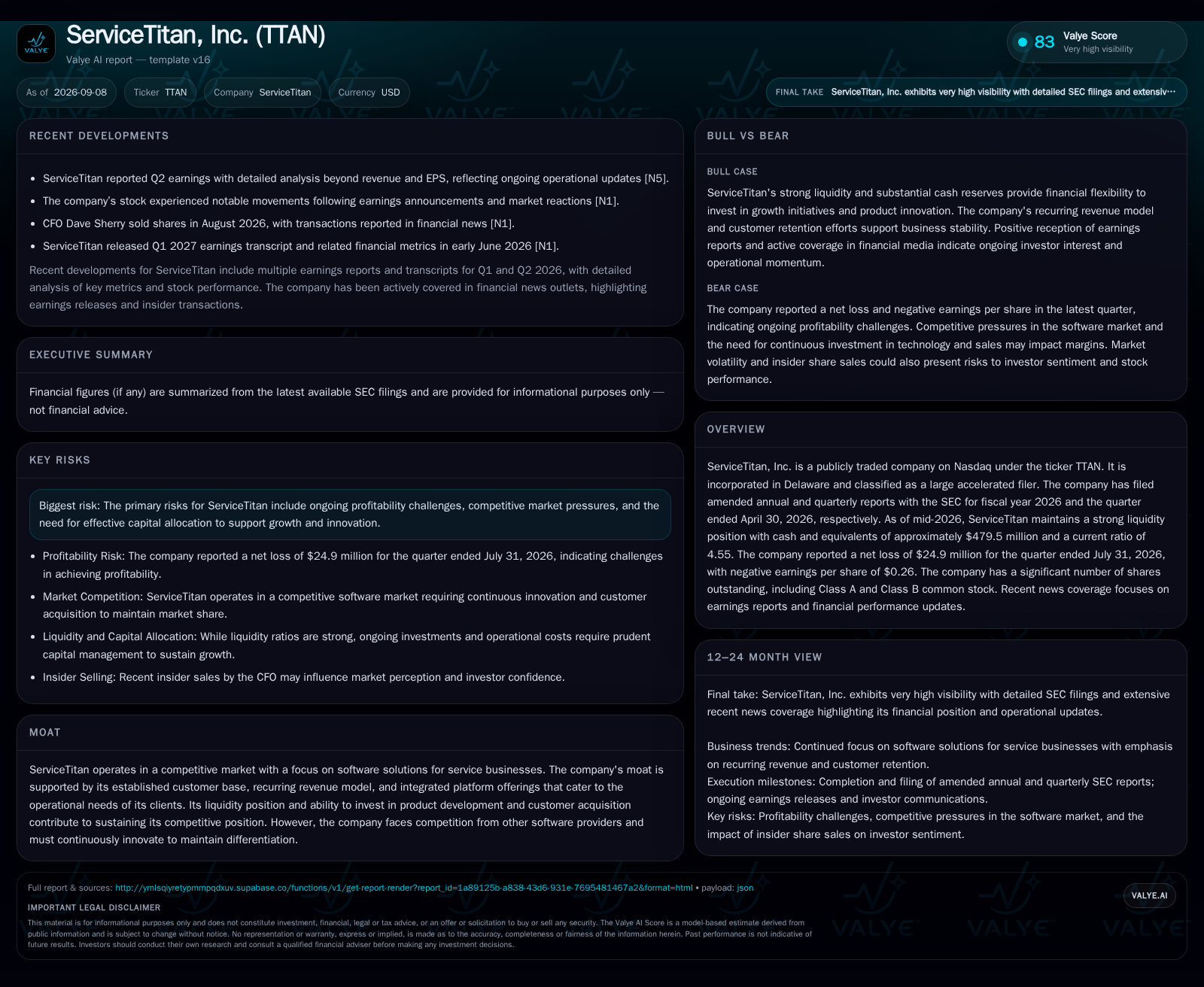
ServiceTitan, Inc. (Nasdaq: TTAN) maintains a reported liquidity position with $479.5 million in cash and a current ratio of 4.55 as of July 31, 2026. However, the company reported a net loss of $24.9 million for the most recent quarter, highlighting ongoing profitability challenges. The company’s strategy centers on expanding its integrated platform and increasing customer adoption of add-on and AI-powered products, aiming to grow wallet share and recurring revenue. The next phase hinges on whether this platform expansion can drive operating leverage and margin improvement in the face of a competitive software landscape. [S2]
ServiceTitan, Inc. enters the latter half of 2026 at a strategic crossroads. While the company boasts reported liquidity position with nearly half a billion dollars in cash and a healthy current ratio, it continues to post quarterly net losses as it invests heavily in platform expansion and product development. Management’s bet is clear: that deepening customer engagement through bundled, AI-powered, and fintech-enabled solutions will ultimately unlock profit potential and defensible market share. Yet, with competition intensifying across the service business software landscape, ServiceTitan must demonstrate that its recurring revenue model and product innovation can deliver operating leverage and sustainable margins.
Reported Liquidity Position Meets Persistent Net Losses: The 2026 Snapshot
As of July 31, 2026, ServiceTitan reported $479.5 million in cash and cash equivalents, with current assets of $670.4 million and current liabilities of $147.5 million, yielding a robust current ratio of 4.55 and a cash ratio of 3.25. This positions the company with considerable potential financial flexibility to fund growth initiatives and absorb operational volatility. However, the company’s net loss of $24.9 million for the quarter, with negative EPS of $0.26, highlights the persistent challenge of achieving profitability despite scale and a presumably sticky customer base. The company’s amended SEC filings and active investor communications suggest a focus on transparency and market engagement during this critical phase. [S2]
Recurring Revenue Ambitions and the Path to Operating Leverage
ServiceTitan’s business model is built around its integrated software platform for service businesses, with a focus on recurring revenue streams from core subscriptions and add-on modules. The economics of such a platform model are attractive in theory: as customer adoption deepens—with the addition of fintech, upsell, and AI-powered products—the company’s share of customer wallet increases, potentially driving higher average revenue per user (ARPU) and improved lifetime value. In practice, realizing these economics depends on the company’s ability to scale customer acquisition efficiently and to upsell existing customers without commensurate increases in cost.
Fixed costs related to R&D, product development, and customer success teams are substantial, but if incremental gross margins on new modules are high, ServiceTitan could realize significant operating leverage as revenue grows. The company’s strong cash position allows continued investment, but repeated net losses indicate that current growth is not yet translating into positive operating margins. The key unknown is whether the incremental economics of add-on and AI-powered products will ultimately yield the margin expansion necessary for long-term profitability.
A critical factor influencing the path to operating leverage is the scalability of ServiceTitan’s customer success and support functions. As the platform expands to include more complex AI-driven and fintech capabilities, the cost structure of servicing customers may shift. If the additional modules require significant onboarding, training, or ongoing support, the incremental costs could partially offset the higher gross margins from upselling. Conversely, if these products integrate seamlessly and reduce manual intervention through automation, the company could achieve a more favorable cost-to-serve ratio, reinforcing margin expansion potential. Understanding the elasticity of support costs relative to revenue growth is thus pivotal for modeling long-term profitability.
Platform Integration as Differentiator—But Competitive Moats Remain Contested
ServiceTitan operates in a crowded field of vertical SaaS providers targeting service-based small and medium businesses (SMBs). Its competitive pitch centers on an integrated, end-to-end platform that promises workflow automation, embedded fintech, and, increasingly, AI-driven insights. In theory, such integration can increase switching costs and support high retention if customers rely on ServiceTitan for mission-critical processes. However, the software market for trades and service businesses is highly fragmented, with both legacy incumbents and nimble, cloud-native challengers.
The durability of ServiceTitan’s moat depends on its ability to continually innovate, bundle new features, and demonstrate clear ROI to customers. In addition, as more competitors introduce their own AI-powered or industry-specific modules, differentiation may erode unless ServiceTitan’s platform delivers superior value or network effects. Price competition, alternative point solutions, and evolving customer expectations all present ongoing headwinds.
The competitive dynamics in the vertical SaaS market also hinge on the pace of technological adoption among SMB customers. While AI and fintech features may offer differentiation, their value realization depends on customer willingness and capability to integrate these tools into daily operations. If adoption rates are slower than anticipated due to customer inertia, limited digital maturity, or integration complexity, ServiceTitan’s ability to leverage these innovations as competitive moats could be constrained. Moreover, competitors focusing on niche verticals or simpler solutions may capture segments of the market less receptive to comprehensive platforms, fragmenting the opportunity and pressuring ServiceTitan’s pricing and retention.
How Platform Expansion Could Unlock Margin Acceleration
If ServiceTitan succeeds in driving broad adoption of its add-on and AI-powered products, it could see a step-change in wallet share and customer stickiness. In this scenario, incremental revenue from existing customers—via upsells and cross-sells—would flow through at higher incremental margins, as fixed costs are already absorbed by the core platform. This would allow the company to demonstrate operating leverage, with revenue growth outpacing increases in operating expenses, eventually flipping net losses into sustained profitability.
Confirmation of this scenario would come from sequential improvements in gross and operating margins, declining net losses, and evidence that a growing share of revenue is derived from add-on modules and fintech products. Strong customer retention, higher ARPU, and positive feedback on new product launches would further validate that ServiceTitan’s platform strategy is resonating and defensible.
Incremental Growth, Margin Pressure, and the Long Road to Profitability
The most plausible trajectory for ServiceTitan is one of steady, if uneven, progress: recurring revenue expands as core and add-on adoption grows, but heavy investment in R&D, sales, and customer success keeps operating margins under pressure. The company leverages reported liquidity metrics do not by themselves establish acquisition or investment capacity, but competition remains fierce and price-sensitive, limiting near-term pricing power.
In this scenario, ServiceTitan may narrow losses gradually as scale effects and upsell economics improve, but the path to break-even is extended. Evidence would include modest reductions in quarterly net losses, stable or improving gross margins, and continued growth in customer count and revenue per user. However, persistent spending on product development and market expansion may delay meaningful profitability.
Competitive Pressures and Innovation Gaps Could Stall Progress
Should ServiceTitan’s product roadmap fail to keep pace with evolving customer needs or if competitors successfully undercut pricing or out-innovate with superior solutions, the company could see slowing customer growth, higher churn, and margin compression. In this scenario, expensive investments in platform expansion do not yield the anticipated upsell or retention benefits, and the company’s net losses widen or persist longer than anticipated.
Warning signs would include stagnant or declining revenue growth, rising customer acquisition costs, increased churn, or a shrinking pipeline for new product adoption. If competitive differentiation erodes, ServiceTitan may be forced into price-based competition, further pressuring margins and raising questions about the long-term sustainability of its business model.
Milestones and Metrics That Will Shape ServiceTitan’s Profitability Narrative
Quarterly gross and operating margin trends—improvement would signal operating leverage is materializing; erosion would suggest cost structure or pricing pressure issues.
Growth in revenue attributable to add-on, fintech, and AI-powered modules—if disclosed, this would help confirm the platform expansion thesis.
Customer retention and churn rates—a useful metric would be whether deeper platform adoption correlates with higher retention.
Average revenue per user (ARPU) and wallet share—rising figures would indicate successful upselling and cross-selling.
Customer acquisition cost (CAC) relative to lifetime value (LTV)—if disclosed, this would test whether growth investments are yielding attractive unit economics.
R&D and sales/marketing expense as a percentage of revenue—declining ratios would support the case for improving operating leverage.
New product adoption rates—strong uptake of AI-powered and fintech offerings would validate innovation investments.
Competitive win rates or market share changes, if disclosed, to assess ServiceTitan’s positioning relative to peers.
Disclaimer: This is research-only, informational analysis and not investment advice. It may include AI-generated interpretation and general industry context. Always verify important details using primary sources.

Comments