
MiniMed Group’s Next Chapter: Integrated Diabetes Ecosystem, Margin Pressure, and the Battle for Global Adoption
MiniMed’s growth in international sales and rising CGM adoption underscore the appeal of its integrated diabetes platform. Yet, persistent margin pressure, net losses, and intensifying competition raise critical questions about the sustainability of its business model and the path to durable profitability.
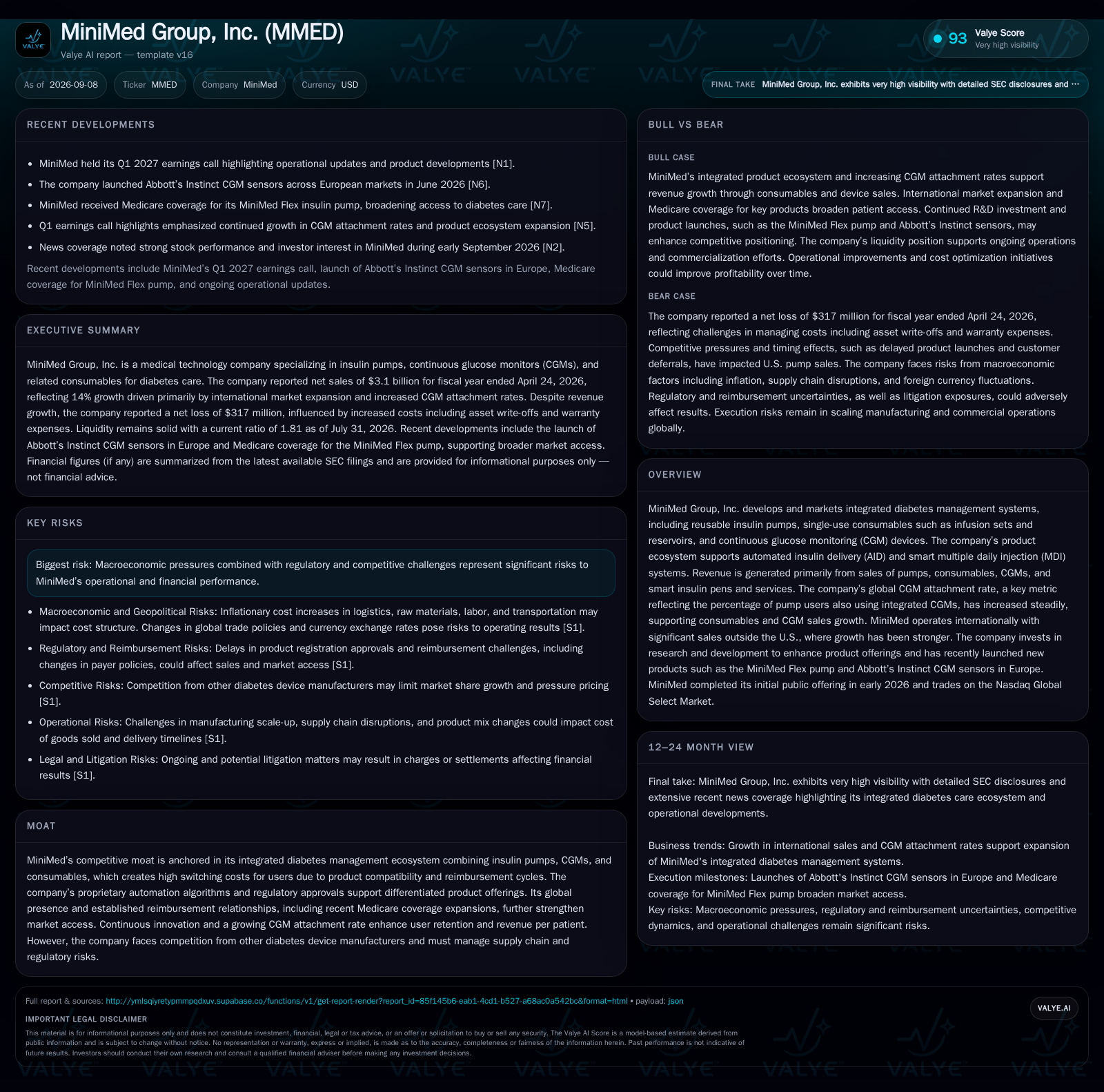
MiniMed Group, now an independent public company, reported $3.1 billion in fiscal 2026 sales—a 14% year-over-year increase driven by international expansion and a substantial rise in CGM attachment rates. Recent launches, including Abbott’s Instinct CGM sensors in Europe and Medicare coverage for the MiniMed Flex pump, have broadened access. However, net losses have widened to $317 million amid rising cost of goods sold, asset write-offs, and warranty expenses. The company’s liquidity remains adequate, but long-term margin improvement is not yet evident as pricing pressure and competition intensify. The core debate: Can MiniMed’s expanding ecosystem and recurring consumables revenue overcome cost challenges and defend its market position as global diabetes device markets evolve? [S1] [S2] [N6]
MiniMed Group, Inc., newly spun out from Medtronic and now trading independently, is navigating the complex transition from a high-growth diabetes device business to a standalone public company with global ambitions. With robust international sales expansion and a notable increase in continuous glucose monitor (CGM) attachment rates, MiniMed’s integrated ecosystem is gaining traction. Yet, the company remains unprofitable, facing persistent margin pressure due to rising costs, product mix, and growing competitive threats—especially in the CGM segment where pricing is under strain. The next 12–24 months will test whether MiniMed’s recurring consumables revenue and product innovation can offset these headwinds and establish a path to sustainable profitability.
Recent Growth, Margin Compression, and Strategic Launches Define the Current Landscape
MiniMed’s fiscal 2026 net sales reached $3.1 billion, up 14% year-over-year, with international sales surging 21% and U.S. sales growing just 2%. This acceleration was underpinned by a global CGM attachment rate jump from 59% to 66%, signaling greater adoption of MiniMed’s integrated pump-CGM systems [S1]. However, the company’s net loss widened to $317 million, reflecting not only higher sales volumes but also increased cost of goods sold (45.8% of sales), asset write-offs, and warranty expenses [S1].
Strategically, two recent developments are pivotal: the European launch of Abbott’s Instinct CGM sensors and the securing of Medicare coverage for the MiniMed Flex pump. These initiatives broaden access and have the potential to drive further adoption, especially outside the U.S. [N6]. Yet, they also coincide with intensifying pricing pressure in the CGM market, which could weigh on gross margins [S2].
Liquidity as of July 31, 2026, stood at $207 million in cash and equivalents, with a current ratio of 1.81. While this suggests operational flexibility, a cash ratio of 0.26 underscores the importance of improving cash conversion as the company scales [S2].
How MiniMed Makes—and Risks Losing—Money in Integrated Diabetes Care
MiniMed’s revenue model hinges on a razor-and-blade dynamic: durable insulin pumps are typically replaced every 4–5 years, while consumables (infusion sets, reservoirs) and CGM sensors require frequent replacement, generating recurring, higher-margin sales. The CGM attachment rate is a crucial lever—each incremental user who adopts both pump and CGM boosts lifetime revenue and enhances stickiness.
However, this model is exposed to several countervailing forces. Product mix shifts toward CGMs and consumables can lift recurring revenue, but pricing pressure—especially in international markets—can erode per-unit margins. The Q2 2026 cost of goods sold at 45.8% of net sales and rising warranty/asset write-off expenses reveal that operating leverage is not yet materializing despite scale [S1] [S2].
R&D investment remains high, at $448 million (14.5% of sales), reflecting the need for continual innovation to maintain regulatory approval and competitive parity. SG&A expense is also elevated at $1.2 billion (38.1% of sales), driven by commercialization, marketing, and incentives—suggesting that customer acquisition and retention are costly, and that MiniMed’s route to profitability depends on both volume growth and cost discipline.
Defending the Moat: Switching Frictions, Ecosystem Lock-In, and the Threat from Lower-Cost CGMs
MiniMed’s competitive positioning is anchored in its closed-loop ecosystem linking insulin pumps, CGMs, dosing algorithms, and connected apps. This integration generates switching costs: patients, once onboarded, face both logistical and reimbursement challenges if considering alternative systems. Proprietary automation algorithms and regulatory clearances create some product differentiation, while international reimbursement relationships (now including Medicare for Flex) expand addressable markets.
However, the moat is not impregnable. The CGM segment is seeing new entrants and aggressive pricing, especially in Europe and emerging markets. Lower-cost CGM options and broader payer coverage could drive price-based switching, compressing MiniMed’s margins and potentially eroding its base if competitors reach parity in integration or user experience.
The company’s legacy as Medtronic’s diabetes business confers scale and established clinical relationships, but as an independent entity, MiniMed must now invest heavily in brand, support, and distribution to defend and grow share against diversified device makers and pure-play diabetes tech challengers.
If Recurring Revenue and Ecosystem Expansion Outpace Margin Pressure
A bull case for MiniMed hinges on the company sustaining double-digit revenue growth through international expansion, further gains in CGM attachment, and successful commercialization of new products like the MiniMed Flex and Instinct CGM. If the adoption of integrated pump-CGM systems continues to rise—especially in markets newly accessed via Abbott and Medicare partnerships—MiniMed could achieve critical mass in recurring consumables revenue, driving operating leverage.
Confirmation would come from sequential improvement in gross and operating margins even as sales volumes rise, indicating that cost discipline and product mix are overcoming pricing headwinds. Additional evidence would be accelerating user growth, especially outside the U.S., and signs of stickier patient retention as more users rely on the full ecosystem.
Falsification would entail persistent or widening losses despite revenue growth, stagnant or declining CGM attachment rates, or evidence that new launches are cannibalizing rather than expanding MiniMed’s installed base.
Incremental Growth, Margin Volatility, and the Long Road to Profitability
The most plausible medium-term outcome is that MiniMed continues to deliver solid topline growth—driven by international expansion, higher CGM attachment, and new product launches—but faces ongoing gross margin volatility due to pricing pressure and the high cost of acquiring and supporting new users. The mix of recurring consumables revenue will rise, but offsetting cost reductions and scale efficiencies will be gradual.
In this scenario, net losses narrow only modestly over the next 12–24 months, with profitability dependent on a combination of sustained volume growth, cost optimization, and successful defense against lower-cost competitors. Confirmation would be a steady or improving gross margin trend, positive operating cash flow, and continued growth in both the user base and recurring revenue per user.
Falsification would be further deterioration in margins, evidence of user churn, or a reversal in international or CGM-driven sales growth.
When Price Wars, Cost Overruns, or Regulatory Delays Derail the Ecosystem Strategy
A bear case unfolds if intensifying price competition in CGMs and pumps (especially in Europe and other cost-sensitive markets) leads to sharp margin compression that outpaces MiniMed’s ability to scale. If cost of goods sold and SG&A remain stubbornly high, or if warranty and write-off expenses escalate, MiniMed could face ongoing or worsening net losses, forcing it to raise capital or cut growth investments.
Further risk comes from regulatory or reimbursement setbacks—such as delayed approvals for next-gen products, or unfavorable Medicare/payer changes—that stall adoption and undermine the company’s ability to fully monetize its pipeline. Execution missteps in manufacturing scale-up or supply chain management could also erode trust and market share.
Downside confirmation would be a decline in cash/short-term liquidity, negative operating cash flow, layoffs or cutbacks in R&D/commercialization, or a noticeable loss of market share to lower-cost or more innovative competitors.
Milestones That Will Determine MiniMed’s Long-Term Value Creation
Quarterly and annual trends in gross margin: Sustained improvement would suggest pricing power or cost discipline; further erosion would raise red flags.
Actual CGM attachment rate progression: If disclosed, monitoring whether the percentage of pump users adopting CGMs continues to climb is essential.
Recurring revenue per user: A useful metric would be the dollar value of consumables and sensors sold per active user per year, indicating ecosystem monetization depth.
International versus U.S. sales mix: Watch for continued outperformance internationally and any signs of renewed U.S. momentum post-Flex launch.
Net cash from operating activities: Tracking whether MiniMed turns positive on an operating cash flow basis will test claims of scalability and business model resilience.
Product pipeline milestones: Updates on regulatory approvals, new product launches, and integration of Abbott’s Instinct sensors will be pivotal.
Competitive pricing trends in CGMs: If disclosed, any evidence of further price cuts or reimbursement changes impacting average selling prices.
Warranty and asset write-off expenses: Ongoing high or rising costs here would suggest quality or operational execution risks remain unresolved.
Disclaimer: This is research-only, informational analysis and not investment advice. It may include AI-generated interpretation and general industry context. Always verify important details using primary sources.

Comments