
Cooper Companies’ Dual-Segment Model Under Pressure from ERP, Customer Concentration, and Global Complexity
Strong Q3 profitability and global reach underscore Cooper Companies’ operational resilience, but ERP transitions, customer consolidation, and regulatory hurdles could reshape its risk-reward profile.
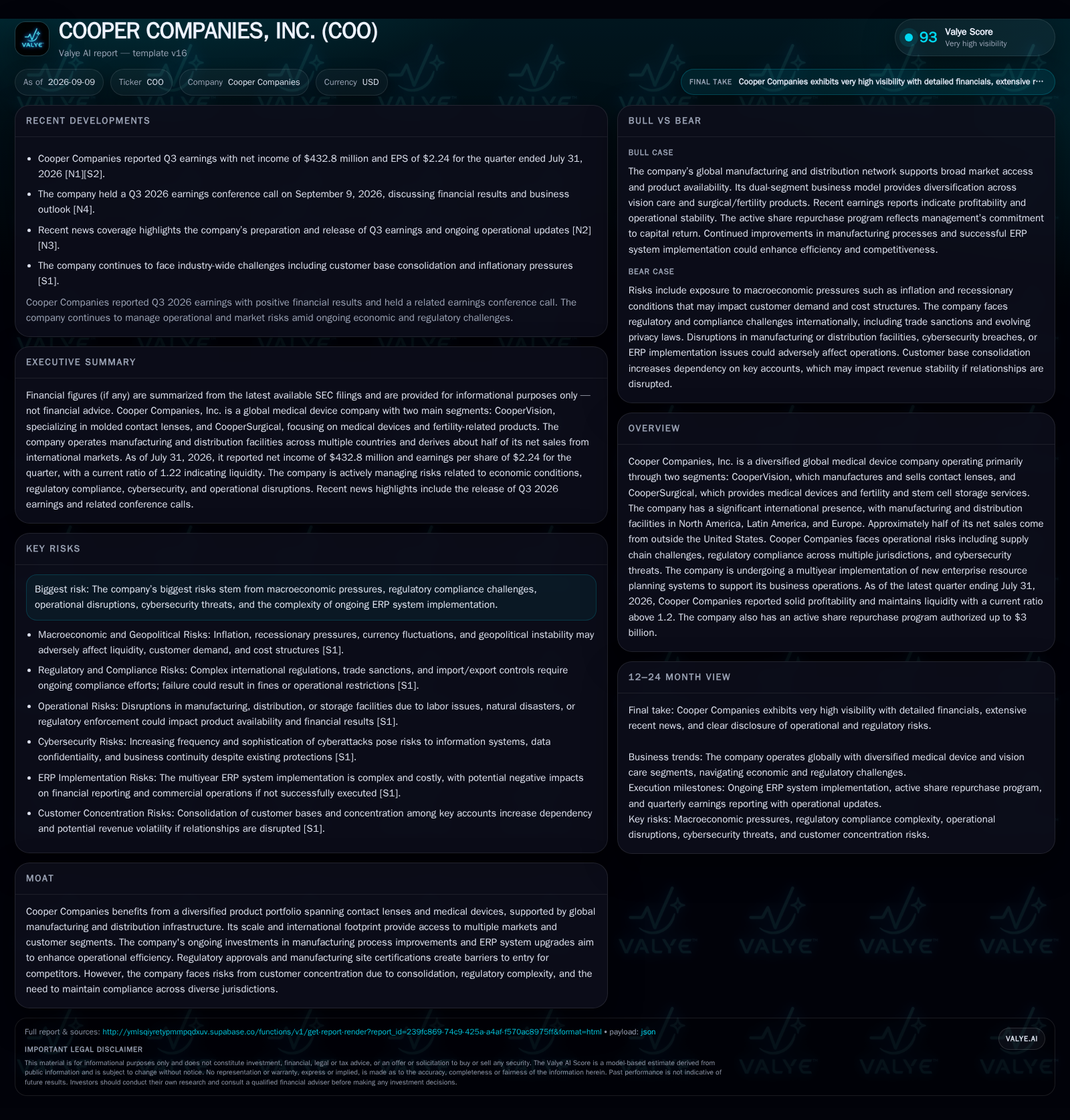
Cooper Companies reported robust Q3 net income and maintains a diversified portfolio across contact lenses and surgical/fertility devices, with roughly half of sales from international markets [S1] [S2] [N1]. While its global manufacturing footprint and active share repurchase program suggest stability, ongoing ERP implementation, customer concentration, and complex regulatory environments present material risks [S1] [S2]. The company’s ability to execute on process upgrades and manage operational disruptions will determine whether recent profitability is sustainable.
Cooper Companies, Inc. enters late 2026 with strong quarterly profitability and a global footprint spanning contact lenses and surgical/fertility products [S2] [N1]. Its dual-segment model and international reach offer diversification, but the company faces a complex risk landscape: a multiyear ERP overhaul, heightened customer concentration, and exposure to shifting macroeconomic and regulatory conditions [S1]. With half of its revenue sourced outside the U.S. and a large share repurchase authorization in place, the next phase hinges on execution—both in operational upgrades and in maintaining resilient customer and supply relationships.
Q3 Profitability and Global Operations Define the Current State
Cooper Companies reported net income of $432.8 million and earnings per share of $2.24 for the quarter ended July 31, 2026, signaling robust short-term profitability [S2] [N1]. The company’s liquidity metrics, with a current ratio of 1.22 and $154.7 million in cash, suggest it maintains a buffer against near-term shocks [S2].
Approximately half of net sales in fiscal 2024 and 2025 came from outside the United States, highlighting the company’s significant exposure to international markets and associated currency and geopolitical risks [S1]. Operationally, Cooper Companies is in the midst of a multiyear ERP system implementation across both CooperVision and CooperSurgical, a process that is both costly and operationally complex [S1]. The company continues to face industry-wide challenges such as customer base consolidation and inflationary pressures, which could alter its revenue stability and cost structure [S1].
How Cooper Companies Monetizes Vision and Fertility Solutions
Cooper Companies operates two main business segments: CooperVision, which manufactures molded contact lenses, and CooperSurgical, which manufactures medical devices and fertility and stem cell storage products [S1]. The vision care business typically relies on recurring purchases, with molded contact lenses representing a consumable, replacement-driven revenue stream. Surgical and fertility products may have a mix of one-time equipment sales, consumables, and service contracts, with fertility storage adding an element of recurring revenue.
Pricing power in both segments is influenced by the degree of product differentiation, regulatory approvals, and customer switching costs. The company’s global manufacturing footprint offers economies of scale, but also increases fixed costs and exposes it to supply chain disruptions. Operating leverage could emerge if the ERP system implementation succeeds in reducing administrative and manufacturing inefficiencies, but this is counterbalanced by the risk of cost overruns or integration failures during the transition. The capital intensity is moderate, with ongoing investments required for regulatory compliance, manufacturing upgrades, and digital infrastructure.
Diversified Portfolio Versus Regulatory and Customer Dynamics
Cooper Companies’ competitive position rests on its diversified portfolio and global manufacturing and distribution capabilities [S1]. In the contact lens market, it competes with established players such as Johnson & Johnson Vision, Alcon, and Bausch + Lomb, where brand, product breadth, and regulatory approvals are key differentiators. In the surgical and fertility space, competition includes both large diversified medtech firms and specialized device makers.
Barriers to entry are reinforced by regulatory certifications, manufacturing scale, and the complexity of global distribution. However, consolidation among large distributors and healthcare providers could increase buyer power, compressing margins or threatening revenue concentration if key accounts are lost. Regulatory complexity across jurisdictions—especially regarding data privacy, trade sanctions, and product approvals—raises compliance costs and the risk of operational disruptions. The effectiveness of the ERP upgrade may influence the company’s ability to maintain or extend its competitive edge.
Efficiency Gains and Global Expansion Drive Outperformance
A favorable scenario for Cooper Companies would see the successful implementation of the ERP system, leading to improved operational efficiency, streamlined supply chain management, and enhanced decision-making. If the company leverages its global footprint to capture incremental share in both developed and emerging markets, while maintaining product innovation and regulatory compliance, it could expand margins and accelerate earnings growth.
Evidence supporting this scenario would include sustained or improving gross and operating margins, stable or growing international sales, and minimal operational disruptions during the ERP rollout. A falsification would be a spike in costs, reporting delays, or a decline in service quality linked to the ERP transition, or evidence of market share loss to competitors.
Operational Upgrades Confront External Pressures
The most plausible scenario is that Cooper Companies maintains steady performance, with moderate growth across its two segments offset by periodic disruptions from ERP implementation, inflation, and international regulatory changes. The company’s diversified business mix and global presence provide resilience, but margin expansion is likely capped by ongoing compliance costs and price competition in key markets.
Confirmation would come from relatively stable revenue and earnings, with incremental improvements in operating efficiency and no major negative surprises from the ERP rollout. Evidence against this scenario would include persistent operational setbacks, loss of major customers, or a material contraction in international sales due to macroeconomic or geopolitical shocks.
ERP Missteps or Customer Losses Undermine Profitability
A negative outcome could result if the ERP system implementation encounters significant delays, cost overruns, or operational disruptions, leading to supply chain bottlenecks, inventory issues, or reporting failures. Concurrently, if customer consolidation accelerates and Cooper Companies loses one or more major accounts, revenue volatility could increase and margins could compress.
Supporting evidence for this downside would include rising SG&A or restructuring charges, missed earnings targets, or disclosures of operational setbacks related to the ERP transition. This scenario could be falsified if the company reports smooth ERP progress, retains key customers, and maintains stable or improving profitability metrics.
Key Questions on Execution, Customer Stability, and Global Risk
The following milestones and metrics will be essential to evaluate Cooper Companies’ trajectory:
– Progress updates and cost disclosures related to the ERP system rollout, including any reported operational disruptions or delays [S1].
– Segment-level revenue and margin trends for CooperVision and CooperSurgical, particularly in international markets where currency and regulatory risks are pronounced [S1].
– Customer concentration metrics: if disclosed, the proportion of revenue from top customers or distributors would help gauge risk from consolidation [S1].
Disclaimer: This is research-only, informational analysis and not investment advice. It may include AI-generated interpretation and general industry context. Always verify important details using primary sources.

Comments