
Trio Petroleum Expands Heavy Oil Portfolio Through Strategic Acquisitions Despite Regulatory and Financial Challenges
Trio Petroleum’s pivot from California to Utah and Canadian heavy oil assets reflects efforts to secure stable cash flow and growth potential, but execution risks and cost pressures present ongoing challenges.
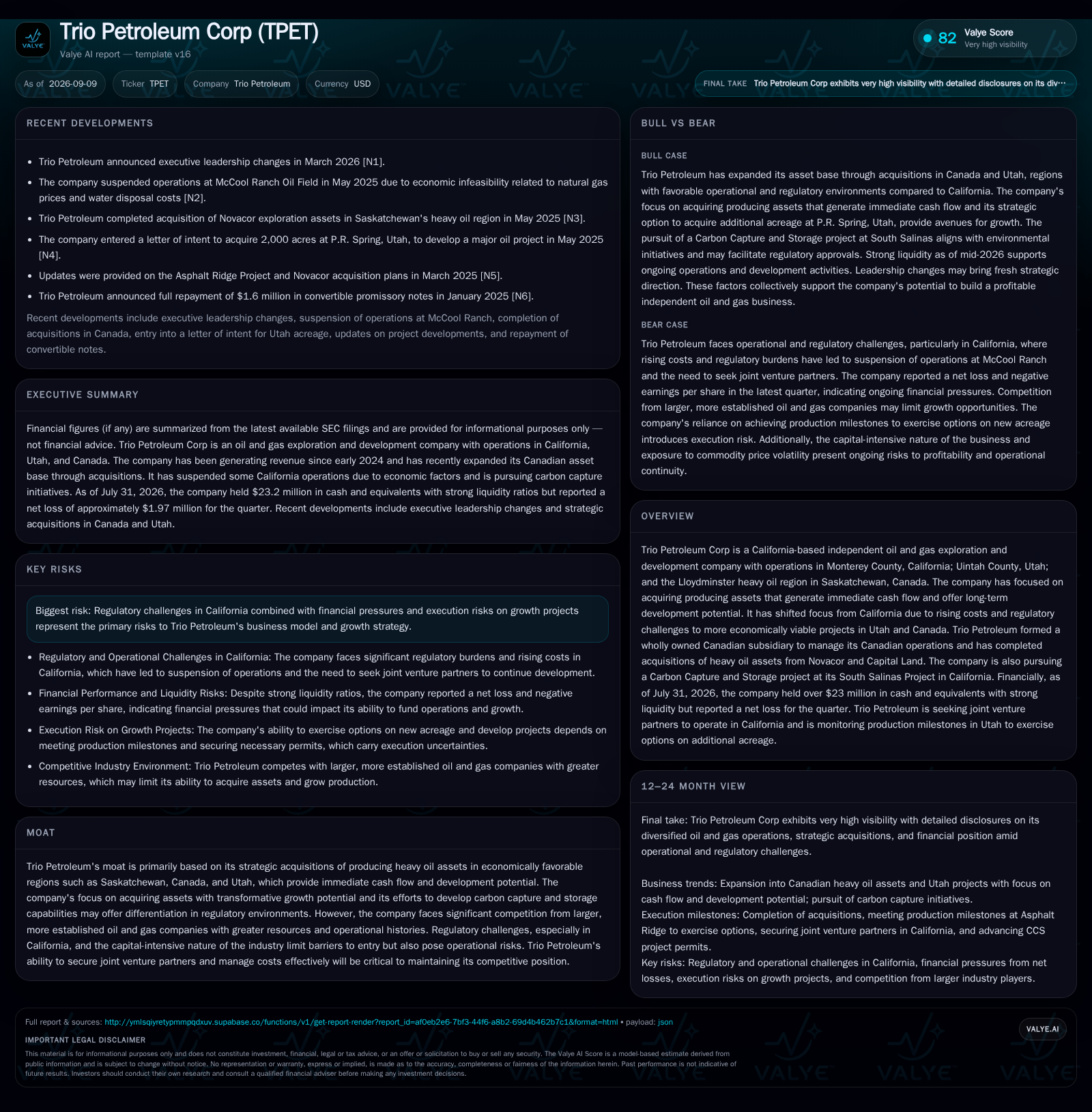
Trio Petroleum Corp, an independent oil and gas producer with operations spanning California, Utah, and Canada, is reshaping its portfolio toward economically favorable regions through strategic acquisitions and development projects. The company reported $23.2 million in cash and equivalents and a current ratio above 20 as of July 31, 2026, alongside a quarterly net loss of $1.97 million, reflecting ongoing financial pressures amid operational challenges. The company’s business model centers on acquiring producing heavy oil fields with near-term cash flow and transformative potential, but regulatory hurdles, capital intensity, and the need to meet production milestones to unlock acreage options complicate growth prospects. Trio’s pursuit of carbon capture projects may offer regulatory and environmental advantages if successful. The company’s outlook hinges on execution in Utah and Canada, effective cost management, and partnerships to navigate California’s challenging environment.
Trio Petroleum Corp is repositioning its upstream oil and gas portfolio by emphasizing producing heavy oil assets in Utah and Canada while scaling back operations in California due to economic and regulatory pressures. This strategic shift is supported by recent acquisitions in Saskatchewan and conditional acreage options in Utah, which offer immediate cash flow and development upside. Despite reported cash and liquidity ratios as of July 31, 2026, the company faces near-term financial losses, regulatory complexities, and execution risks tied to production targets and permit approvals. Trio’s investment in carbon capture technology further reflects attempts to align with evolving energy policies. The company’s ability to convert its growth pipeline into sustainable cash flow will critically shape its trajectory in a capital-intensive and competitive industry.
Asset Rebalancing and Financial Position Amid Operational Shifts
Trio Petroleum has actively rebalanced its geographic portfolio by suspending the McCool Ranch Oil Field operations in California in May 2025, citing economic infeasibility due to natural gas commodity prices and high water disposal costs [N2]. This move underscores the regulatory and cost challenges intrinsic to California’s oil sector, prompting a strategic pivot toward the more favorable operating environments of Utah and Canada.
Complementing this shift, Trio completed acquisitions of heavy oil assets in Saskatchewan through Novacor and Capital Land deals in 2025, managed via a newly formed Canadian subsidiary established in March 2025 [N3] [N4]. The company also holds conditional acreage rights in Utah’s P.R. Spring, contingent on production milestones at the Asphalt Ridge Project [N4]. Financially, as of July 31, 2026, Trio Petroleum reported cash and equivalents of $23.2 million, current assets of $24.7 million, current liabilities of $1.2 million, resulting in a current ratio of 20.55, alongside a quarterly net loss of $1.97 million, reflecting ongoing operational and profitability pressures [S2].
Generating Cash Flow from Heavy Oil Assets with Capital-Intensive Development
Trio Petroleum’s business model focuses on acquiring producing heavy oil assets that provide near-term cash flow while offering longer-term development potential. Heavy oil production typically involves higher lifting costs and more complex extraction techniques, such as thermal recovery, increasing capital intensity and operating expenses. The company’s acquisitions in Saskatchewan, a known heavy oil region, align with this model, aiming to leverage existing infrastructure and established production to reduce initial capital outlays.
Revenue generation depends on crude oil prices, production volumes, and operational efficiency. Given Trio’s limited scale, fixed costs related to regulatory compliance, water disposal, and carbon capture initiatives weigh heavily on margins. Operating leverage is conditional on increasing production volumes and achieving economies of scale, but the capital-intensive nature of heavy oil extraction and regulatory costs limit rapid margin expansion. The company’s pursuit of carbon capture and storage (CCS) at South Salinas could mitigate environmental compliance costs and potentially create regulatory goodwill, influencing cost structures and permitting timelines if successfully implemented [S1].
Competing in a Fragmented Market with Regulatory and Scale Challenges
Trio Petroleum operates in a highly competitive and capital-intensive oil and gas sector dominated by large integrated companies with deeper pockets and broader operational footprints. The company’s competitive advantage lies in its strategic acquisitions of producing heavy oil assets in regions with more favorable regulatory environments (Utah and Canada) and its early CCS initiative, which could differentiate it amid tightening environmental regulations.
However, the regulatory burden in California, which forced suspension of key operations, exposes Trio to significant regional risk and cost disadvantage. The need to secure joint venture partners in California underscores challenges in scaling operations and managing costs effectively. Trio’s smaller scale compared to industry peers limits bargaining power on service costs and reduces flexibility to withstand commodity price volatility. Maintaining a competitive position will likely depend on successful execution of growth projects, cost control, and leveraging regulatory differentiation through CCS capabilities.
Expansion in Utah and Canada Drives Sustainable Cash Flow Growth
In a favorable scenario, Trio meets production milestones at the Asphalt Ridge Project in Utah, enabling exercise of the option to acquire 2,000 additional acres at P.R. Spring [N4]. Concurrently, the heavy oil assets in Saskatchewan deliver stable or improving production volumes with operational efficiencies. These developments drive meaningful revenue growth and improve cash flow, allowing Trio to reduce losses and finance further development internally.
The company’s CCS project at South Salinas advances toward regulatory approval and commercial viability, helping to offset carbon-related compliance costs and enhancing the company’s profile with regulators and investors [S1]. Leadership changes in March 2026 facilitate sharper strategic focus and operational discipline [N1]. Confirmation of expanding production, improving unit economics, and successful CCS deployment would falsify downside concerns about regulatory or financial viability.
Growth Slows Due to Regulatory and Capital Limitations
The most plausible middle-path scenario envisions Trio gradually ramping production in Utah and Canada but facing ongoing cost pressures and regulatory hurdles, particularly in California. The company exercises acreage options but with delays caused by permitting and production ramp-up challenges. Heavy oil production remains steady but capital-intensive, limiting margin expansion.
Liquidity remains sufficient to fund near-term operations, but modest net losses persist as Trio invests in infrastructure and CCS development. Joint venture partnerships in California materialize but require careful cost-sharing to manage economic feasibility. This scenario is confirmed if production growth is incremental, financial performance stabilizes without significant profit, and CCS projects progress but face timeline uncertainties. Conversely, rapid margin improvement or large-scale regulatory setbacks would falsify this balanced outlook.
Regulatory and Execution Failures Curtail Growth and Financial Stability
Under a downside scenario, continued regulatory challenges and rising operational costs in California prevent resumption of suspended operations and stall joint venture negotiations. Production milestones at Asphalt Ridge are missed or delayed, causing the loss of acreage options [N4]. Canadian heavy oil assets underperform due to technical or market pressures, reducing cash flow and stressing liquidity.
Capital constraints limit the company’s ability to invest in CCS projects or optimize operations, exacerbating financial losses beyond the reported $1.97 million quarterly deficit [S2]. A prolonged negative earnings trajectory could impair investor confidence and restrict access to external capital. Evidence confirming this scenario would include additional asset impairments, failure to secure partners, or regulatory denials. Signs of improved operational metrics or successful capital raises would contradict this negative outlook.
Critical Indicators to Assess Trio Petroleum’s Execution and Financial Health
Monitoring production volumes and operational uptime at Asphalt Ridge and Saskatchewan heavy oil fields would help gauge the company’s ability to generate cash flow and meet growth targets. If disclosed, unit operating costs and lifting costs per barrel would be valuable to assess margin trends.
Progress on CCS project permitting and initial deployment at South Salinas is a critical regulatory and strategic milestone influencing cost structure and long-term viability. Updates on joint venture partnerships or development agreements in California would indicate the company’s capacity to manage regulatory complexity.
Financial metrics such as quarterly net income or loss, cash burn rate, and changes in liquidity beyond July 2026 figures would test whether the company can sustain operations without external funding. If disclosed, customer or offtake contract renewals and pricing terms would illuminate revenue stability.
Achievement of production milestones tied to the P.R. Spring acreage option will confirm or negate the company’s planned expansion in Utah. Leadership commentary on strategic priorities and capital allocation in upcoming reports would clarify management’s confidence and direction.
Disclaimer: This is research-only, informational analysis and not investment advice. It may include AI-generated interpretation and general industry context. Always verify important details using primary sources.

Comments