
Dell Technologies Struggles with Margin Pressure Despite Strong AI Backlog and Intense Competition
Dell’s substantial $51 billion AI factory backlog signals strong demand in AI infrastructure and cloud analytics, yet evolving AI hardware/software cost dynamics and intense market rivalry challenge margin sustainability and growth prospects.
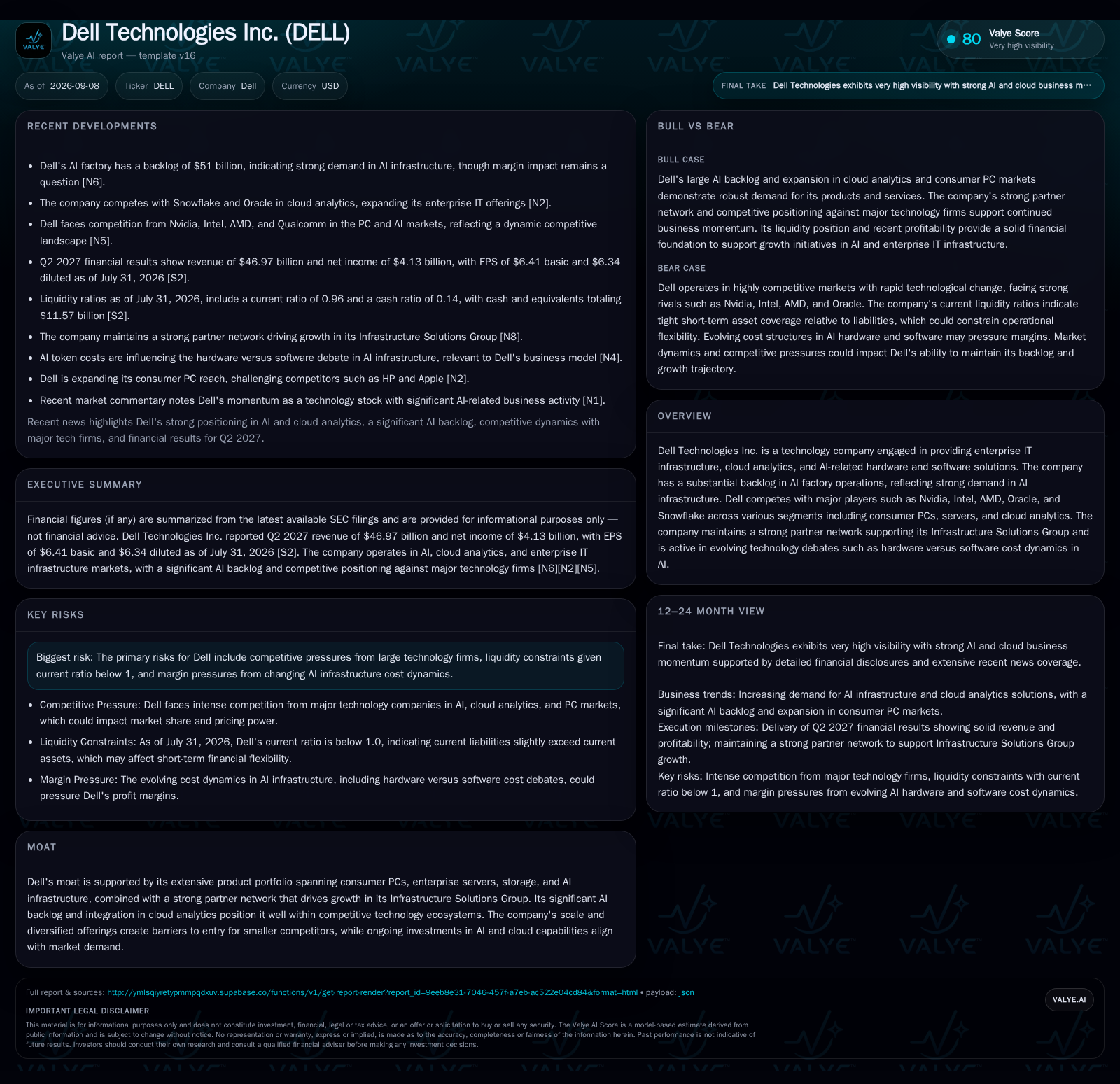
Dell Technologies reported solid Q2 2027 results with revenue near $47 billion and net income exceeding $4 billion, driven by a large AI factory backlog. However, cost pressures from AI token economics and competition from leading tech firms temper margin outlook and operational flexibility. The company’s partner network and infrastructure solutions provide growth avenues, but liquidity ratios below 1.0 could constrain short-term agility. Key uncertainties include backlog conversion, margin trajectory, and competitive responses from Nvidia, Intel, AMD, Oracle, and Snowflake.
Dell Technologies’ Q2 2027 earnings highlighted strong demand in AI infrastructure and cloud analytics, underscored by a substantial $51 billion AI factory backlog. The company delivered $46.97 billion in revenue and $4.13 billion in net income, demonstrating operational strength. Yet, the evolving cost dynamics of AI hardware and software, coupled with intense competition from major technology firms, raise critical questions about Dell’s margin sustainability and growth trajectory in a rapidly shifting market.
Robust AI Demand Meets Cost and Liquidity Constraints
Dell Technologies Inc. reported strong Q2 2027 financial results, with revenue of $46.97 billion and net income of $4.13 billion, reflecting solid execution in its core enterprise IT and AI infrastructure businesses [S2].
Central to this performance is Dell’s $51 billion AI factory backlog as of mid-2026, signaling robust demand for AI-related hardware and services. This sizable backlog provides visibility into near-term revenue streams and highlights Dell’s positioning in the AI infrastructure market [N6].
Despite this strength, Dell’s liquidity ratios reveal some constraints, with a current ratio of 0.96 and a cash ratio of 0.14, alongside $11.57 billion in cash and equivalents. These metrics suggest limited short-term potential financial flexibility that could affect investment and operational agility [S2].
The company operates in a highly competitive environment, contending with major players such as Nvidia, Intel, AMD, Qualcomm, Snowflake, and Oracle across AI hardware, cloud analytics, enterprise servers, and consumer PC segments [N2][N5].
Additionally, evolving AI token costs introduce complexity into Dell’s cost structure, impacting the balance between hardware and software expenses and posing potential margin pressures moving forward [N4].
Margin Compression and Liquidity Stress From Intensifying Competition
One downside risk for Dell is sustained margin erosion driven by rising AI hardware costs coupled with competitive pricing pressure in software and cloud analytics offerings. As AI token costs evolve, hardware margins may shrink if cost inflation outpaces pricing power [N4].
Increased competition from firms such as Nvidia and AMD, which have strong footholds in AI chipsets, could lead to market share losses in critical segments. Similarly, cloud analytics competition from Oracle and Snowflake might constrain Dell’s pricing and revenue growth [N2][N5].
Liquidity constraints pose a further downside risk. Dell’s current ratio below 1.0 indicates that current liabilities nearly match current assets, potentially impairing short-term operational flexibility and limiting capital available for strategic investments or responding to market shifts [S2].
Failure to maintain or grow the Infrastructure Solutions Group’s partner network could further weaken Dell’s market position, reducing sales growth and integration capabilities [N8].
If these factors materialize, backlog cancellations or slower conversion could follow, undermining revenue visibility and investor confidence.
A Diverse Competitive Set Challenges Dell’s AI and Cloud Leadership
Dell competes across multiple overlapping markets, including AI hardware, cloud analytics, enterprise servers, and consumer PCs. This diversification offers resilience but also exposes the company to intense rivalry from specialized and large-scale technology firms [N2][N5].
Nvidia dominates AI chipsets and GPUs, putting pressure on Dell to innovate or source competitively priced components. Intel and AMD also vie for market share in AI and server processors, increasing pricing pressure and technology race urgency [N2].
In cloud analytics, Oracle and Snowflake’s focus on software and data platforms challenges Dell’s ability to capture high-margin service revenues. Qualcomm’s presence in related hardware markets adds to competitive complexity [N5].
Dell’s strong partner network underpins its Infrastructure Solutions Group, enabling robust sales channels and integration capabilities that support competitive differentiation [N8]. However, sustaining and expanding this network is critical amidst aggressive competitor advances.
The company’s presence in the consumer PC market offers revenue diversification but is also intensely competitive with thin margins.
AI Backlog Drives Revenue Visibility Amid Cost and Margin Uncertainties
Dell’s $51 billion AI factory backlog is a key economic driver, providing revenue visibility and underpinning investment in AI infrastructure hardware and related services [N6]. This backlog reflects strong customer commitments and demand momentum.
However, the business model faces margin pressure from evolving AI token costs, which blur traditional hardware versus software cost distinctions. As AI workloads increase, the balance between upfront hardware costs and ongoing software/service expenses will shape profitability [N4].
Dell’s liquidity profile, with a current ratio just below 1.0 and a cash ratio of 0.14, indicates moderate short-term potential financial flexibility but may limit capacity for rapid investment or operational pivots [S2].
The competitive environment further influences unit economics; pricing pressure from market leaders may compress margins, while Dell’s partner network and infrastructure capabilities support higher sales efficiency and integration value [N8].
Overall, the business economics hinge on successful backlog conversion, margin management amid cost evolution, and sustaining competitive differentiation.
Growth Maintains Momentum Despite Margin and Competitive Pressures
In the base case, Dell converts its AI factory backlog steadily, maintaining revenue growth near current levels without significant backlog deterioration [N6].
Profitability remains solid, with moderate margin pressure stemming from AI token cost evolution and competitive pricing, but not severe enough to erode net income substantially [N4].
The competitive landscape holds Dell’s market share stable, though pricing power is limited by rivals such as Nvidia and Oracle [N2][N5].
Liquidity ratios stay roughly constant, supporting ongoing operations and moderate investments without major stress [S2].
The Infrastructure Solutions Group continues to expand via its partner network, sustaining sales growth and customer integration [N8].
Margin Expansion and Market Share Gains Through Backlog Conversion and Partner Growth
An optimistic scenario sees Dell successfully converting its $51 billion AI factory backlog into revenue with limited margin erosion, benefiting from operational efficiencies and favorable AI token cost developments [N6][N4].
Expansion in the consumer PC market and enterprise IT segments diversifies revenue and strengthens Dell’s competitive positioning against rivals [N2][N5].
Growth acceleration in the Infrastructure Solutions Group partner network enhances sales reach and integration capabilities, fueling market penetration and higher-margin service offerings [N8].
Improved liquidity ratios through operational cash flow and disciplined capital management provide Dell with flexibility to invest in innovation and strategic initiatives [S2].
These factors combine to support margin expansion, stronger revenue growth, and enhanced shareholder value in the near to medium term.
Metrics Tracking Dell’s AI Momentum and Margin Trajectory
Monitor trends in the AI factory backlog conversion rate and any changes in backlog size, which directly affect near-term revenue visibility and growth prospects [N6].
Track Dell’s margin performance relative to evolving AI token costs to assess how hardware and software cost dynamics influence profitability [N4].
Observe liquidity ratios, particularly the current and cash ratios, to evaluate potential financial flexibility and capacity for strategic investments [S2].
Follow competitive developments from Nvidia, Intel, AMD, Oracle, and Snowflake, including product launches, pricing strategies, and market share shifts [N2][N5].
Assess growth and retention within Dell’s Infrastructure Solutions Group partner network, as this underpins sales execution and integration capabilities [N8].
Disclaimer: This is research-only, informational analysis and not investment advice. It may include AI-generated interpretation and general industry context. Always verify important details using primary sources.

Comments