
Signet Jewelers Drives Brand-Focused Growth While Managing Store Rationalization and Margin Pressure
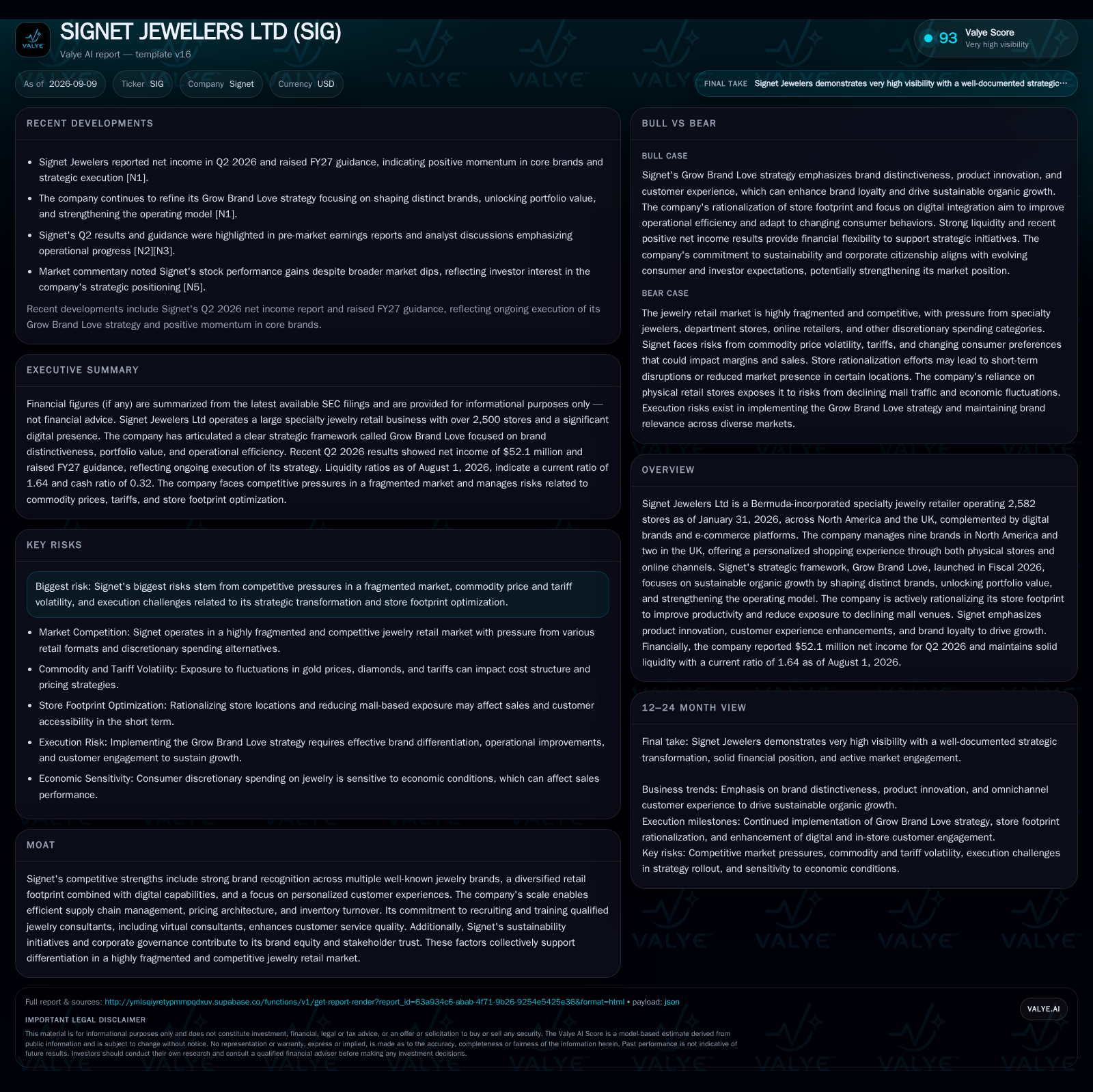
Signet Jewelers is executing a strategic pivot through its Grow Brand Love initiative, emphasizing brand differentiation and omnichannel customer experience while managing operational efficiencies via store rationalization. Despite a slight sales decline, the company’s raised guidance and net income signal cautious optimism tempered by competitive and commodity challenges.
Signet Jewelers operates over 2,500 stores across North America and the UK, complemented by digital platforms. Its Grow Brand Love strategy aims to drive sustainable organic growth by enhancing brand distinctiveness, expanding adjacent categories, and strengthening its operating model. Recent Q2 2026 results showed a modest revenue dip but positive net income of $52.1 million and increased FY27 guidance. Store rationalization and digital integration efforts seek to improve productivity and customer experience amid a fragmented jewelry market facing commodity price and tariff volatility. Sustained execution of strategic initiatives and margin management will determine Signet’s trajectory.
Signet Jewelers, a leading specialty jewelry retailer with a broad footprint across North America and the UK, is navigating a transformative phase defined by its Grow Brand Love framework. This approach centers on building brand distinctiveness, enhancing customer experiences, and optimizing operations through store rationalization and digital integration. Despite a slight overall sales contraction in recent quarters, Signet’s profitable Q2 2026 performance and raised guidance underscore progress against competitive pressures and margin headwinds. The company’s ability to balance physical and digital retail, manage commodity cost volatility, and execute on strategic priorities will shape its growth prospects in a fragmented and evolving market.
Strategic Progress and Financial Momentum in a Changing Retail Landscape
Signet Jewelers reported a net income of $52.1 million for Q2 ending August 1, 2026, alongside a slight 0.3% sales decline in Q4 Fiscal 2026, reflecting mixed demand dynamics [S2] [S1]. The North American segment experienced a 0.7% same-store sales decline, while the International segment grew 2.1%, highlighting regional variability [S1]. Despite sales softness, increased average unit retail prices driven by product assortment strategies and elevated gold prices partially offset volume challenges [S1].
The company raised its FY27 guidance following these results, signaling confidence in its core brand momentum and ongoing strategic execution under the Grow Brand Love framework [N1]. Concurrently, Signet continues rationalizing its store footprint to improve overall productivity and reduce exposure to traditional mall locations, aligning physical retail presence with evolving consumer shopping behaviors [S1]. These developments collectively indicate a phase of cautious optimism amid operational adjustments and market pressures.
Integrating Brand Growth with Operational Efficiency in Jewelry Retail
Signet monetizes primarily through specialty jewelry retail sales across its physical stores and digital platforms, leveraging a multi-brand portfolio to capture diverse customer segments. Pricing power partly derives from branded product assortments and premium materials like gold, whose prices influence average unit retail and gross margins [S1]. Volume trends fluctuate with consumer discretionary spending and economic cycles, while mix shifts toward higher-value items can enhance revenue without proportional increases in unit sales.
The company’s economics feature a mix of fixed costs in retail real estate, store staffing, and centralized inventory management, alongside variable costs tied to merchandise procurement and distribution. Store rationalization efforts aim to reduce underperforming outlets and mall-based locations, thereby lowering fixed cost burdens and improving operating leverage potential. However, the capital intensity of physical stores remains significant, and the transition to an omnichannel model requires investments in digital infrastructure and supply chain agility to support seamless customer experiences such as buy-online-pickup-in-store and same-day delivery [S1].
An important dynamic in Signet's business economics is the interplay between product mix shifts and margin resilience. While higher average unit retail prices can boost revenue, they also expose the company to greater sensitivity around commodity price fluctuations, particularly gold and diamonds. This sensitivity necessitates agile pricing strategies and inventory management to avoid margin erosion during periods of raw material cost spikes. Moreover, the balance between premium and entry-level products must be carefully managed to maintain broad customer appeal without diluting brand exclusivity or profitability.
The omnichannel transformation presents both opportunities and challenges for Signet’s cost structure. Investments in digital platforms, fulfillment capabilities, and data analytics can drive long-term efficiency and customer lifetime value, but require upfront capital and ongoing operating expenses. The integration of physical and digital channels also demands sophisticated inventory allocation and supply chain coordination to minimize stockouts and markdowns, which directly impact gross margins. Success in this area hinges on the company’s ability to leverage data insights for demand forecasting and personalized marketing while controlling fulfillment costs.
Competing in a Fragmented Market Through Brand Differentiation and Omnichannel Reach
Signet operates in a highly fragmented jewelry retail market characterized by competition from specialty jewelers, department stores, mass merchandisers, and pure-play online retailers. Its competitive strengths include a diversified portfolio of well-known brands—such as Kay, Zales, Jared, and Blue Nile—and a broad geographic footprint spanning over 2,500 stores plus digital channels [S1]. This scale supports supply chain efficiencies, pricing architecture, and customer loyalty programs.
Durable advantage is enhanced by Signet’s emphasis on personalized customer service through trained jewelry consultants and virtual advisors, fostering engagement and repeat purchases [S1]. However, competitive pressure persists from both established players and emerging digital-first entrants, requiring continuous product innovation and marketing investments. External challenges include commodity price volatility, tariffs, and shifting consumer preferences that test the resilience of traditional retail formats and margin structures.
Signet’s competitive positioning benefits from economies of scale in procurement and distribution, enabling better negotiation leverage with suppliers and more efficient logistics. However, scale alone is insufficient to sustain advantage in a fragmented market where consumer preferences rapidly evolve. Continuous innovation in product design, materials, and customer engagement models is critical to differentiate brands and justify premium pricing. Furthermore, the rise of digitally native competitors with lower cost bases challenges Signet to accelerate its digital capabilities and rethink traditional retail formats to remain relevant.
Customer loyalty in jewelry retail is often influenced by emotional and experiential factors beyond product attributes, including personalized service and brand storytelling. Signet’s focus on trained jewelry consultants and virtual advisors aims to deepen these connections, but scaling such personalized experiences across thousands of stores and digital touchpoints requires robust training programs and technology platforms. The company must also monitor shifts in consumer demographics and values, such as increased demand for ethically sourced materials and sustainability, which could reshape competitive dynamics and brand perceptions over time.
Brand Reinvention Fuels Sustainable Growth and Margin Improvement
In the favorable scenario, Signet’s Grow Brand Love strategy effectively differentiates its brands through innovative product assortments and captivating customer experiences, translating into increased brand loyalty and higher average spend per customer. The rationalized store footprint improves overall productivity, with remaining stores in prime locations delivering stronger sales per square foot and reduced fixed costs. Enhanced omnichannel capabilities bolster customer convenience and retention, growing digital sales and reducing reliance on mall-based traffic [S1].
Confirming evidence would include sustained same-store sales growth in North America, margin expansion driven by improved pricing architecture and lower occupancy costs, and growing digital sales contribution. A falsification test would be persistent sales declines despite strategic initiatives or deterioration in customer engagement metrics such as loyalty program participation or repeat purchase rates, signaling failure to connect with evolving consumer preferences.
Recovery Supported by Operational Enhancements Amid Market Challenges
The base case envisions Signet maintaining near-flat overall sales with modest growth in digital channels offsetting declines in physical store traffic. Store rationalization yields incremental efficiency gains but is partially offset by ongoing mall traffic challenges and competitive discounting pressures. Commodity price volatility and tariffs continue to compress gross margins, limiting margin expansion despite operational discipline [S1].
Execution of the Grow Brand Love strategy progresses steadily, enhancing brand distinctiveness and customer experience without dramatic market share shifts. Confirming evidence includes stable or slightly improving same-store sales in North America, consistent margin levels, and moderate growth in digital sales channels. Falsification would be a sharp deterioration in cash flow or a failure to sustain positive net income amid these headwinds.
Execution Risks and Market Pressures Impact Sales and Profitability
In a downside scenario, Signet struggles to successfully implement its strategic initiatives, leading to disappointing brand engagement and customer retention. Store rationalization disrupts sales without compensatory gains in remaining locations or digital channels, exacerbating revenue declines. Rising commodity prices and tariffs squeeze margins, and competitive discounting intensifies, pressuring profitability [S1].
Confirming evidence would include consecutive quarters of declining same-store sales, margin compression, and weakened liquidity ratios despite solid reported cash balances. Indicators such as higher inventory levels or increased promotional activity would signal operational stress. Falsification would involve recovery in sales trends or margin stabilization stemming from improved execution or market conditions.
Indicators for Evaluating Strategic Execution and Market Response
First, same-store sales growth in North America and International segments will be critical to gauge demand traction and brand resonance amid store footprint changes [S1]. Second, the proportion of digital sales to total revenue and growth rate of omnichannel fulfillment options (buy-online-pickup-in-store, same-day delivery) will reveal customer adoption of new shopping modalities.
Third, gross margin trends reflecting pricing discipline and commodity cost management will test the company’s ability to navigate external cost pressures. Fourth, productivity metrics such as sales per square foot and store operating costs post-rationalization will indicate operational leverage effectiveness. Fifth, customer engagement metrics—if disclosed—like loyalty program participation, repeat purchase rates, and virtual consultant utilization could provide insight into brand loyalty development.
Lastly, liquidity and working capital management indicators such as inventory turnover and cash conversion cycle would help assess financial flexibility amid margin pressures and investment in digital capabilities.
Disclaimer: This is research-only, informational analysis and not investment advice. It may include AI-generated interpretation and general industry context. Always verify important details using primary sources.

Comments