
Apnimed’s Post-IPO Outlook: Managing Liquidity, Clinical Progress, and Oxnimbi’s Market Entry
After a well-subscribed IPO and a flush balance sheet, Apnimed stands at a pivotal crossroads: the commercial fate of Oxnimbi, its late-stage sleep apnea therapy, will dictate whether early financial strength translates into a durable business.
Apnimed, Inc. entered public markets in August 2026 after raising over $200 million through its IPO, reporting reported liquidity position and an atypically high net income for a late-stage clinical pharmaceutical company in Q2 2026. The company’s future hinges almost entirely on Oxnimbi, its lead—and currently sole—product candidate for obstructive sleep apnea (OSA), which has completed Phase 3 trials but awaits regulatory approval. While cash reserves are robust, Apnimed’s risk is concentrated: success now depends on regulatory clearance, commercial execution, and the ability to navigate the complexities of launching a novel combination therapy in a competitive and highly regulated market.
Apnimed’s recent debut on public markets, backed by a sizable cash infusion and a headline-making net income, belies the true nature of its risk: an all-or-nothing bet on Oxnimbi, its late-stage, oral combination drug candidate for obstructive sleep apnea. With reported liquidity position and no debt overhang, Apnimed is financially positioned for the next leg of its journey. Yet, the company’s business model and future cash flows remain almost entirely contingent on the regulatory and commercial success of a single product. This creates a binary outlook: either Apnimed establishes itself as a commercial-stage pharmaceutical innovator, or it faces the prospect of protracted losses and strategic uncertainty.
IPO Completion, Capital Raised, and Clinical Milestones for Oxnimbi
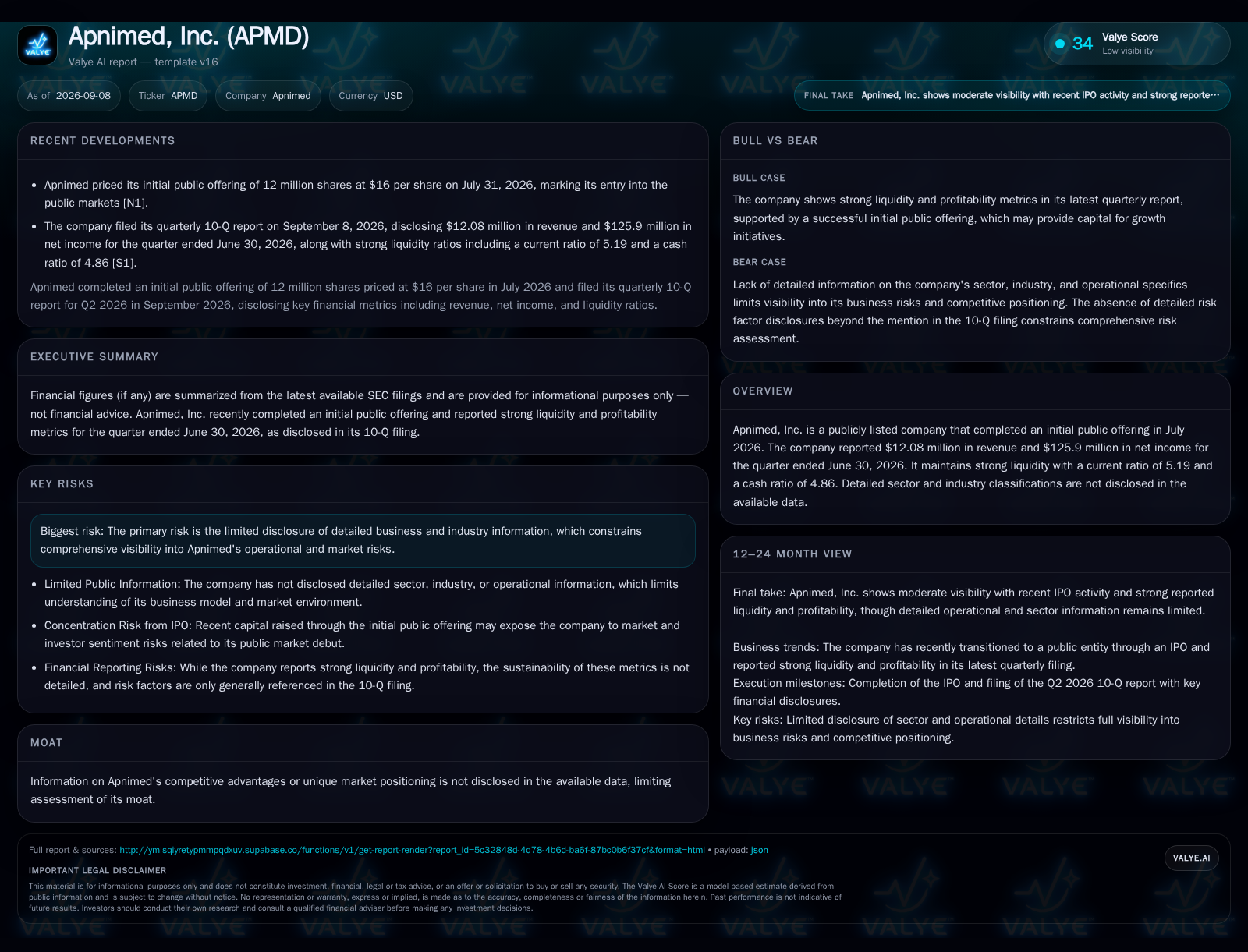
Apnimed completed its IPO in August 2026, raising approximately $200.4 million in net proceeds after underwriter expenses, and consolidated its capital structure by converting all preferred and convertible securities to common stock. As of June 30, 2026, Apnimed reported $172.8 million in cash and cash equivalents, with current assets of $184.8 million and current liabilities of $35.6 million, resulting in a current ratio of 5.19 and a cash ratio of 4.86, both indicative of strong near-term liquidity [S1].
Despite reporting $12.08 million in quarterly revenue and a net income of $125.9 million for Q2 2026, these figures are atypical for a late-stage clinical pharmaceutical company and may reflect one-time events or accounting adjustments rather than recurring profitability [S1].
Operationally, the company’s fate is tied to Oxnimbi, its only advanced-stage asset, which has completed Phase 3 trials for obstructive sleep apnea but has not yet received regulatory approval. This concentration of risk around a single product and a pending regulatory milestone is the defining feature of Apnimed’s current context [S1].
Linking Apnimed’s Valuation to Oxnimbi’s Commercial Success
Apnimed’s ability to generate sustainable revenue and profit will depend on successfully commercializing Oxnimbi, its investigational oral combination therapy for OSA. As a late-stage pharmaceutical company, Apnimed faces a capital-intensive model: significant R&D and regulatory outlays precede any commercial revenue, and breakeven is typically achieved only after market uptake of an approved drug. The $12.08 million in reported Q2 2026 revenue is unusual for a pre-commercial biotech and may not be repeatable unless Oxnimbi secures approval and launches successfully [S1].
If approved, Oxnimbi would likely be priced at a premium to generic OSA treatments, potentially supported by its novel mechanism and oral delivery format. However, initial uptake could be constrained by payer negotiations, prescriber education, and the need to build out commercial infrastructure. Gross margins for novel oral pharmaceuticals are typically high once scale is achieved, but fixed costs related to sales, marketing, and post-marketing studies can be substantial, especially in the early years post-launch.
Despite robust current liquidity, Apnimed’s capital needs could escalate if regulatory approval is delayed or if additional trials are required. The company’s current cash position provides a runway, but not indefinite security, and future equity or debt raises may be necessary if commercialization is slower or costlier than anticipated.
Evaluating Apnimed’s Position in the Competitive Sleep Apnea Landscape
Apnimed’s main competitive lever is the potential first-mover advantage in oral pharmacotherapy for OSA, a market long dominated by device-based solutions such as CPAP and, to a lesser extent, surgical interventions. If Oxnimbi demonstrates compelling efficacy, tolerability, and ease of use, it could capture patients unable or unwilling to use existing therapies.
However, the OSA space is highly competitive and conservative: CPAP is entrenched, and payers may be reluctant to reimburse a novel, potentially higher-priced therapy without long-term outcomes data. Barriers to entry for other pharmaceutical competitors are moderate—development risk is high, but the commercial model is attractive if efficacy and safety are proven. Large diversified pharma companies and specialty biotech firms are plausible future competitors, especially if Oxnimbi’s launch validates the pharmacologic approach.
Switching frictions could exist if Oxnimbi’s side effect profile or real-world effectiveness is less favorable than in trials, or if payers require step therapy. The company’s competitive position will ultimately depend on regulatory labeling, real-world adoption, and the speed at which it can scale commercial operations relative to larger, better-resourced peers.
Rapid Approval and Strong Market Entry Could Propel Oxnimbi to Market Leadership
The most favorable scenario for Apnimed is regulatory approval of Oxnimbi with a broad label and no major safety restrictions, enabling a swift commercial launch. If early prescriber and patient adoption is strong—particularly among OSA sufferers poorly served by CPAP—Apnimed could quickly establish Oxnimbi as a first-line or adjunctive therapy in a large, underpenetrated market.
In this scenario, the company’s high gross margins and low incremental manufacturing costs would drive operating leverage, while positive post-marketing data could further solidify payer support and physician confidence. Rapid revenue growth and positive cash flow would validate the business model and could enable pipeline expansion, either internally or via partnerships.
Evidence confirming this pathway would include FDA approval without restrictive labeling, inclusion in major treatment guidelines, rapid formulary wins, and disclosure of high initial prescription volumes if reported.
Delays in Approval and Moderate Market Reception Represent the Most Likely Scenario
Given the complexities of regulatory review for combination therapies and the conservative nature of the OSA treatment landscape, the most plausible outcome is that Oxnimbi secures approval, but with a narrower label or post-marketing study requirements. Initial uptake may be moderate, with payer hurdles and prescriber caution limiting early adoption.
Apnimed would likely need to invest heavily in market education and real-world evidence generation, delaying breakeven and necessitating careful cash management. Revenue growth would be slower but could be durable if Oxnimbi demonstrates real-world value and expands its label over time.
Confirmation of this scenario would come from regulatory approval with post-marketing commitments, moderate initial sales if disclosed, and measured commentary from management about ramp timelines and market access challenges.
Potential Setbacks for Oxnimbi Include Regulatory Hurdles, Safety Concerns, and Commercial Challenges
In the adverse scenario, regulatory authorities could delay or reject Oxnimbi due to safety, efficacy, or manufacturing concerns, or require a highly restrictive label that limits commercial potential. Even if approved, unexpected safety signals, poor payer coverage, or tepid prescriber uptake could undermine Apnimed’s ability to generate sufficient revenue to cover fixed costs.
Given the company’s single-asset focus, a major setback for Oxnimbi would leave Apnimed with limited strategic alternatives, forcing it to pursue additional capital raises, pipeline acquisitions, or cost-cutting measures to survive. The business could enter a protracted period of losses, risking delisting or distressed sale.
Evidence supporting this scenario would include regulatory complete response letters, reports of adverse post-marketing events, or disclosure of disappointing launch metrics and cash burn acceleration if reported.
Crucial Events Shaping Apnimed’s Trajectory Following the IPO
Regulatory decisions, timelines, and labeling outcomes for Oxnimbi—each will heavily influence both near- and long-term business prospects.
Initial prescription volumes and market uptake rates for Oxnimbi, if disclosed, would directly test the company’s commercial execution and product-market fit.
Updates on payer coverage, formulary wins, and reimbursement rates for Oxnimbi would help clarify the path to revenue scaling.
Evidence of post-marketing safety and real-world effectiveness, including any adverse event disclosures, will be crucial for sustaining adoption.
Cash burn rates and revised guidance on runway or additional capital needs, especially if launch is delayed or sales lag expectations.
Development progress or pipeline expansion beyond Oxnimbi—whether through internal programs or licensing—would indicate efforts to diversify risk.
Management commentary on strategic priorities, market access challenges, and commercialization timelines in earnings calls or filings.
If disclosed, metrics on patient adherence and persistence with Oxnimbi therapy would provide insight into real-world usage and switching frictions.
Disclaimer: This is research-only, informational analysis and not investment advice. It may include AI-generated interpretation and general industry context. Always verify important details using primary sources.

Comments