
ChargePoint Expands EV Charging Platform Amid Margin and Competitive Challenges
ChargePoint Holdings Inc leverages a broad hardware and cloud-based software ecosystem to address accelerating EV adoption, but navigating profitably through fierce competition, evolving technology, and capital intensity remains pivotal.
ChargePoint operates a substantial EV charging network across North America and Europe, combining hardware sales with recurring software services. While revenue growth outpaces expectations, the company continues to incur operational losses amid competitive pricing pressures and supply chain risks. Prospects hinge on scaling subscription offerings, integrating AI-driven efficiencies, and deepening partnerships to improve margins and lock in customer loyalty. Key uncertainties include sustaining demand amid shifting EV adoption rates, managing capital needs, and countering established and emerging competitors.
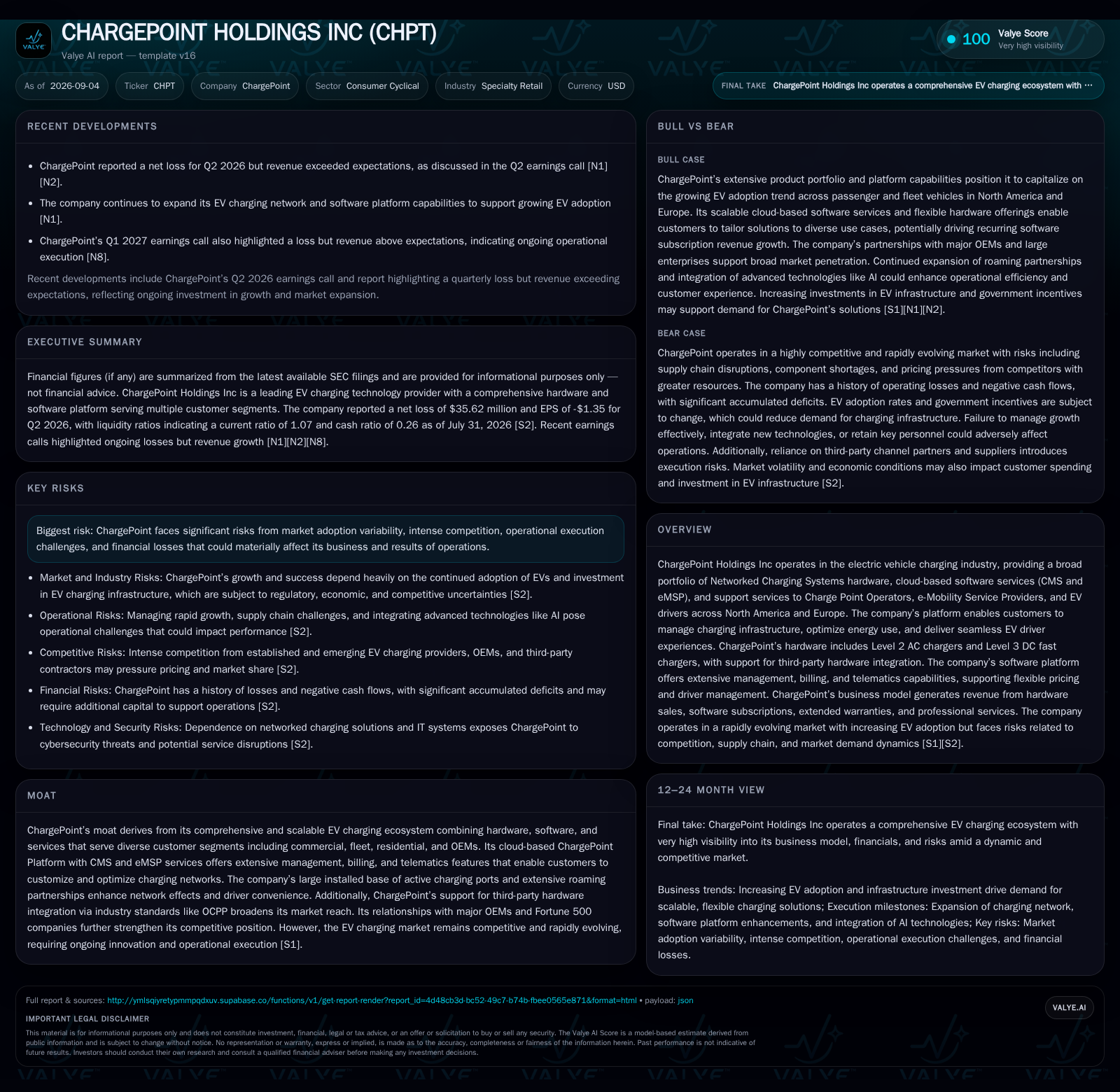
ChargePoint Holdings Inc stands as a significant player in the accelerating electric vehicle (EV) charging infrastructure sector, operating a large footprint of over 385,000 active ports serving more than 1.48 million EV drivers each quarter. Its comprehensive product suite spans Level 2 AC chargers and Level 3 DC fast chargers integrated with a cloud-based software platform offering network management, fleet telematics, billing, and interoperability services. Despite revenue growth beating expectations in recent quarters, the company continues to operate at a loss, highlighting the capital-intensive and competitive nature of the EV market. As EV adoption grows, ChargePoint’s ability to scale its recurring software revenue, optimize operational efficiency through AI, and defend its market share against aggressive competitors will shape its trajectory toward profitability and sustainable growth.
ChargePoint’s Growing Network and Revenue Amid Persistent Losses
ChargePoint commands a substantial presence in the EV charging sector with over 385,000 active charging ports servicing approximately 1.48 million active EV drivers quarterly across North America and Europe [S1]. This scale reflects the company’s success in capturing diverse customers including commercial operators, fleet managers, residential users, and OEM partners. The breadth of its hardware portfolio—encompassing Level 2 AC chargers and Level 3 DC fast chargers—complements its cloud-based software services that facilitate network management, energy optimization, billing, and driver engagement.
Despite these operational achievements, ChargePoint reported a net loss of $35.62 million in Q2 2026, continuing a trend of unprofitability amid rapid growth and investment [S2][N1][N2]. Liquidity metrics such as a current ratio of 1.07 and cash ratio of 0.26 indicate a modest buffer but also underline limited near-term potential financial flexibility [S2]. Recent earnings calls emphasize revenue outperforming market expectations, signaling demand strength, yet the company faces ongoing pressure to convert scale into sustainable profits [N1][N2][N8].
Blending Hardware Sales with Recurring Software Revenues in a Capital-Intensive Market
ChargePoint’s revenue model combines upfront hardware sales of charging stations with recurring income from SaaS-based software subscriptions (ChargePoint CMS and eMSP services), extended warranty programs, and professional services [S1]. Hardware sales generate initial revenue and drive network expansion, but margins may be constrained by manufacturing costs, supply chain volatility, and competitive pricing. Conversely, software subscriptions offer higher gross margins and recurring revenue streams tied to network management, billing, fleet telematics, and driver services, presenting potential for operating leverage as the installed base scales.
Capital intensity remains significant given hardware manufacturing, installation, and ongoing network maintenance costs. Operating leverage may emerge if software subscription revenue grows faster than fixed costs, but this depends on successful customer adoption of software solutions and retention. Integration of AI and automation to improve operational efficiency could also reduce variable costs over time. However, scale benefits may be offset by investments in R&D, customer acquisition, and the need to continuously innovate amid evolving EV infrastructure standards and regulatory requirements.
Network Scale, Platform Flexibility, and Industry Alliances as Differentiators in a Crowded EV Charging Market
ChargePoint’s competitive edge stems from its extensive installed base of charging ports and a versatile platform supporting multiple customer segments and hardware compatibility via Open Charge Point Protocol (OCPP). Its cloud-based CMS and eMSP software services enable customers to customize pricing, energy optimization, and driver management, enhancing switching costs and customer stickiness. The company’s partnerships with OEMs, large enterprises, and third-party hardware providers broaden its ecosystem reach and could create network effects critical in EV charging.
Nevertheless, the market is intensely competitive with players including other specialized EV charging providers, automaker-backed networks, and third-party contractors capable of leveraging alternative technologies or cost structures [S2]. Pricing pressures, technological innovation race, and supply chain constraints pose ongoing challenges. ChargePoint’s ability to maintain leadership depends on sustaining software innovation, expanding roaming partnerships, and integrating AI-driven efficiencies to defend margins against rivals with potentially deeper capital resources or vertically integrated models.
Scaling Recurring Revenues and AI-Enabled Efficiencies Drive Profitability Expansion
A favorable path for ChargePoint involves accelerating growth in its SaaS subscription business, where recurring revenues from CMS and eMSP services expand faster than hardware sales, improving gross margins and operational leverage. Increasing deployment of AI and automation technologies could reduce maintenance and customer support costs, streamline fleet operations, and optimize energy usage, enhancing profitability. Expanding roaming interoperability and integrations with OEMs and large fleets would deepen customer stickiness and could create network effects that discourage switching.
Confirming evidence for this scenario would include rising software subscription revenue as a percentage of total revenue, improving gross margins, and narrowing net losses or positive operating income reported over consecutive quarters. Additionally, successful AI deployment metrics such as reduced operational expenses or improved charger uptime would support this outlook. Failure to grow recurring revenue or integrate AI effectively, resulting in continued losses or churn, would falsify this scenario.
Network Growth Balances Investment Costs and Competitive Pressures
The most plausible trajectory involves steady expansion of ChargePoint’s hardware network aligned with EV adoption rates, accompanied by gradual adoption of its software services. Revenue growth continues but at a pace that requires ongoing investment in infrastructure and R&D, limiting margin improvement near term. Competitive dynamics and supply chain challenges keep pricing under pressure, while customer retention remains steady but not exceptional, resulting in persistent losses or breakeven operating results over the next several quarters.
Evidence supporting this scenario includes consistent revenue growth with stable or slowly improving gross margins, ongoing capital expenditures for network expansion, and modest gains in software subscription penetration. Earnings calls or filings would report losses narrowing only slightly or flattening, with continued emphasis on scaling and operational improvements. Sudden margin compression or accelerated losses would challenge this middle path assumption.
Intensifying Competition and Slower EV Adoption Undermine Scale Economies and Profitability
A downside outcome arises if EV adoption growth slows due to regulatory shifts or economic headwinds, reducing demand for charging infrastructure. Concurrently, intensifying competition from better-capitalized incumbents, OEMs with integrated charging solutions, or disruptive new entrants drives aggressive price cuts and margin erosion. Supply chain disruptions inflate hardware costs and delay deployments, further pressuring financial results. Failure to scale recurring software revenues or to integrate AI and automation technologies effectively impairs operating leverage, leading to sustained losses and cash flow challenges.
Key indicators confirming this scenario include declining or stagnating network growth, worsening gross margins, increasing churn or reduced customer acquisition, and rising operational expenses without commensurate revenue gains. Negative developments such as regulatory retrenchment of EV incentives or increased competition announcements would also support this outlook. Resilience in adoption rates or margin stabilization would argue against it.
Metrics to Gauge ChargePoint’s Path Toward Sustainable Growth
Key operational and financial indicators to monitor include: growth rate of software subscription revenue as a percentage of total revenue, which would indicate progression toward higher-margin recurring income; gross margin trends distinguishing hardware from software segments, reflecting pricing power and cost control; customer retention and churn rates among Charge Point Operators and e-Mobility Service Providers, which would reveal satisfaction and switching risks; and capital expenditures relative to network expansion and maintenance needs, signaling capital intensity management.
Additional useful metrics would be AI and automation adoption rates within operations, measured by reductions in operating expenses or improved network uptime; utilization rates of charging ports, pointing to demand strength; and the number and nature of roaming partnerships or OEM integrations, illustrating ecosystem robustness. Monitoring competitive pricing actions and supply chain developments also remains essential to assess external pressures.
Disclaimer: This is research-only, informational analysis and not investment advice. It may include AI-generated interpretation and general industry context. Always verify important details using primary sources.

Comments