
Ooma’s Shift to Business Subscription Growth Demonstrates Recurring Revenue Strength Despite Margin Challenges
Ooma Inc’s strategic pivot toward expanding its higher-value business customer base, bolstered by acquisitions, strengthens its subscription revenue profile but faces enduring product margin challenges and liquidity constraints that shape profitability outlook.
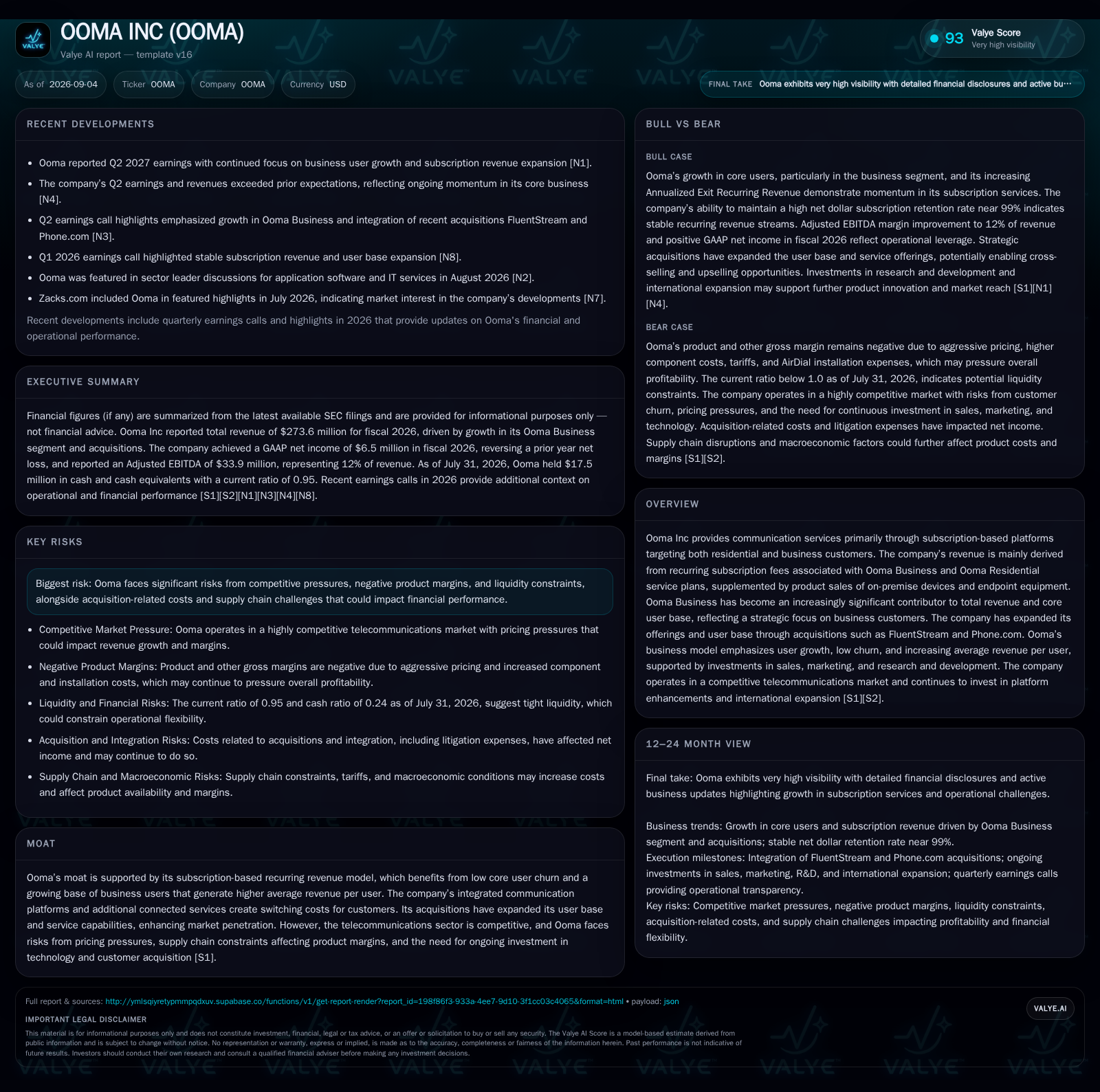
Ooma has increased its core user base and subscription revenue primarily through growth in its Ooma Business segment and acquisitions, achieving near 99% subscription retention and positive GAAP net income in fiscal 2026. However, persistent negative product gross margins due to pricing and cost pressures, combined with liquidity tightness, temper the upside potential. The company’s recurring revenue model, elevated business user mix, and acquisitions underpin its competitive positioning, yet sustained investment and successful integration remain critical. Key uncertainties include margin recovery, competitive pricing dynamics, and funding flexibility, with outcomes hinging on Ooma’s execution in scaling business subscriptions while managing cost structure and cash flow.
Ooma Inc’s fiscal 2026 performance showcases a strategic evolution prioritizing growth in its Ooma Business segment and bolstering subscription revenue through acquisitions. This transition towards a higher-value business customer base underpins steady revenue expansion and improved profitability metrics, including a positive GAAP net income turnaround and robust subscription retention. However, the persistence of negative product gross margins amid cost pressures and a current ratio below 1.0 signal operational and liquidity challenges. How Ooma navigates these countervailing forces—balancing recurring revenue growth with margin recovery and cash flow management—will be pivotal in defining its medium-term financial trajectory.
Subscription Growth and Acquisition Integration Drive Revenue Expansion
Ooma’s total revenue for fiscal 2026 reached $273.6 million, reflecting a 7% year-over-year increase largely attributable to growth in the Ooma Business segment and the acquisitions of FluentStream and Phone.com in December 2025 [S1]. Core users increased to approximately 1.4 million, with business users rising to about 49% of total, up from 41% the previous year, indicating a successful strategic shift toward higher-value business customers [S1].
The company’s Annualized Exit Recurring Revenue (AERR) hit $245.9 million as of January 31, 2026, supported by increased average revenue per core user and the rising share of business users. The net dollar subscription retention rate near 99% reveals low churn and subscription revenue stability [S1]. These developments highlight Ooma’s strengthening recurring revenue base amid ongoing integration efforts for recent acquisitions.
Recurring Revenue Model Benefits from Business User Mix but Faces Margin Compression
Ooma’s primary revenue driver is its subscription-based communication services, with pricing and volume growth propelled by the higher average revenue per user characteristic of business customers. Subscription and services revenue grew 10% year-over-year, contributing to a gross margin of 61% for fiscal 2026, consistent with the prior year, underpinned by relatively high-margin subscription services [S1]. This model offers operating leverage potential as fixed platform costs are spread over a growing subscriber base.
However, product and other gross margins remain negative due to aggressive pricing strategies, elevated component costs, tariffs, and AirDial installation expenses, which erode overall profitability and are expected to persist [S1]. Operating expenses are increasing in absolute terms, reflecting investments in sales and marketing to acquire higher-value business customers, research and development for platform enhancements, and general administrative costs. This mix of fixed and variable cost growth tempers operating leverage, especially if product margin pressures continue.
A critical factor influencing Ooma’s recurring revenue model sustainability is the elasticity of demand among its business customers in response to pricing changes. Given the competitive telecom landscape, the company’s ability to maintain or grow average revenue per user depends on the perceived value of its integrated communication services relative to alternatives. If business customers view Ooma’s platform as indispensable for operational efficiency or customer engagement, pricing power strengthens, supporting margin expansion. Conversely, if competitors offer comparable services at lower costs or with superior features, Ooma may face pressure to reduce prices or increase promotional spending, compressing margins further. Monitoring shifts in customer usage patterns and willingness to pay thus serves as an important test of the model’s durability.
Another dimension shaping margin outcomes is the balance between fixed and variable costs within Ooma’s cost structure. While fixed platform costs provide operating leverage as subscriber volume grows, variable costs tied to product components, installation, and customer support can erode incremental profitability, especially if product margins remain negative. The extent to which Ooma can optimize supply chain efficiency, negotiate better component pricing, or redesign product offerings to reduce cost intensity will influence its ability to convert revenue growth into sustainable profit gains. Additionally, the pace and scale of acquisition integration affect cost synergies and overhead absorption, which are crucial for margin improvement.
Subscription Retention and Acquisition Synergies Support Competitive Position in a Crowded Market
Ooma’s moat rests on its subscription-based recurring revenue, characterized by a low churn rate near 1%, which creates predictable revenue streams and enhances customer lifetime value. The company’s increasing penetration of business customers, who tend to generate higher average revenue per user and exhibit stickier demand for integrated communication services, further bolsters competitive positioning [S1].
Acquisitions of FluentStream and Phone.com expand Ooma’s user base and service capabilities, potentially increasing cross-selling and upselling opportunities. However, Ooma operates in a highly competitive telecommunications and communications services market, where pricing pressure and the need for continuous innovation and customer acquisition create ongoing risks. Negative product margins also constrain potential financial flexibility, while supply chain challenges and tariff impacts add complexity.
Business User Growth and Margin Recovery Drive Sustainable Profit Expansion
In a favorable scenario, Ooma successfully integrates its acquisitions, expanding its business customer base further and achieving steady increases in average revenue per user. Strong net dollar subscription retention remains stable or improves, preserving revenue visibility. The company leverages its fixed platform costs to enhance operating leverage as subscription volume grows.
Concurrently, cost management initiatives and supply chain improvements help reverse negative product gross margins, either through better pricing discipline, component cost reductions, or operational efficiencies. This margin recovery, combined with scaled subscription revenue, translates into higher Adjusted EBITDA margins and stronger cash flow, enabling reinvestment in sales, marketing, and R&D to sustain growth. Confirmation would be rising product margins and accelerating business user additions, while sustained margin compression or rising churn would falsify this upside.
Subscription Revenue Growth Offset by Ongoing Margin and Liquidity Challenges
The most likely scenario involves continued growth in Ooma Business subscriptions and modest revenue gains from acquisitions, with net dollar retention remaining near current levels. Subscription gross margins hold steady around 60%, underpinning stable profitability. However, product and other gross margins remain negative due to ongoing pricing pressures and cost inflation, limiting overall margin expansion.
Operating expenses grow to support incremental user acquisition and platform enhancements, maintaining a relatively stable Adjusted EBITDA margin near 12%. Liquidity remains tight, with current ratios below 1.0, requiring careful cash flow management and potentially constraining large-scale investment. This scenario is confirmed by flat or modestly improving product margins, stable subscription churn, and slow growth in cash balances, while large margin deterioration or significant liquidity improvement would challenge this view.
Competitive Pressures and Margin Erosion Lead to Profitability and Cash Flow Stress
Under downside conditions, intensifying competition drives increased pricing pressure, eroding average revenue per core user and increasing churn beyond current near-99% retention. Acquisition integration proves more costly and disruptive than expected, hampering cross-selling synergies and customer growth. Product margin pressures worsen due to supply chain disruptions, tariffs, and higher installation costs, further depressing overall gross margins.
Operating expenses rise disproportionately as Ooma invests to defend market share, but returns diminish. Liquidity tightens further due to negative cash flow, forcing constraints on R&D and marketing, which may impair long-term competitiveness. Confirmation would be declining subscription retention rates, widening product margin losses, and deteriorating liquidity ratios. Conversely, stabilization or improvement in these metrics would falsify this downside path.
Measures to Gauge Subscription Momentum and Margin Sustainability
Key metrics that would illuminate Ooma’s trajectory include net dollar subscription retention rates, which if disclosed by segment, would clarify stability and expansion within residential versus business users. Average revenue per user trends, especially in the business segment, would help assess pricing power and mix effects. Monitoring changes in product and subscription gross margins separately would reveal margin recovery or pressure points.
Cash flow generation and liquidity ratios such as the current ratio and cash ratio remain vital to understanding operational flexibility amid rising expenses and acquisition integration costs. Customer acquisition costs (CAC) and sales and marketing efficiency would help test the sustainability of growth investments. Finally, updates on the progress of integrating FluentStream and Phone.com acquisitions, including any realized synergies or cost savings, would serve as leading indicators of competitive positioning and profitability potential.
Disclaimer: This is research-only, informational analysis and not investment advice. It may include AI-generated interpretation and general industry context. Always verify important details using primary sources.

Comments