
Dillard's Boosts Margins and Liquidity in a Challenging Retail Landscape
Dillard's recent quarterly results show margin improvements and reported liquidity position, but its retail business faces ongoing competitive and consumer demand uncertainties that will test its operational agility and capital allocation.
Dillard's posted solid Q2 2026 earnings driven by tariff refunds and margin gains, supported by a reported liquidity position. The company operates both retail and construction segments, with retail as the key profit driver. Despite favorable short-term earnings momentum, the competitive retail environment and discretionary consumer spending dynamics temper longer-term visibility. Dillard's capital allocation flexibility is notable, though the absence of share buybacks in the quarter signals potential caution. Key future outcomes hinge on sustaining margin improvements, managing supply chain risks, and adapting to evolving consumer preferences amid sector pressures.
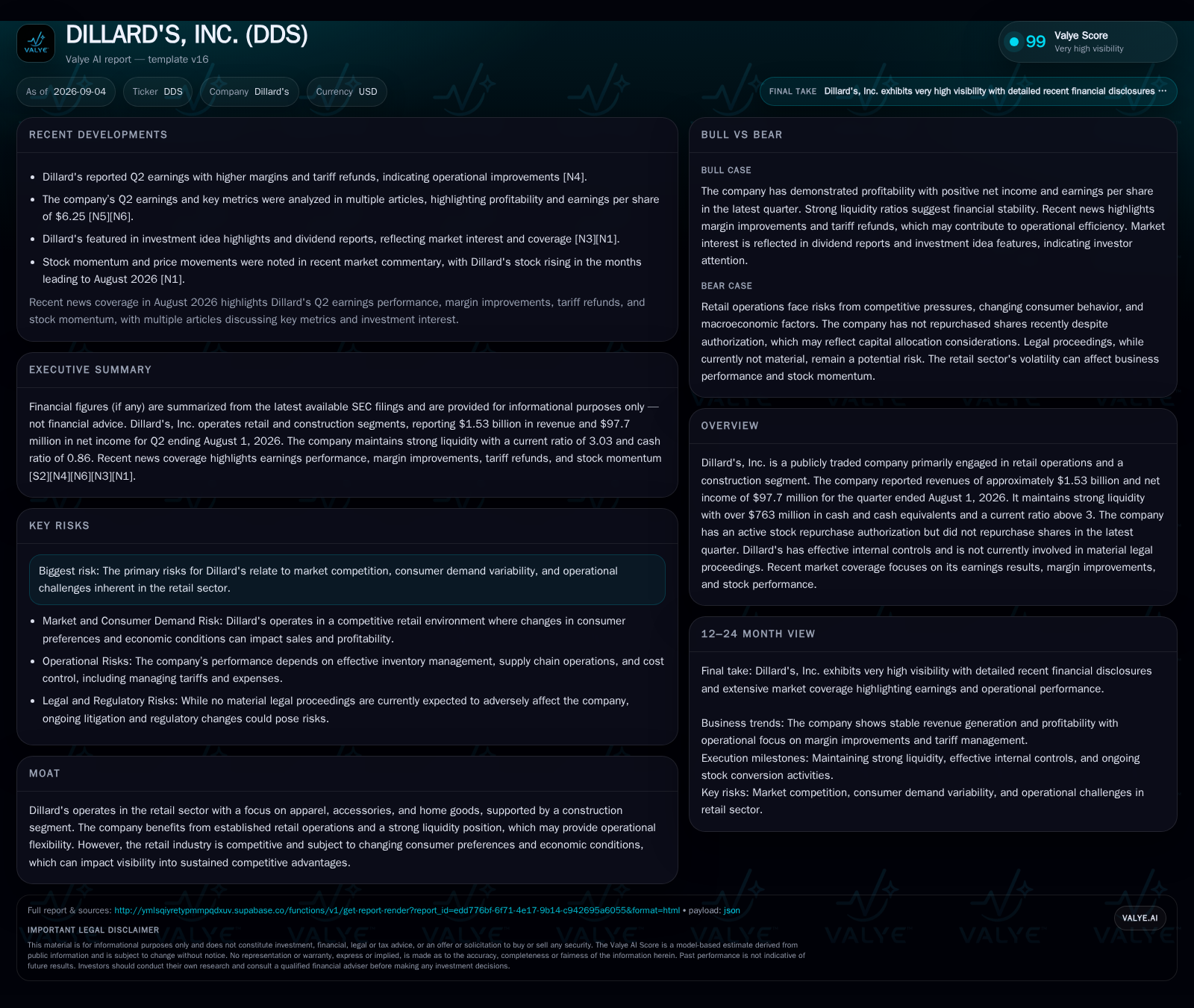
Dillard's, Inc. demonstrated solid financial performance in its second quarter of 2026, reporting $1.53 billion in revenue and net income of nearly $98 million. Key drivers included improved margins partially resulting from tariff refunds, alongside a reported liquidity position with over $760 million in cash. While these operational strengths provide a runway for strategic investments and resilience, the company’s retail segment operates in a highly competitive environment sensitive to shifts in consumer spending and preferences. The company’s cautious capital allocation, highlighted by no share repurchases during the quarter despite authorization, reflects prudent management amid uncertainties. Going forward, Dillard’s ability to maintain margin improvements and adapt to evolving market dynamics will be critical for sustaining its financial momentum.
Margin Gains and Liquidity Set the Stage for Q2 Performance
Dillard’s reported second-quarter 2026 revenues of approximately $1.53 billion with net income close to $97.7 million and earnings per share of $6.25, exceeding analyst expectations in part due to tariff refunds contributing to margin expansion [S2][N4]. This reflects operational improvements in cost management, supply chain efficiency, and pricing leverage during the period.
The company’s liquidity profile remains strong, with cash and equivalents at $763.1 million, a current ratio of 3.03, and a cash ratio of 0.86, indicating ample short-term potential financial flexibility [S2]. No shares were repurchased in the quarter despite an existing buyback authorization of $165.2 million, signaling a conservative capital deployment stance in the near term.
Retail-Driven Revenue with Margin Leverage and Capital Discipline
Dillard’s primary revenue generation stems from its retail operations, selling apparel, accessories, and home goods, complemented by a smaller construction segment. Profitability hinges on managing pricing, volume, and product mix amid a competitive retail landscape. Tariff refunds during Q2 helped reduce cost of goods sold, temporarily boosting gross margins, but sustaining these gains depends on ongoing supply chain efficiencies and cost control.
The company’s fixed costs include retail store leases, distribution infrastructure, and labor, which create operating leverage if sales rise without proportional cost increases. Capital intensity is moderate, focused on inventory investment and store maintenance rather than heavy fixed assets. Operating leverage may improve if Dillard’s can increase comparable store sales or enhance online penetration without expanding fixed costs significantly. The absence of share repurchases in Q2 suggests capital allocation is currently prioritized toward liquidity preservation or other strategic needs.
A critical factor influencing Dillard's retail economics is the elasticity of consumer demand relative to pricing strategies, especially in a mid-tier department store context. If the company can effectively segment its customer base and tailor pricing and promotions to distinct groups, it may enhance margin resilience despite competitive pricing pressures. However, this requires robust data analytics capabilities and agile inventory management to avoid overstock or stockouts, which could erode profitability. Additionally, the balance between inventory turnover and markdown frequency is a key determinant of gross margin stability; high turnover with minimal discounting typically signals healthy demand and efficient supply chain operations, whereas reliance on markdowns to clear inventory can compress margins and signal demand weakness.
Facing Intense Retail Rivalry Amid Shifting Consumer Tastes
Dillard’s competitive advantage is anchored in its established retail footprint and brand recognition in mid-tier department store apparel and home goods. However, this sector faces pressure from e-commerce growth, fast fashion, and discount retailers, which limit pricing power and customer retention. The company’s ability to differentiate through product assortment, customer experience, and supply chain agility will be vital to maintaining market share.
Peer retailers include both traditional department stores and specialty apparel chains, alongside digital-native competitors. Dillard’s mix of physical and digital channels may generate switching frictions if it can embed loyalty and offer seamless omnichannel experiences. However, the retail industry’s volatility and consumer preference changes impose persistent risks that could erode Dillard’s relative competitive strength if not actively managed.
The interplay between fixed and variable costs in Dillard's retail operations creates a nuanced leverage profile. While fixed costs such as store leases and salaried staff are relatively inelastic in the short term, variable costs tied to merchandise purchasing and hourly labor can be adjusted more quickly in response to sales fluctuations. This cost structure means that achieving higher sales volumes can disproportionately improve operating margins, provided that the incremental sales contribute positively after covering variable costs. However, if sales growth is driven primarily by discounting or promotional activity, the incremental margin contribution may be muted. Therefore, monitoring the quality of sales growth—whether from full-price or discounted merchandise—is essential to understanding margin trajectory.
Sustained Margin Expansion and Strategic Growth Drive Earnings Upside
In a favorable scenario, Dillard’s converts tariff-related margin improvements into permanent cost savings via enhanced supply chain efficiencies and procurement scale. This would enable the company to invest selectively in store refreshes and digital initiatives, improving customer engagement and increasing sales volume and mix quality.
Confirming evidence would include consistent quarter-over-quarter margin stabilization above historical averages, higher same-store sales growth, and successful rollout of innovative retail formats or digital shopping experiences. Falsification would be a return to compressing margins, declining comparable sales, or inability to adapt product offerings to consumer trends.
Dillard's competitive positioning is also shaped by its ability to integrate physical and digital retail channels effectively. Omnichannel capabilities can could increase switching costs for customers by offering convenience, personalized experiences, and loyalty incentives that are difficult for pure-play e-commerce competitors to replicate. However, this integration requires substantial investment in technology infrastructure, supply chain synchronization, and staff training. Failure to execute a seamless omnichannel experience could result in customer frustration, increased returns, and lost sales. Furthermore, the pace of digital adoption among Dillard's target demographics will influence how quickly these investments translate into improved customer retention and sales growth, adding a layer of uncertainty to competitive dynamics.
Operational Stability Supports Profitability Amid Sector Headwinds
The most plausible outlook sees Dillard’s maintaining roughly stable revenue and profitability levels with modest margin improvements offsetting inflationary pressures. The company’s reported liquidity position and internal controls enable it to manage supply chain disruptions and cost volatility without significant earnings shocks.
Evidence supporting this includes steady retail sales with minor fluctuations, gradual margin improvement driven by cost control, and disciplined capital allocation without aggressive share repurchases. A falsification scenario would be sharp revenue declines, margin erosion from rising input costs, or liquidity constraints limiting operational flexibility.
Competitive Pressures and Consumer Spending Shifts Curtail Profitability
On the downside, intensifying competition from discount and online retailers, combined with shifts in consumer preferences away from department store formats, could depress Dillard’s sales volumes and force promotional discounting that compresses margins. Rising tariffs, supply chain disruptions, or cost inflation could exacerbate margin pressures.
Confirming signs would include declining same-store sales, increasing inventory markdowns, shrinking gross margins, and non-recurrence of tariff refunds. Failure to innovate digitally or refresh the store base could accelerate customer attrition. Reversal of the company’s current liquidity cushion due to operational stress or unexpected legal costs would deepen downside risks.
Operational Metrics to Gauge Retail Resilience and Margin Trajectory
Useful metrics to monitor include comparable store sales growth, gross margin percentage, and inventory turnover rates to assess demand trends and cost management effectiveness. Tracking changes in product mix, such as the share of higher-margin categories or private-label sales, would help evaluate margin sustainability.
Capital allocation signals, including share repurchase activity and capital expenditures, will indicate management’s confidence and growth investments. Disclosure of customer loyalty program adoption, digital sales penetration, and online conversion rates would further clarify competitive positioning. Finally, monitoring tariff developments and supply chain costs is essential to anticipate margin fluctuations.
Disclaimer: This is research-only, informational analysis and not investment advice. It may include AI-generated interpretation and general industry context. Always verify important details using primary sources.

Comments