
General Fusion’s Public Debut Advances Commercial Fusion Energy Prospects
The fusion energy pioneer emerges from its SPAC merger with solid liquidity and institutional backing but faces steep technological and operational hurdles before commercial success can be realized.
General Fusion Group Ltd., formed through a SPAC merger with Spring Valley Acquisition Corp. III, is advancing fusion energy technology amid reported liquidity position and institutional investor support. Despite its promising position in a capital-intensive and complex sector, the company confronts significant technological, financial reporting, and commercialization risks. The evolution of fusion from experimental to commercial phase will depend heavily on technological breakthroughs, effective capital deployment, and regulatory clarity. Monitoring progress on operational milestones, financial controls, and market conditions will be critical to assessing the company’s trajectory.
Spring Valley Acquisition Corp. III’s transformation into General Fusion Group Ltd. via a business combination with General Fusion Inc. represents a key step toward commercializing fusion energy technology. The new entity commands reported liquidity position and institutional ownership, positioning it to fund ongoing research and development efforts. Yet, fusion energy remains a frontier technology riddled with scientific and engineering challenges, long development cycles, and regulatory complexity. The company’s early financial losses and reported control weaknesses underscore risks inherent in scaling such a capital- and expertise-intensive venture. Investors must weigh these factors alongside the potential for fusion’s transformative impact on clean energy markets.
Completion of Public Merger Sets Stage for Fusion Advancement Amid Early Financial and Governance Challenges
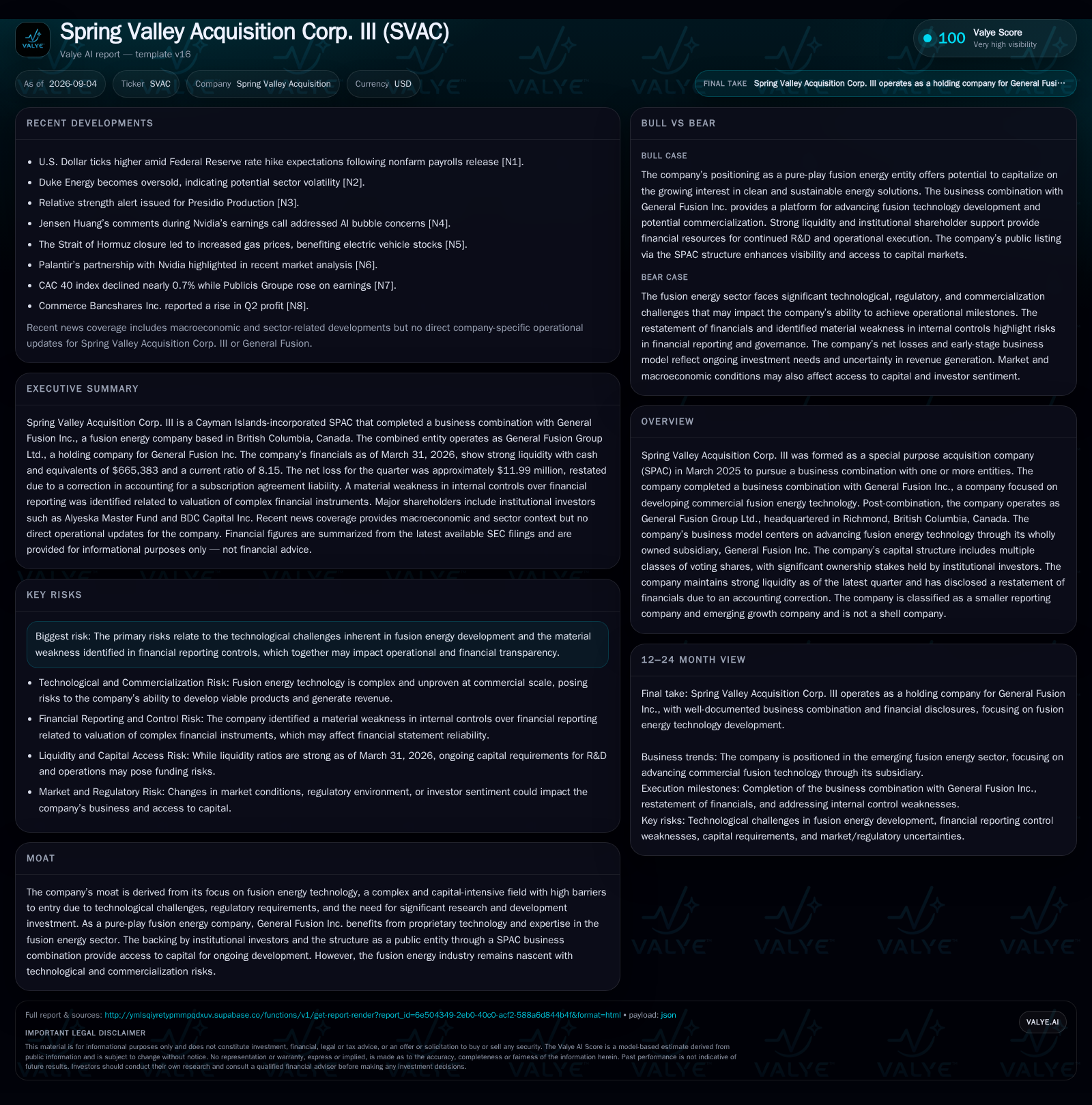
Spring Valley Acquisition Corp. III, originally established as a SPAC in March 2025, successfully completed its business combination with General Fusion Inc., a British Columbia-based fusion energy technology company. The merger resulted in General Fusion Inc. becoming a wholly owned subsidiary and the company’s rebranding as General Fusion Group Ltd., headquartered in Richmond, Canada [S1]. This transition provides General Fusion with a public listing and access to capital markets, critical for its capital-intensive fusion R&D.
As of March 31, 2026, the company reported cash and cash equivalents of $665,383 and maintained a strong current ratio of 8.15, reflecting solid liquidity [S2]. However, the company recorded a net loss of approximately $11.99 million for the quarter, consistent with ongoing investment in technology development. Additionally, a material weakness in internal controls over financial reporting was identified, specifically related to valuation of complex financial instruments [S2]. This finding raises concerns about the robustness of financial governance during this formative stage.
High Capital Intensity and Research-Driven Spending Define Early Fusion Energy Business Economics
General Fusion’s business model centers on developing commercial fusion energy technology—a sector characterized by enormous upfront capital requirements and uncertain timelines to revenue generation. Its economic model is predominantly driven by R&D spending rather than near-term product sales, meaning operating leverage is currently limited. The company incurs fixed costs related to specialized facilities, skilled personnel, and complex equipment, while variable costs depend on ongoing experimentation and prototype iterations.
Pricing power and revenue mix remain speculative given the absence of commercial fusion products. Should fusion technology reach commercialization, revenue would likely derive from energy sales or licensing proprietary technology, potentially commanding premium pricing due to the clean, sustainable energy value proposition. However, the timing and scale of volume growth remain uncertain, and achieving operating leverage depends critically on technological breakthroughs and successful scale-up. Capital intensity suggests sustained funding rounds or partnerships will be necessary before positive cash flow is attainable.
The capital intensity inherent in fusion energy development also creates a complex dynamic for investor returns and valuation models. Given the extended timeline before revenue realization, traditional metrics such as EBITDA or free cash flow may remain negative or irrelevant for years, requiring investors to rely heavily on milestone-based valuation inflections. This makes the company’s ability to hit technical and operational milestones critical for re-rating by the market. Additionally, the long development cycle increases exposure to risks such as technology obsolescence, shifts in energy policy, or emergence of competing technologies, all of which could impact the ultimate commercial viability and scale of fusion energy solutions. Hence, monitoring the company’s burn rate relative to milestone achievements and capital availability is crucial to assess sustainability.
Proprietary Fusion Technology and Institutional Backing Offer Differentiation but Face Sector Wide Uncertainties
General Fusion’s moat is primarily rooted in its proprietary approach to fusion technology and the significant barriers to entry in this field, including scientific complexity, regulatory scrutiny, and high capital thresholds. The company’s institutional shareholders such as Alyeska Master Fund and BDC Capital Inc. provide stable capital sources and potential strategic support [S1]. This financial backing facilitates sustained R&D and helps to navigate regulatory and commercialization hurdles.
Nonetheless, the fusion energy sector remains nascent with multiple competitors pursuing varied technological pathways, including magnetic confinement and inertial fusion approaches. Competitive threats include well-funded private and government-backed entities with differing technological bets. Success depends not only on scientific innovation but also on execution capabilities, regulatory approvals, and eventual market acceptance. The company’s public status may enhance visibility but also subjects it to market pressures and scrutiny not faced by private peers.
The competitive landscape in fusion energy is characterized by a fragmented technological ecosystem, where no single approach has yet demonstrated clear superiority or commercial feasibility. This environment amplifies the importance of General Fusion’s proprietary technology differentiation, but also introduces execution risk given the uncertainty around which fusion method will ultimately prove scalable and cost-effective. Barriers to entry remain high due to the specialized knowledge, capital requirements, and regulatory hurdles, yet the sector’s nascent state means that rapid advancements or breakthroughs by competitors could shift the competitive dynamics significantly. Therefore, the company’s ability to maintain its technological edge through continuous innovation, intellectual property protection, and strategic partnerships will be essential to sustain its moat over the long term.
Breakthroughs in Fusion Technology Unlock Viable Commercial Energy with Expanding Market Opportunity
In a favorable scenario, General Fusion achieves critical technological milestones validating its fusion approach at pilot scale, attracting further investment and strategic partnerships. Demonstrated technical feasibility, combined with scalable manufacturing processes, could enable the company to transition from R&D to pilot commercial deployments within a plausible timeframe. Robust institutional support and access to public capital markets would facilitate the necessary capital expenditures.
This trajectory would unlock expanding revenue potential as fusion-generated electricity competes with traditional and renewable sources, benefiting from increasing demand for clean, reliable, and dispatchable energy. Confirmation of progress through consistent operational updates and successful control environment remediation would reinforce investor confidence. Conversely, failure to achieve technological benchmarks or capital constraints would falsify this outlook.
Progress Driven by R&D Investment and Technological Validation
The most plausible path involves steady but incremental advances in fusion technology, with continued heavy R&D expenditures leading to partial proof-of-concept achievements over the next several years. The company maintains reported liquidity position through disciplined capital management and institutional backing, though net losses persist reflecting the long development cycle inherent in fusion energy.
Progress toward commercialization is paced by scientific validation, regulatory engagement, and gradual scale-up of experimental facilities. In this scenario, financial reporting controls are strengthened over time, improving transparency and governance. Market conditions and investor sentiment remain mixed, reflecting broader uncertainty about fusion’s commercial viability. Failure to sustain funding or significant delays in technological milestones would challenge this baseline view.
Technological Setbacks and Governance Issues Undermine Capital Access and Operational Execution
A downside scenario unfolds if General Fusion encounters insurmountable technical challenges that delay or derail fusion commercialization efforts. The complex physics and engineering hurdles inherent in fusion could lead to cost overruns, missed milestones, and waning investor enthusiasm. The reported material weakness in financial controls might exacerbate concerns about management oversight and financial transparency, undermining credibility with capital markets.
Liquidity could deteriorate due to higher cash burn and limited ability to raise additional funds under adverse market conditions. Regulatory uncertainties or unfavorable policy shifts could further constrain progress. Confirming evidence would include missed deadlines, repeated restatements, or difficulty in accessing capital. Conversely, remediation of control weaknesses and demonstrable technical advances would provide a counterpoint to this scenario.
Technological, Financial, and Commercial Developments Will Influence Investor Confidence
Critical metrics to monitor include detailed operational milestones such as prototype performance data, successful completion of pilot reactor tests, and progress on regulatory approvals. If disclosed, cadence and quality of R&D outputs and patent filings would help assess technological momentum. Financially, improvements in internal controls over financial reporting, timely restatement resolution, and narrowing net losses would signal governance strengthening.
Capital deployment rates relative to cash reserves, updates on subsequent funding rounds or strategic partnerships, and shifts in shareholder composition—especially institutional support—would illuminate potential financial flexibility. Market factors such as regulatory developments in fusion energy policy and broader clean energy adoption trends will also be pivotal. Transparency in these areas will be essential to validate or challenge the investment thesis.
Disclaimer: This is research-only, informational analysis and not investment advice. It may include AI-generated interpretation and general industry context. Always verify important details using primary sources.

Comments