
Twin Disc Targets $500 Million Revenue with Defense and Electrification Growth
Twin Disc’s strategic acquisition and global diversification underpin recent sales momentum and margin improvements, while cyclical demand, currency swings, and supply risks temper near-term visibility.
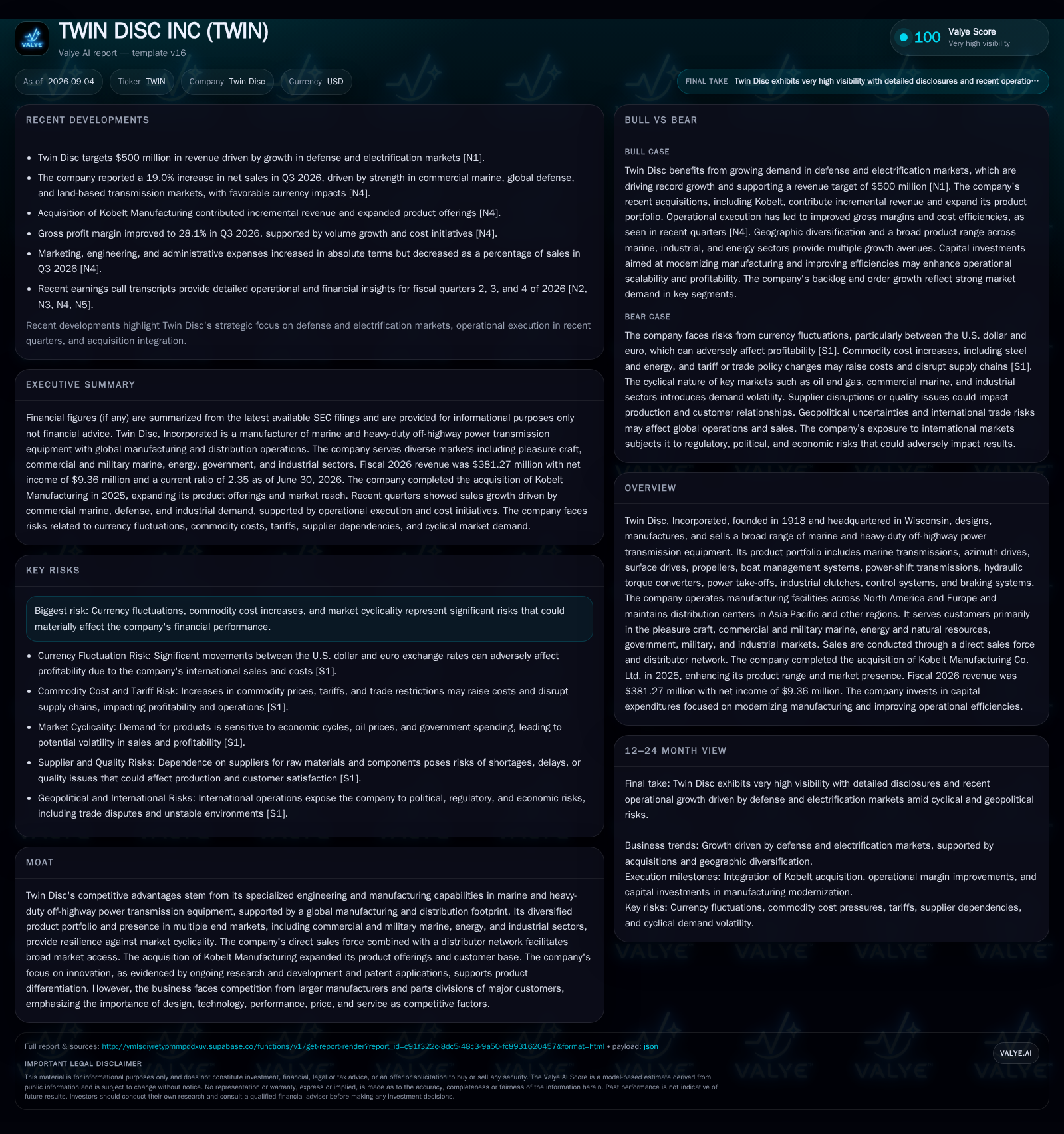
Twin Disc, a century-old manufacturer of marine and heavy-duty off-highway power transmission equipment, is leveraging defense and electrification market growth alongside the Kobelt acquisition to pursue a $500 million revenue target. Recent quarters show solid volume-driven margin expansion and geographic expansion. However, the company’s exposure to currency fluctuations, commodity cost pressures, and sector cyclicality create operational and financial headwinds that require monitoring. Capital investments and product innovation could unlock operating leverage, but the pace of adoption in electrified powertrains and defense budgets will be key to sustaining growth beyond the cyclical industrial baseline.
Twin Disc, Incorporated has signaled a new growth trajectory targeting $500 million in revenue, propelled by strong performance in defense and electrification markets and bolstered by its 2025 acquisition of Kobelt Manufacturing. The company’s diversified portfolio of marine and heavy-duty off-highway power transmission equipment, coupled with a broad geographic footprint, supports recent double-digit sales growth and margin expansion. While these factors paint a positive near-term operational picture, Twin Disc must navigate significant macroeconomic headwinds including currency fluctuations, commodity inflation, and demand cyclicality. Its capital investments in manufacturing modernization and continued product innovation will be critical to sustain profitable growth amid competitive and geopolitical challenges.
Robust Q3 Growth and Strategic Acquisition Drive Momentum
Twin Disc posted a 19.0% revenue increase in the third quarter of fiscal 2026, reaching $96.7 million. This growth was primarily fueled by strong demand in commercial marine, global defense, and land-based transmission markets. Favorable currency movements further amplified top-line gains during the period [N4].
The acquisition of Kobelt Manufacturing in February 2025 contributed incremental revenue and expanded Twin Disc’s product offerings in controls, propulsion, steering, and braking systems serving marine, oil and gas, and industrial markets. This strategic move enhanced the company’s geographic reach, notably in Europe and Asia-Pacific, complementing its existing manufacturing facilities across North America and Europe, as well as distribution centers worldwide [S1][N4].
Volume-Driven Margins and Capital Investment Underpin Operational Leverage
Twin Disc’s business model generates revenue predominantly from engineered marine and heavy-duty off-highway power transmission products. Pricing dynamics likely reflect a mix of negotiated contracts in commercial and defense markets, with some pricing power arising from specialized engineering and product differentiation. Volume growth, especially from defense and electrification sectors, can drive gross margin expansion through improved fixed cost absorption and production scale.
The company’s manufacturing footprint across multiple countries introduces capital intensity, with planned 2026 capital expenditures of $13 to $16 million aimed at modernizing facilities and enhancing efficiency. This suggests moderate capital intensity that, if leveraged by higher volumes and productivity gains, could translate into operating leverage. However, margin improvement faces headwinds from commodity cost inflation and supply chain complexities. The integration of Kobelt may introduce mixed cost synergies and incremental fixed costs, with net impact dependent on successful operational integration.
A critical aspect of Twin Disc’s margin dynamics involves the balance between fixed and variable costs within its manufacturing operations. As volume increases, particularly in higher-margin defense and electrification segments, the company can spread fixed costs such as facility overhead, engineering, and R&D expenses over a larger revenue base. This operating leverage can significantly enhance profitability if volume growth is sustained. However, this leverage is conditional on maintaining stable or improving production yields and avoiding quality issues that could increase warranty or rework costs. Additionally, the timing of capital investments relative to volume ramp-up is crucial; premature or excessive capital spending without commensurate sales growth may depress returns on invested capital and strain cash flow.
Another important consideration is the potential for pricing pressure in Twin Disc’s end markets. While specialized engineering and product differentiation provide some pricing power, competitive dynamics and customer bargaining power—especially in government defense contracts or large industrial accounts—may limit the company’s ability to fully pass through rising input costs. The interplay between cost inflation and pricing flexibility will be a key determinant of margin sustainability. Monitoring gross margin trends alongside input cost indices and contract renewal terms would provide insight into Twin Disc’s pricing resilience and cost management effectiveness.
Diversified Portfolio and Global Footprint Mitigate but Don’t Eliminate Cyclicality
Twin Disc’s broad product range across marine transmissions, propellers, control systems, and heavy-duty industrial equipment, coupled with a presence in commercial, military, energy, and government sectors, provides some resilience against industry cyclicality. The recent Kobelt acquisition further diversifies offerings into controls and steering systems, potentially enhancing cross-selling and customer retention.
Nevertheless, the company operates in an environment of competition from larger manufacturers and in-house parts divisions of major customers, placing emphasis on product innovation, reliability, and service. The global footprint exposes Twin Disc to foreign exchange risk and geopolitical uncertainties, especially given that 72% of sales are international. Competitive advantage depends on maintaining design and technological differentiation alongside efficient global manufacturing and distribution.
The geographic diversification of Twin Disc’s manufacturing and sales footprint also introduces complexity in operational execution and risk management. While spreading production across North America, Europe, and Asia-Pacific can mitigate regional demand shocks and supply chain disruptions, it also requires robust coordination and integration of manufacturing processes, quality standards, and inventory management. Currency fluctuations not only affect reported revenues and profits but can also impact the relative cost competitiveness of production sites. Strategic decisions about where to locate production for specific product lines must weigh labor costs, logistics, tariff exposure, and proximity to key customers, all of which influence overall cost structure and responsiveness to market changes.
Furthermore, Twin Disc’s competitive moat depends substantially on its ability to innovate and maintain technological differentiation in a market where customers may opt for in-house solutions or competitors with broader product ecosystems. Continuous investment in R&D and product development is necessary to stay ahead, particularly as electrification trends reshape powertrain architectures and control systems. The integration of Kobelt’s control and steering technologies offers potential to create more comprehensive and integrated solutions, enhancing customer switching costs and enabling cross-selling. However, realizing these benefits requires effective product integration, alignment of sales channels, and clear communication of value propositions to diverse customer segments.
Defense and Electrification Catalyze Accelerated Revenue and Margin Expansion
In a favorable scenario, sustained growth in defense spending and electrification adoption drives robust demand for Twin Disc’s specialized transmissions and control systems. The Kobelt acquisition unlocks synergies and new markets, while capital investments improve manufacturing efficiency and capacity. Volume growth leverages fixed costs, pushing gross margins above 30% and expanding operating margins.
Confirmation of this upside includes continued order backlog growth exceeding current $178 million, accelerating penetration into electrified powertrain segments, and successful integration of Kobelt’s product lines. Conversely, failure to sustain defense budgets or delays in electrification adoption would falsify this scenario, as would margin pressure from increased raw material costs or supply constraints.
Growth Outlook Influenced by Cyclical Demand and Cost Pressures
The most plausible outcome involves steady but moderate revenue growth driven by ongoing defense contracts and gradual electrification market share gains offset by cyclical softness in commercial marine and industrial sectors. Volume gains support modest margin improvement through scale and cost initiatives, but commodity inflation and currency fluctuations limit upside.
This base case is confirmed by stable backlog trends, consistent capital spending on manufacturing modernization, and incremental revenue from Kobelt integration without transformational synergy realization. Evidence against this scenario would be a material acceleration or contraction in defense or electrification demand, or significant margin erosion from tariff hikes or supply disruptions.
Currency Volatility, Supply Chain Disruptions, and Market Downturn Curtail Profitability
A downside pathway emerges if adverse currency movements—particularly a strengthening U.S. dollar against the euro—compress international profitability, given Twin Disc’s substantial overseas sales. Simultaneously, rising steel and energy costs, coupled with tariff and trade uncertainties, elevate production expenses and disrupt supply chains, leading to delays and quality issues.
This scenario is reinforced by cyclical downturns in marine, industrial, and energy markets reducing order intake and pressuring utilization. Failure to integrate Kobelt effectively or to invest efficiently in manufacturing modernization could exacerbate operational challenges. A reversal of recent backlog growth or margin contraction below historical lows would further confirm downside risks.
Indicators to Gauge Growth Sustainability and Margin Trajectory
Order backlog growth and composition by segment would help assess demand sustainability, particularly in defense and electrification markets. If disclosed, segment revenue growth rates and geographic sales splits would illuminate diversification success and currency impact.
Margins at gross and operating levels, along with cost breakdowns, would clarify whether volume gains translate into durable profitability amid commodity and tariff pressures. Capital expenditure efficiency and manufacturing productivity metrics would indicate the effectiveness of modernization efforts.
Customer retention rates, if available, and repeat order frequency would gauge competitive positioning and switching friction. Monitoring currency exchange trends and commodity price fluctuations remains vital given their outsized influence on cost structures and net margins.
Progress on integrating Kobelt, including synergy realization and new product development pipelines, would serve as a barometer for acquisition success and potential incremental growth levers.
Disclaimer: This is research-only, informational analysis and not investment advice. It may include AI-generated interpretation and general industry context. Always verify important details using primary sources.

Comments