
NutriBand’s Focus on Abuse-Deterrent Transdermal Systems Amid Development and Regulatory Challenges
NutriBand Inc. pursues a niche pharmaceutical opportunity with proprietary drug delivery technology but confronts typical early-stage biotech challenges including capital needs, regulatory uncertainty, and competitive technology dynamics.
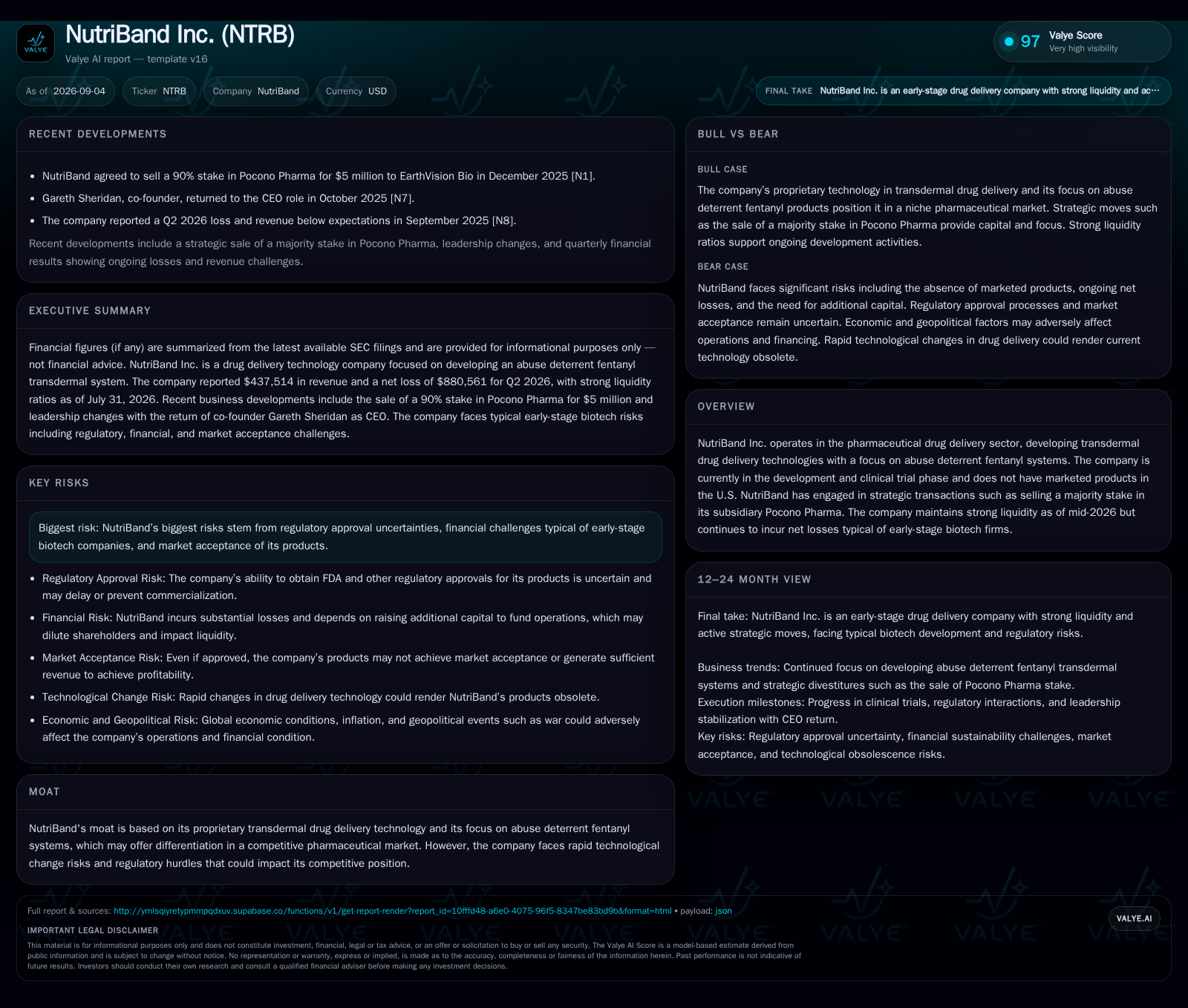
NutriBand is developing an abuse deterrent fentanyl transdermal system in early clinical stages, with no marketed products and ongoing net losses. The company’s recent sale of a majority stake in its subsidiary and CEO leadership change reflect strategic recalibration. Its business economics hinge on successful regulatory approval and market adoption of a differentiated delivery platform, but risks from technology obsolescence, financing, and competitive pressure remain significant. The company’s reported liquidity position provides runway but not assurance of commercial success.
NutriBand Inc. operates at the intersection of drug delivery innovation and opioid abuse deterrence, aiming to develop a fentanyl transdermal system that mitigates misuse risks. As of mid-2026, the company remains in clinical development without marketed products, reporting modest revenue and ongoing quarterly losses. Recent strategic actions such as divesting a majority stake in its Pocono Pharma subsidiary and reinstating co-founder Gareth Sheridan as CEO reflect a recalibration amid the complex regulatory, financial, and competitive landscape typical of early-stage biotech firms. NutriBand’s value creation depends heavily on navigating regulatory approval pathways and establishing market adoption against a backdrop of rapid technological change and capital intensity.
Strategic Realignment in Clinical Development and Financial Environment
NutriBand is currently developing an abuse deterrent fentanyl transdermal system, a specialty drug delivery platform targeting opioid abuse mitigation. The company has no marketed products in the U.S. and is in the clinical trial phase, reflecting its early-stage status [S2].
Recent corporate moves include the December 2025 sale of a 90% stake in its subsidiary Pocono Pharma for $5 million to EarthVision Bio, which provides capital and allows NutriBand to focus resources on its core drug delivery technology [N1]. Additionally, Gareth Sheridan’s return as CEO in October 2025 signals leadership stabilization intended to drive strategic execution [N7]. Despite these moves, NutriBand reported a net loss of $880,561 in Q2 2026 alongside modest revenue of $437,514, underscoring ongoing financial pressures [S2][N8].
Capital-Intensive Development with High Operating Leverage Potential Post-Approval
NutriBand’s revenue model is contingent on progressing from clinical development to regulatory approval and eventual commercialization of its proprietary transdermal drug delivery system. Early-stage biotech economics typically involve heavy fixed costs in R&D, clinical trials, and regulatory compliance, while variable costs per unit are relatively low once manufacturing scale is achieved. The company’s current revenue is minimal, reflecting pre-commercial status, with losses driven primarily by fixed overhead and development expenses [S2].
If NutriBand secures FDA approval and market acceptance, it could benefit from operating leverage as incremental sales volumes scale with relatively stable fixed costs. However, commercial success depends on pricing power in a competitive pharmaceutical market, reimbursement dynamics, and the ability to maintain product differentiation. Capital intensity remains significant until revenue ramps, requiring ongoing financing despite NutriBand’s reported liquidity position [S2]. The sale of Pocono Pharma’s stake likely improves near-term cash flow but does not reduce development capital needs for the core technology.
In early-stage biotech companies like NutriBand, the capital-intensive nature of development creates a significant risk-return tradeoff. Large upfront investments in R&D and clinical trials are necessary before any revenue can be realized, often requiring multiple financing rounds that dilute existing shareholders. However, the potential for operating leverage post-approval means that once fixed costs are absorbed, incremental sales can contribute disproportionately to profit margins. This dynamic incentivizes efficient capital allocation and milestone-driven development to extend runway and maximize valuation. Monitoring changes in cash burn relative to clinical progress and pipeline expansion would provide insight into management’s capital efficiency and the robustness of the company’s financial strategy.
Another critical economic consideration is the reimbursement environment for abuse deterrent formulations. Payers and healthcare providers increasingly scrutinize cost-effectiveness, especially for opioid products given the societal impact of abuse. NutriBand’s ability to command premium pricing hinges on demonstrating not only clinical efficacy but also meaningful reductions in misuse and associated healthcare costs. If the product fails to secure favorable formulary placement or reimbursement codes, commercial uptake could be severely limited despite regulatory approval. Therefore, payer engagement and health economics data generation should be considered integral components of the company’s commercialization planning and investor watchpoints.
Adapting to a Rapidly Evolving Drug Delivery Landscape with Niche Differentiation
NutriBand’s competitive advantage rests on its proprietary technology for abuse deterrent fentanyl transdermal systems, addressing a growing societal and regulatory focus on opioid misuse. This niche could confer differentiation if the technology effectively limits abuse without sacrificing therapeutic efficacy. However, the pharmaceutical drug delivery market is highly competitive, with incumbents and other innovative players developing alternative abuse deterrent formulations and delivery methods, including implantable devices and novel pharmacologic agents [S1].
Key competitive risks include rapid technological change which could render NutriBand’s platform obsolete, and the regulatory environment that favors proven safety and efficacy data. Switching costs for prescribers and patients may be moderate, as alternative opioid formulations and pain management therapies are available. NutriBand’s early-stage status and lack of marketed products mean it must establish clinical and commercial credibility to build defensible market positioning amid these pressures.
The competitive landscape in abuse deterrent opioid delivery is shaped by both technological innovation and regulatory scrutiny. New entrants must demonstrate clear advantages over existing alternatives, such as improved deterrence mechanisms or enhanced patient convenience, to overcome prescriber inertia and entrenched formularies. NutriBand’s proprietary transdermal system may offer unique benefits, but rapid advances in drug formulation chemistry, implantable devices, and digital adherence monitoring could erode its differentiation over time. Additionally, regulatory agencies may favor products with extensive post-market surveillance data, creating a barrier for newer platforms. A useful falsification test would be the emergence of a competing technology that achieves faster regulatory approval or broader market acceptance, signaling potential obsolescence risks for NutriBand.
Intellectual property protection and patent life are also important competitive moats in the pharmaceutical delivery sector. NutriBand’s ability to defend its proprietary technology through robust patents and trade secrets will influence its long-term market exclusivity and pricing power. Weak or narrow IP coverage could invite generic competition or alternative delivery methods that circumvent the abuse deterrent features. Moreover, partnerships with established pharmaceutical companies could enhance NutriBand’s competitive position by leveraging existing commercial infrastructure and regulatory expertise. Conversely, failure to secure strategic alliances may limit resources and market reach, increasing vulnerability to competitive pressures.
Successful Clinical Validation and Regulatory Approval Leading to Market Penetration
In a favorable outcome, NutriBand completes clinical trials demonstrating clear abuse deterrent properties without compromising fentanyl’s therapeutic effects, thereby gaining FDA approval. This success would validate its proprietary transdermal technology and trigger licensing or direct commercialization opportunities. The capital from the Pocono Pharma sale and reported liquidity position would support scaling manufacturing and marketing activities, enabling rapid revenue growth and improved profitability.
Confirming evidence would include positive clinical trial results, acceptance by regulatory authorities, and initial market uptake signaled by prescriber endorsement or payer reimbursement. A falsification test would be failure to meet primary clinical endpoints, regulatory delays, or weak demand post-approval, which would undermine the commercial case and pressure valuation.
Ongoing Development Progress with Continued Capital Needs and Market Uncertainty
The most plausible scenario involves steady but cautious progress through clinical trials with mixed or modestly positive data, leading to protracted regulatory review. NutriBand would continue to incur losses and require additional financing rounds, potentially diluting shareholders. Commercial launch may be delayed or limited in scope, with market adoption constrained by competition and conservative prescriber behavior regarding new opioid formulations.
Evidence supporting this includes incremental clinical milestones without breakthrough results, ongoing strong cash burn, and absence of significant partnership deals. A falsification test would be either rapid regulatory approval and commercial success or conversely, trial failures leading to program termination.
Regulatory Setbacks or Technological Obsolescence Curtailing Commercial Viability
A downside scenario entails failure to obtain regulatory approval due to insufficient clinical evidence of abuse deterrence or safety concerns. Alternatively, competing technologies might emerge that are more effective or economically viable, rendering NutriBand’s platform obsolete. In this case, continued losses and inability to raise capital would force operational cutbacks or insolvency.
Signs confirming this risk would include clinical trial failures, adverse FDA feedback, withdrawal of development partners, or inability to secure financing. Conversely, successful regulatory filings or sustained investor support would falsify this negative outlook.
Clinical Milestones, Regulatory Feedback, and Financial Health Indicators Will Drive Outlook
Key performance indicators to monitor include clinical trial progress and results, particularly endpoints related to abuse deterrence and safety. Regulatory interactions such as FDA meetings, submission acceptances, and advisory committee outcomes will be critical milestones to gauge approval likelihood.
Financial metrics such as cash runway, burn rate, and capital raising activities will indicate operational sustainability. Additional useful metrics include licensing or partnership agreements reflecting external validation, market research data on prescriber and payer acceptance if disclosed, and any early commercial sales or pre-launch orders. Monitoring competitive developments and technological innovations in opioid delivery will also help assess NutriBand’s relative positioning.
Disclaimer: This is research-only, informational analysis and not investment advice. It may include AI-generated interpretation and general industry context. Always verify important details using primary sources.

Comments