
Abercrombie & Fitch’s Regional Growth Divergence and Cost Dynamics Shape Profitability Trajectory
Strong tariff-driven margin gains and APAC sales growth contrast with EMEA softness and rising expense pressures, creating a complex profitability outlook for Abercrombie & Fitch in 2026.
Abercrombie & Fitch reported modest net sales growth in Q2 2026, propelled by average unit retail increases and new stores, with marked regional performance differences. Tariff refunds materially enhanced gross margins, supporting operating income expansion despite rising selling and administrative expenses. The Americas and EMEA regions delivered operating income gains, but APAC, while registering robust sales growth, remained unprofitable. The company’s business economics hinge on leveraging pricing power and cost efficiencies amid competitive retail dynamics and geographic market variability. Future outcomes depend on managing expense deleverage, improving APAC profitability, and stabilizing EMEA comparable sales.
Abercrombie & Fitch’s Q2 2026 performance reflects a nuanced interplay of pricing power, geographic market dynamics, and cost structure shifts. While tariff refunds and average unit retail growth bolster margins and operating income, the company faces contrasting regional narratives: steady progress in the Americas, ongoing profitability challenges in APAC despite impressive sales growth, and a softening comparable sales environment in EMEA. These forces underscore the complexity of sustaining profitability in the global apparel retail sector, where operational leverage is tempered by expense deleverage and regional market heterogeneity. The company’s path forward depends on translating top-line momentum into sustainable profit expansion across diverse markets.
Tariff Benefits and Regional Sales Growth Define Recent Financial Outcomes
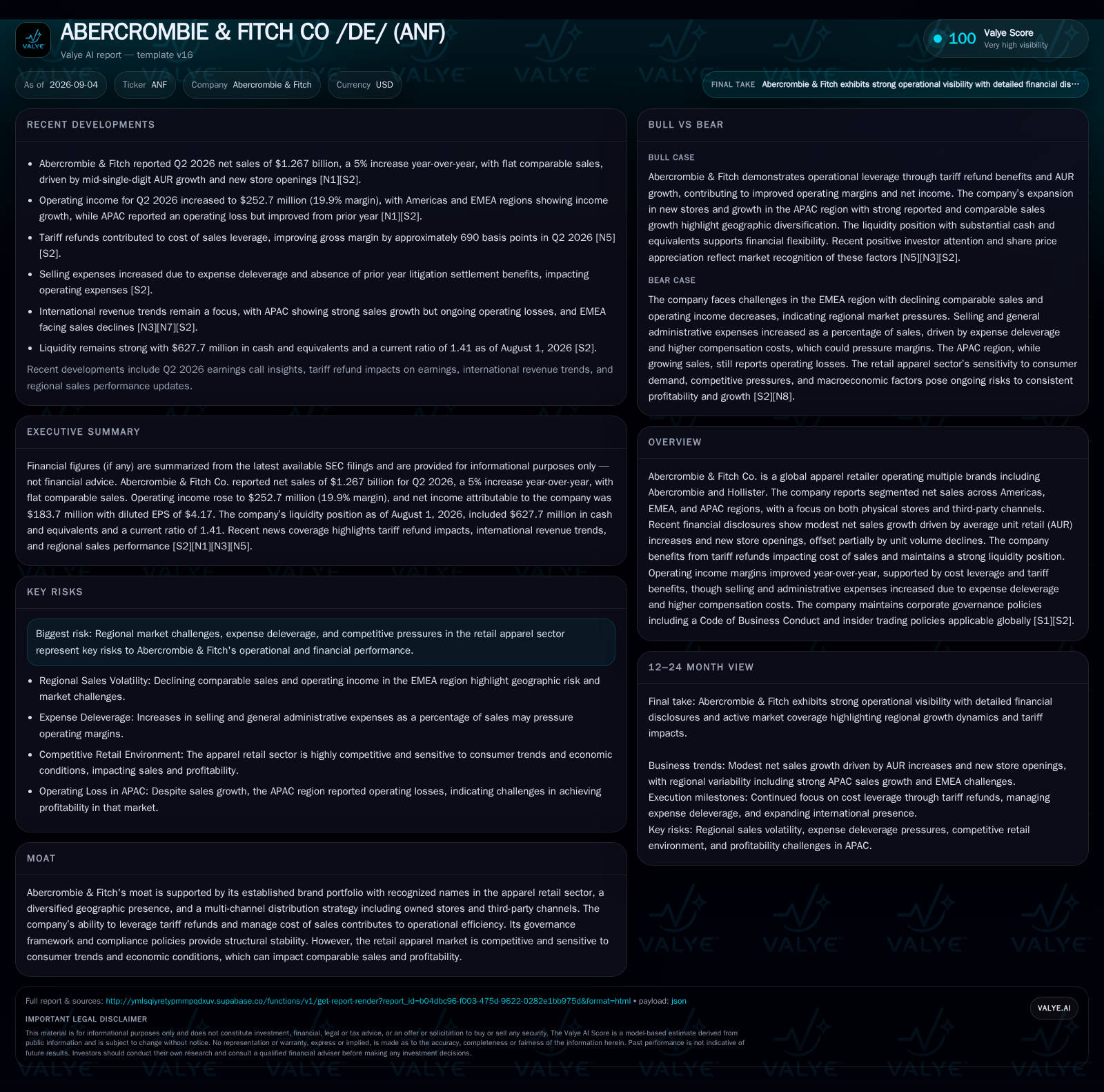
Abercrombie & Fitch’s Q2 2026 results featured a 5% year-over-year net sales increase to $1.267 billion, primarily driven by a mid-single-digit rise in average unit retail (AUR) and new store additions, while comparable sales overall remained flat [S2]. This indicates the company’s ability to extract higher price points and expand its physical footprint, though the flat comparable sales suggest volume challenges or stable customer traffic.
Tariff refunds materially reduced the cost of goods sold, contributing to an approximately 690 basis point improvement in gross margin. This tariff impact, combined with freight cost declines, underpinned a 19.9% operating margin and operating income of $252.7 million, marking a 280 basis point margin expansion from the prior year [S2][N5]. However, rising selling and administrative expenses partially offset these gains, reflecting expense deleverage and higher compensation costs.
Pricing Power and Cost Leverage Offset by Expense Increases and Regional Margin Disparities
Abercrombie & Fitch’s revenue growth primarily derives from pricing (AUR increases) and new store openings rather than volume expansion, as indicated by flat comparable sales. This suggests the company relies on enhancing unit economics rather than broadening customer reach. The tariff refunds contribute a form of cost leverage by reducing landed cost of inventory, boosting gross margins without corresponding price increases. Freight cost reductions further amplify this fixed-cost relief.
However, operating leverage is constrained by rising selling and general administrative expenses, which have increased both in absolute terms and as a percentage of sales due to expense deleverage and higher employee compensation. These cost pressures erode some margin gains from sales and tariff benefits. Capital intensity is moderate, given the retail sector’s investment in store expansion and e-commerce platforms, but Abercrombie’s liquidity position, including $627.7 million in cash and equivalents and a current ratio of 1.41 as of August 1, 2026, indicates available financial resources to support moderate growth investments if needed [S2]. The operating loss in APAC, despite strong sales, points to regional cost structure or scale inefficiencies limiting profitability leverage.
Brand Strength and Geographic Reach Face Headwinds from Regional Market Complexity
Abercrombie & Fitch competes in a highly saturated and trend-sensitive apparel retail sector, leveraging established brand names such as Abercrombie and Hollister. The company’s multi-channel distribution, including owned stores and third-party retail, supports broad customer access. Its tariff refund advantage and cost management create temporary operational efficiency, but these factors do not constitute durable moats. The competitive environment pressures pricing and volume, especially amid evolving consumer preferences and digital disruption.
Geographically, the Americas delivers steady growth and profitability, reinforcing core market position. EMEA shows reported sales growth but a decline in comparable sales and operating income, reflecting regional market softness and competitive intensity. APAC’s strong sales expansion is offset by operating losses, likely due to high customer acquisition costs, infrastructure investments, or pricing competition. Competitors in each region vary from global fast fashion brands to local specialty retailers, intensifying the challenge to sustain margins and market share.
Sustained Pricing Power and APAC Profitability Turnaround Propel Earnings Expansion
A favorable scenario would see Abercrombie & Fitch successfully translate its AUR gains into sustained pricing power without significant volume erosion, supported by product differentiation and brand loyalty. Continued tariff refund benefits and freight cost declines would maintain gross margin expansion, providing operating leverage. Crucially, APAC could improve operating profitability through scale economies, cost efficiencies, and refined channel strategies, converting strong sales growth into positive earnings contributions.
Confirming evidence would include rising comparable sales in APAC and EMEA, stable or expanding operating margins regionally, and controlled selling and administrative expenses despite growth initiatives. Tariff refund impacts would persist or be replaced by competitive sourcing advantages. Falsification would be evident if APAC losses deepen, comparable sales decline further in EMEA, or expense pressures accelerate beyond sales growth, undermining margin progress.
Net Sales Growth and Margin Improvements Tempered by Regional Profitability Challenges
The most plausible path involves modest net sales growth driven by AUR increases and incremental store openings, with flat to slightly positive comparable sales overall. Tariff refund impacts fade gradually, but cost efficiencies and pricing power partially offset this. Americas continue to deliver steady operating income growth, while EMEA’s comparable sales remain challenged, limiting margin expansion. APAC maintains strong sales momentum but struggles to achieve profitability, resulting in ongoing operating losses albeit narrowing from prior periods.
Selling and administrative expenses rise moderately due to inflationary wage pressures and investments in growth initiatives, partly offsetting gross margin improvements. Confirming factors include stable or slightly improved operating margins in Americas and EMEA, narrowing APAC losses, and manageable expense growth. Falsification would occur if tariff benefits abruptly disappear without replacement cost efficiencies or if regional sales deteriorate sharply, causing margin contraction.
Expense Pressures and Regional Sales Declines Erode Profitability, Undermining Growth
A downside scenario unfolds if Abercrombie & Fitch faces accelerating expense deleverage amid stagnant or declining comparable sales, particularly in EMEA and APAC, exacerbated by macroeconomic headwinds or intensifying competition. The loss of tariff refunds without compensatory sourcing cost reductions would compress gross margins. APAC’s operating losses could deepen due to failed scale economies or pricing discounting, while Americas growth stalls due to market saturation or shifting consumer preferences.
This scenario’s confirming evidence would be falling comparable sales in multiple regions, expanding operating losses in APAC, margin contraction despite sales growth, and escalating selling and administrative expenses eroding operating income. Falsification would be sustained margin expansion, improved sales trends across regions, or successful cost management offsetting tariff refund expiration.
Evaluating Regional Sales Momentum and Expense Management to Gauge Profitability Trajectory
Key metrics to watch include regional comparable sales growth rates, especially in EMEA and APAC, to gauge market acceptance and competitive positioning. Monitoring the trajectory of APAC operating income and margin trends will be critical to assess progress toward profitability. The company’s average unit retail changes relative to volume shifts will reveal the balance between pricing power and customer retention.
Expense ratios—specifically selling, general, and administrative expenses as a percentage of sales—will help test the company’s ability to manage cost deleverage amid growth efforts. The persistence or replacement of tariff refund benefits through sourcing or freight cost improvements is a vital factor.Finally, liquidity metrics, such as cash and equivalents and current ratio trends, provide insight into available financial resources that could; this balance-sheet information alone does not establish acquisition or investment capacity [S2].
Disclaimer: This is research-only, informational analysis and not investment advice. It may include AI-generated interpretation and general industry context. Always verify important details using primary sources.

Comments