
Petco's Q2 2026 Profit Growth Reflects Omnichannel Strength Despite Liquidity Constraints
Petco Health & Wellness Company’s recent earnings reflect operational momentum driven by its integrated retail and health service model, though constrained liquidity and competitive pressures underscore the need for strategic discipline.
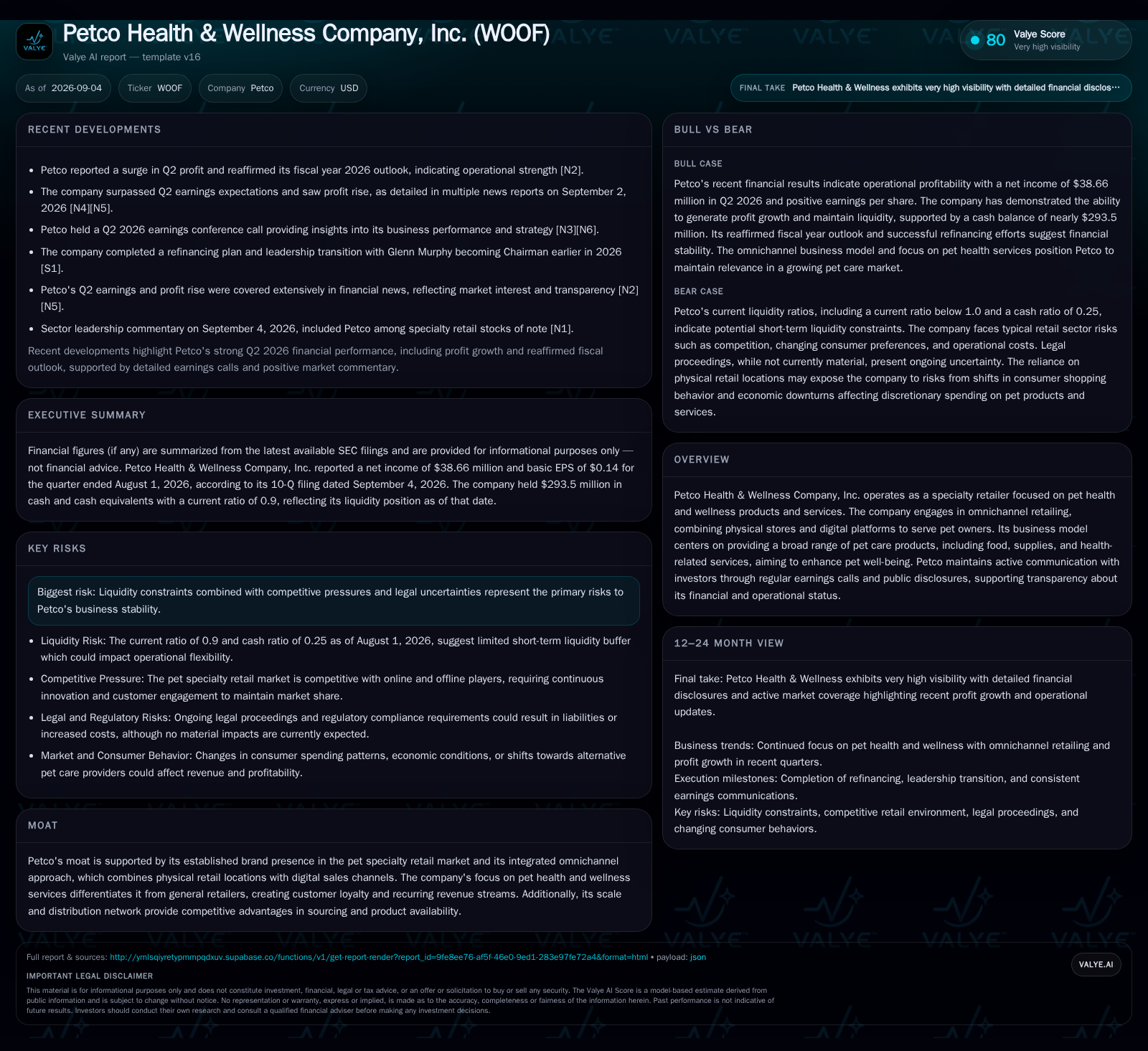
Petco reported solid Q2 2026 profitability driven by its specialty pet health retail and services combined across physical and digital channels, reaffirming its fiscal outlook. The company’s business economics hinge on balancing scale advantages and operating leverage against capital-intensive store operations and evolving consumer preferences. Competitive dynamics in pet specialty retail, legal risks, and liquidity ratios below 1.0 present notable headwinds. Scenarios range from substantial growth fueled by health services expansion to challenges in retail traffic and margin compression. Key investor watchpoints include same-store sales trends, service revenue mix, liquidity metrics, and customer retention indicators.
Petco Health & Wellness Company, Inc. demonstrated operational strength in Q2 2026 with a notable profit increase and reaffirmation of its fiscal outlook, driven by its specialty pet health retail and services business. The company’s omnichannel approach, combining physical stores and digital platforms, underpins its customer engagement and revenue model. However, liquidity metrics below parity caution about potential financial flexibility, while competitive and legal risks remain relevant. Petco’s ability to leverage its health and wellness focus amid evolving consumer preferences and intensifying competition will shape its medium-term trajectory.
Q2 2026 Earnings Beat Drives Confidence Amid Refinancing and Leadership Shifts
Petco reported net income of $38.66 million for the quarter ended August 1, 2026, with basic EPS of $0.14, surpassing consensus expectations and reinforcing the company’s fiscal 2026 guidance [S2][N2][N4]. The Q2 earnings conference call further detailed operational drivers, emphasizing strength in pet health and wellness services alongside product sales [N3].
Earlier in 2026, Petco completed a refinancing initiative and transitioned Glenn Murphy to Chairman, signaling a governance and capital structure recalibration intended to support ongoing strategic initiatives [S1]. Despite these positive developments, the company’s current ratio of 0.9 and cash ratio of 0.25 highlight liquidity constraints that could limit operational flexibility amid market uncertainties [S2].
Omnichannel Model Leverages Scale but Faces Capital and Margin Tradeoffs
Petco generates revenue primarily through the sale of pet food, supplies, and health-related services distributed via a network of physical stores and digital channels. The business model balances product volume, pricing power, and service mix to drive profitability. Health and wellness services, including veterinary care and grooming, typically command higher margins and create recurring revenue opportunities, potentially increasing customer lifetime value if retention is sustained.
However, physical retail operations introduce significant fixed costs such as store leases, labor, and inventory carrying. The capital intensity and operating leverage associated with omnichannel retailing mean that revenue growth must outpace fixed cost inflation to improve margins materially. Digital sales can offer variable cost advantages, but competition and fulfillment expenses may offset some benefits. The current liquidity ratios suggest limited buffer to absorb shocks or invest aggressively, so operating leverage realization depends on volume scale and service adoption.
The omnichannel model's effectiveness also depends on the integration and seamless coordination between physical stores and digital platforms. Efficient inventory management systems that synchronize stock levels across channels can reduce stockouts and overstock situations, thereby optimizing working capital usage. Additionally, the ability to leverage customer data collected through digital interactions to personalize in-store experiences can enhance customer satisfaction and drive incremental sales. However, such integration requires significant upfront investments in technology and staff training, which may strain liquidity further if not managed carefully. The tradeoff between investing in these capabilities and maintaining short-term financial health is a critical balancing act for sustaining competitive advantage.
Another important consideration is the evolving consumer behavior in pet care, particularly the increasing preference for premium and health-focused products and services. This shift can enable Petco to command higher price points and improve margins, but it also necessitates continuous innovation in product offerings and service quality. The company must monitor emerging trends and adapt its assortment accordingly to avoid obsolescence and maintain relevance. However, catering to premium segments may limit volume growth or require targeted marketing efforts, which could increase customer acquisition costs. Thus, the interplay between product innovation, pricing strategy, and customer acquisition efficiency will influence the overall profitability dynamics within the omnichannel framework.
Specialty Retail Brand and Health Services Focus Counterbalance Rising Market Rivalry
Petco’s established brand in pet specialty retail, combined with its integrated health and wellness services, creates a differentiated customer value proposition that could foster loyalty and recurring engagement. The company’s scale provides sourcing advantages and product assortment breadth, which are important competitive factors in this sector.
Nevertheless, the competitive landscape includes both online pure-plays and offline general retailers expanding pet categories. These rivals may offer lower prices, convenience, or novel service models, pressuring Petco’s market share and margins. Switching costs for customers are moderate, so Petco’s ability to maintain engagement through service quality, loyalty programs, and omnichannel integration will be critical to defend its competitive position.
Expanding Health Services and Digital Penetration Drive Sustainable Profit Growth
A favorable scenario involves Petco successfully scaling its health and wellness services, increasing the proportion of higher-margin recurring revenue streams. Enhanced digital platform capabilities could boost online sales and improve customer data insights, enabling personalized marketing and cross-selling. This would deepen customer relationships and reduce churn, raising lifetime value and supporting premium pricing.
Confirming evidence would include accelerated growth in veterinary and wellness service bookings, rising digital sales contribution, and improving same-store sales trends. Margin expansion driven by operating leverage in services and cost efficiencies in fulfillment would support sustained profit growth. Conversely, failure to grow services or digital engagement, or margin compression from competitive pricing, would falsify this scenario.
The competitive advantage derived from Petco’s health services is contingent on the scalability and differentiation of these offerings. High-quality veterinary and wellness services can create barriers to entry by fostering customer trust and habitual visits, which are less susceptible to price competition than commodity products. Nevertheless, scaling these services involves regulatory compliance, skilled labor recruitment, and capital expenditures for clinic infrastructure, which can be capital intensive and operationally complex. The company must also guard against commoditization of services as competitors replicate successful models. Maintaining a distinctive service portfolio and leveraging data-driven care personalization could strengthen the moat, but execution risks remain significant in this segment.
Customer loyalty programs and omnichannel engagement tools represent another critical mechanism to counteract competitive pressures. By incentivizing repeat purchases and facilitating convenient shopping experiences across channels, Petco can increase switching costs and deepen customer relationships. However, the effectiveness of such programs depends on their perceived value and ease of use, requiring continuous refinement based on customer feedback and behavioral analytics. Additionally, the cost of loyalty initiatives must be balanced against their incremental revenue contribution to avoid margin dilution. Monitoring program participation rates, redemption patterns, and their correlation with customer lifetime value would provide valuable insights into their strategic impact.
Steady Omnichannel Execution Maintains Profitability with Limited Margin Expansion
The most plausible scenario sees Petco continuing to grow revenues modestly through its omnichannel retail and services, maintaining profitability but facing margin pressures from competitive pricing and fixed cost commitments. Liquidity constraints may limit investment in new initiatives, resulting in incremental rather than transformational growth.
Evidence supporting this includes steady product sales offsetting slower service growth, flat or slightly improving margins, and cautious capital spending. The company’s reaffirmed fiscal outlook and completion of refinancing provide stability but not aggressive expansion capital. A deviation from this would be stronger-than-expected service adoption or digital growth driving margin expansion, or alternatively, sharper margin contraction and liquidity stress.
Liquidity Stress and Competitive Erosion Compress Margins and Limit Growth
In a downside outcome, Petco’s liquidity constraints worsen amid a challenging retail environment marked by declining foot traffic, increasing promotional activity, and rising operating costs. Competitive pressure from online and big-box entrants could force price reductions and margin erosion. Legal or regulatory issues, while not currently material, might increase costs or distract management.
Evidence confirming this would be weakening same-store sales, declining service utilization, margin contraction, and deteriorating current ratio or cash balances. Failure to manage inventory or cost structure effectively would exacerbate pressures. Conversely, stable liquidity metrics, resilient customer engagement, or successful cost control could falsify this negative path.
Indicators to Gauge Service Growth, Digital Adoption, and Financial Resilience
Key metrics to monitor include same-store sales and comparable revenue growth split by product and health services categories, which would reveal shifts in customer spending and service adoption. Tracking digital sales penetration and online customer engagement would clarify the impact of omnichannel integration.
Liquidity and capital structure metrics such as current ratio, cash ratio, and leverage ratios are critical to assess potential financial flexibility. Customer retention and repeat purchase rates, if disclosed, would help evaluate loyalty and lifetime value. Operational KPIs like service bookings growth, average transaction value, and fulfillment costs would inform margin trajectory. Legal and regulatory developments should also be monitored for potential impact.
Disclaimer: This is research-only, informational analysis and not investment advice. It may include AI-generated interpretation and general industry context. Always verify important details using primary sources.

Comments